Monday, November 30, 2009

Making Buildings More Efficient: Rationalizing Retrofit Markets

Neat post about how to motivate people on energy efficiency
(and clean energy) from David Roberts here:

As I said in my last post, taking energy efficiency in buildings seriously means expanding our policy horizons beyond the blunt tool of raising energy prices. We have to think in creative ways about how to remove market and behavioral failures that inhibit cost-effective responses to today’s energy prices. How can we make efficiency markets more rational and robust?

What follows is not intended to be comprehensive,  just to call out some of the bigger challenges and a few interesting attempts to overcome them. There are folks out there who know much more about this than me—I hope they’ll comment or email me with things to add.

Read more>>

Capturing the Massive Social Benefits of Fuel Efficiency Requires Regulation

Among the ways to motivate a transition to a Green Economy is simply to mandate greener products and practices, since all too often, people are too comfy with their habits to make changes on their own.

Will that affect how happy consumers are with their new mandated choices (in this case, more fuel-efficient, though likely smaller vehicles)?

In the long run, "no", says this Grist piece about the EPA's new regulation that would make cars and light trucks 30 percent more efficient in 5 years:

(H)ow consumers choose and value cars is...complicated. A car’s newness, size, and power are valued not just for their functionality, but for their relation to the others in the parking lot.  Consumers value horsepower not just for speed but as a status symbol and for the ability to out-accelerate others at a traffic light. People don’t necessarily want a big car, they just want a bigger car.

The problem with prestige goods is they don’t actually increase welfare or status. If Smith buys a bigger car, Jones has to buy a bigger car as well to catch up; relative to average car size, neither has really moved ahead. By devoting resources to conspicuous features like size, less visible features like fuel efficiency and financial savings are sacrificed.

The proposed CAFE regulations correct a market failure and accomplish what the non-cooperative marketplace cannot: fuel efficiency increases, Americans get the value of fuel savings, and consumers do not have to risk their positional status, since over time the entire fleet’s average size and power will shift.

This is one of the chief reasons to regulate: to increase consumer welfare by doing what the market can’t on its own. It might take consumers some time to grow accustomed to the new vehicle options, but relatively quickly they will be just as happy with their new, more fuel-efficient models, and they will be thrilled by the trillions in savings at the pump.

I honestly think this is the case for a lot of -- if not most -- green products and practices.  We've been watching the green marketplace grow considerably for several years.  I know plenty of people who are good and green in their values, but still don't necessarily use the greenest of products or practices.

In many cases, I find that the reason they are slowly, sometimes barely, transitioning to green is simply a matter of habit -- they have a way of doing things and a type of product that they have always used, and they're comfortable with it.   It's part of their routine.  In other cases, they are extremely busy and just haven't gotten around to figuring out which green brands to switch to, which composter to buy, etc.  The way around these perfectly normal human tendencies -- especially if we need to drive a positive social change quickly -- is via regulation.

People harp on regulations, but a new regulation is typically a response to a problem that the market can't solve on its own, for one reason or another.  I don't find anything wrong with smart regulatory approaches -- they are one of several tools in the toolbox and there is certainly a time and place for them.

Read more>>
...

Solar Energy Industry Brings Ray of Hope to the Rust Belt

Could America's emerging renewable energy industry revitalize our ailing Rust Belt?

Encouraged by the stimulus package and new clean energy incentives, that's exactly what's happening, reports the L.A. Times:

For all of green tech's futuristic sheen, solar power plants and wind farms are made of much of the same stuff as automobiles: machine-stamped steel, glass and gearboxes.

That has renewable energy companies hitting the highway for Detroit and Northeastern industrial states, driven in part by the federal stimulus package's incentives and buy-American mandates.

Irvine's Fisker Automotive, for instance, will manufacture its next plug-in electric hybrid car at a defunct General Motors assembly plant in Wilmington, Del.

And Stirling Energy Systems, which is building two massive solar power plants in Southern California, has signed deals with two automotive companies to make components for its giant solar dishes.

Stirling signed an agreement with Tower Automotive to manufacture the dishes' structural components and assemble the mirror facets. The Livonia, Mich., company makes vehicle body parts and other components for the major carmakers but has seen auto orders slow with the downturn.

Jim Bernard, Tower's vice president of North American sales and program management, said the company had been looking to diversify its operations.

"The market that we thought would fit us was alternative energy," he said. "Utility-scale alternative energy projects have some of the exact same requirements that our automotive customers do."

That means Tower can use its existing machinery, with some modifications, and workforce to make SunCatcher components. In turn, Stirling avoids the capital costs of setting up its own factories and gets to tap Tower's manufacturing know-how to bring down its costs, which will be a key competitive advantage in the race to deploy new solar technologies.

I love articles that present a concrete picture of the hope that the Green Economy has to offer.  This is certainly one of them.


Read more>>
...

Future of Farming May Be Urban High Rises


Among the sustainable food production solutions that I am watching with some intrigue is the rise in talk of vertical farming.

Could urban buildings really provide enough food to feed cities, you might wonder?  Well, I wonder the same.

The benefits of these farms certainly sound enticing:

Moving farms off land and into urban buildings offers a solution to land and water scarcity and a really impressive swath of other natural, health, economic and political challenges:
  • Produces crops year-round; 1 indoor acre is equivalent to 4-6 outdoor acres or more,  depending upon the crop (e.g., strawberries: 1 indoor acre = 30 outdoor acres)
  • Avoids weather-related crop failures due to droughts, floods, pests
  • Grown organically: no herbicides, pesticides, or fertilizers
  • Virtually eliminates agricultural runoff by recycling black water
  • Returns farmland to nature, restoring ecosystem functions and services
  • Greatly reduces the incidence of many infectious diseases that are acquired at the agricultural interface
  • Converts black and gray water into potable water by collecting the water of evapotranspiration
  • Adds energy back to the grid via methane generation from composting non-edible parts of plants and animals
  • Dramatically reduces fossil fuel use (no tractors, plows, shipping.)
  • Converts abandoned urban properties into food production centers
  • Creates sustainable environments for urban centers
  • Creates new employment opportunities
  • We cannot go to the moon, Mars, or beyond without first learning to farm indoors on earth
  • May prove to be useful for integrating into refugee camps
  • Offers the promise of measurable economic improvement for tropical and subtropical Least Developing Countries (LDC).  If this should prove to be the case, then vertical farms may be a catalyst in helping to reduce or even reverse the population growth of LDCs as they adopt urban agriculture as a strategy for sustainable food production.
  • Could reduce the incidence of armed conflict over natural resources, such as water and land for agriculture
 As soon as one of these opens up, you can be sure that we'll blog about it!

Read more>>
...

Sunday, November 29, 2009

Signs of Hope in Our Energy Future


So what do we have to gain from taking the lead in solving climate change?

Here's a new pitch from the NY Times' op-ed page:

You want new industry in the United States, with astonishing technological advances, new mass production techniques and jobs, jobs, jobs? Try energy.

Mr. Ovshinsky knows as much or more about the development and production of alternative energy as anyone on the planet. He developed the technology and designed the production method that made it possible to produce solar material “by the mile.” When he proposed the idea years ago, based on the science of amorphous materials, which he invented, he was ridiculed.

But the thin-film photovoltaic solar panel was just one of his revolutionary ideas. He invented the nickel metal hydride battery that is in virtually all hybrid vehicles on the road today. And when I pulled into the parking lot outside his office in Bloomfield Hills, he promptly installed me in the driver’s seat of a hydrogen hybrid prototype — a car in which the gasoline tank had been replaced with a safe solid-state hydrogen storage system invented by Mr. Ovshinsky.

Within minutes, I was driving along a highway in a car that produced zero pollution. No carbon footprint whatsoever. How’s that for a wave of the future?

The point is that these (and many more) brilliant, innovative technologies are here. They are real, tangible. They exist. What’s needed now is the will to develop policies that will vastly expand these advances and radically reduce their costs. The United States should be leading the world in the creation of whole new energy technologies and industries, instead of allowing the forces of the old carbon-based industries — coal, oil, gasoline-powered vehicles — to stand obstinately in the way of real progress.

“Now,” Mr. Ovshinsky told me, “is when we have to build the new industries of the future.” He has always been driven by the desire to use science and technology to solve the real-world problems of real people, and that has meant creating employment and stopping the pollution of the planet. He and his late wife, Iris, formed a company (to become known as Energy Conversion Devices) in Detroit in 1960 with the idea of using their considerable talents, as he put it, “to do good, to change the world.”

As oil defined the 20th century, new forms of energy will define the 21st. The U.S. has the opportunity, the intellectual resources and the expertise to lead the world in the development of clean energy. What we’ve lacked so far has been the courage, the will, to make it happen.

This is the side of the climate change solutions story we need to be hearing about in EVERY media story that covers the Senate debate about climate change and clean energy solutions legislation.  To just talk about climate change as an environmental issue that isn't relevant to our everyday lives is irresponsibly misleading to a public who, for the most part, doesn't seem to know better.

At a time of great economic challenge, this same public is desperately seeking hope, and these types of solutions are exactly what the doctor ordered.  Properly informed, the public will be empowered to demand from Congress that its climate change legislation helps America's future clean energy-related industries realize their potential.

Read more>>
...

What Peak Oil Can Do For Climate Change

Getting real today with a series of outstanding posts from Chris Nelder of GetRealist.

In this installment of facing up to the hard data on energy and climate, he talks about how the urgency of addressing the Peak Oil crisis looming on the horizon can help address the climate crisis that is really starting to bubble up to the surface, even if much of the public continues to act like the proverbial frog in a slowly warming pot of water on a stove...

Says Nelder about what climate change can do for Peak Oil:

With all eyes focused on the Copenhagen climate summit in less than three weeks, perhaps its time for the peakists to find a new purpose.
The reason is simple. Money isn’t interested in problems; it’s only interested in solutions. And wherever capital goes is where the changes will be made.
The public also has little appetite for unpleasant stories, even true ones. The message is: Don’t tell us what we can’t consume — tell us what we can consume. Tell us our grid power costs are going to go up because of climate change and we’ll fight it. But help us buy efficiency improvements and renewables that will pay for themselves in fuel savings, and we’ll support it all the way.
A new Pew study on “apocalypse fatigue” highlights the problem nicely. The public’s confidence in the global warming problem has fallen sharply this year, even as momentum built toward Copenhagen.
Guilt and deprivation simply don’t sell like opportunity does.
That’s why trillions of dollars are pouring into cleantech annually, while the peak oil community continues to go begging for a few dollars to staff a small office and keep a web server running, all while battling a constant onslaught of misinformation placed in the top mainstream media by very deep-pocketed vested interests.
That’s why I said last week that the IEA was shrewd to turn its annual World Energy Outlook into a stalking horse, masquerading its alarm about peak oil as an earnest appeal to address climate change.

What do climate activists need to realize about the threats posed by Peak Oil -- even to renewable energy itself?

First, solving the energy crisis isn’t an either Green or Brown proposition, but all of the above. There is a dangerous paradox here that the peakists can help the world avoid.
Climate activists need to realize that the renewable energy revolution can only be built on the back of fossil fuels. It will take vast amounts of oil, gas, and coal to mine raw ores, crush them, transport them, smelt them down and turn them into stock, transport them again, and turn them into end-products, then transport them again. We have no idea how to do all that without petroleum fuels, gas, and coking coal.
Therefore, in order to build a vast new infrastructure of solar and wind generation, ubiquitous rail transport, plug-in and natural gas vehicles, the next-generation grid, and so on, and do it at a reasonable price, we’ll have to ensure that fossil fuels receive vigorous and sustained investment.
Here’s a rough, rule-of-thumb way of expressing the supply dilemma: We have to fill a 25% gap in 25 years, a 50% gap in 50 years, and we need to be off fossil fuels completely by the end of the century.
Here’s another rule of thumb: Starting two to four years from now, the world will need to build the equivalent of all the world’s existing renewable energy capacity every year just to compensate for the decline of oil.
Meeting that challenge with renewables and efficiency would solve the emissions problem as a side effect, only it would do so by harnessing the profit motive — not by penalizing production. That’s how capitalism works best.
If we allow climate policy to pour cold water on the fire of fossil fuels, we would extinguish the growth in renewables too. Failing to maintain a steady supply of fossil fuels, even as they peak and decline, their prices rise, and their availability shrinks, would subject the cleantech industry to devastating boom and bust cycles.

Head spinning yet?  Here's the real eye-opening claim in Nelder's analysis:

Count on Less Fuel. . . and Less CO2

It’s fairly astonishing, but none of the climate change models take the peaking of any fossil fuels into account. They all project — over a period of 30 years or more! — fairly simple growth curves for population and the global economy, assuming that sufficient oil, gas and coal will be available to satisfy demand at historically normal prices.
As the peakists know, nothing could be further from the truth.
If my current understanding of the situation is even close to correct — peak oil circa 2005-2012; peak gas 2015-2020 and peak coal 2025-2030 — then the climate models are not accurately modeling 78% of the global energy supply over the next 30 years.
Accordingly, the CO2 projections must be wrong. Ultimately, the population-based forecasts must also be wrong. The peak oil study can help correct these glaring flaws by offering better data to the CO2 emissions models.

Easier to Switch than Fight

In resisting the policy focus on climate change and resisting the truth about peak oil, the fossil fuel industry has become its own worst enemy.
By perceiving these issues as threats, the Browns have created a vicious cycle. Fighting the renewable energy revolution sows public opposition, adds cost, and delays the deployment of renewables, which makes the CO2 problem worse. The worse the CO2 problem gets, the more it costs them.
If instead the Browns acknowledged that the future of fossil fuels will be increasingly difficult and expensive, and that CO2 is a problem they need to own, it would feed a virtuous cycle.
Peak-adjusted fuel models would lower the projected CO2 emissions, reducing the cost of mitigation and buying a bit more time for the transition to renewables. It would give the energy industry a clear mandate to invest more in renewables, and do so in a measured, less disruptive way. In turn, the accelerated adoption of renewables would reduce CO2 projections and feed further investment, reducing CO2 even more.
Hopefully, the peakists can help the fossil fuel industry come to terms with a decarbonized future, and in so doing, ensure its long term survival.

Wow -- that scenario is quite entirely different than what most of humanity believes.  If Nelder is right (and I've found that he usually is, even if I don't want to hear it), then what's the solution?

Incentivize, Don’t Penalize
Perhaps the most important way that the peakists can help the climate change cause is by changing the focus to what goes into the engine, instead of what comes out of the tailpipe.
As I have argued, incentivizing renewable energy solutions would be far more effective than penalizing fossil fuel producers.

Emphasizing CO2 emissions in policy...has several undesirable outcomes: It doesn’t address coal plants satisfactorily; it raises costs substantially; it reduces overall power output; and it engenders resistance from the energy industry.
By contrast, focusing on the renewable generation side — what goes into the engine — results in increasing amounts of power that was clean to begin with, at ever-declining costs, and could create a long-term growth opportunity for the energy industry.
This is along the lines of the Nordhaus and Shellenberger's argument that instead of solving climate change by making fossil fuels more expenses, climate policy should focus on making renewable energy cheap -- something that I agree with not yet in terms of supply and demand (I am not familiar enough with the data), but in terms of the types of positive-visioned policies that I think are most likely to inspire the support of citizens and decision-makes. Joe Romm of Climate Progress, however, strongly disagrees -- you can hear him out here. (I've really enjoyed following this fascinating debate)

Read Nelder's full post>>
...

Notes From the 2009 ASPO Peak Oil Conference

Of course, the opposite side of the climate change coin is Peak Oil: another powerful reason to transition to much more efficient and clean energy and transport systems.

Chris Nelder of GetRealList provides us with his notes from the anual ASPO Peak Oil Conference, which included presentations from many of the world's top energy experts.

I know I can't wait to dig into these...
...

Dark Climate Change Messages


Given what we've seen today via our little journey around world visiting places where climate change's impacts are being felt now, the question returns to: how can we motivate people and decision-makers to take bold action?

Here, the Washington Post presents some darker climate change ads that have been used overseas.

Don't turn out the lights...
...

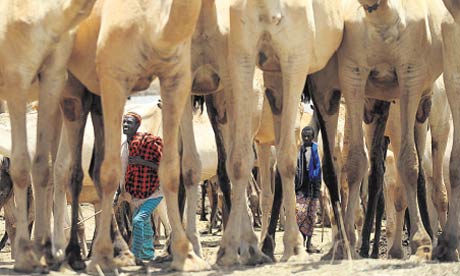
The First Climate Change Conflicts: Fighting Over Water As Kenyan Rains Tail Off

Climate change -- in combination with political and resource management-related factors -- is causing serious water shortage-related conflicts in Kenya.

The Guardian reports:

Three years of failed rains have left nearly 4 million Kenyans dependent on food aid. Thousands of animals have died and malnutrition rates are climbing in a drought that has hit pastoralists the hardest. In many areas they're trekking an extra 20 miles in search of water and pasture, their fate determined by careful negotiations with local leaders such as Abdi. His fear of fighting is not unfounded. According to the UN Office for the Co-ordination of Humanitarian Affairs (Ocha), since January this year 306 pastoralists have died from conflicts over scarce resources.
"What we're observing are some of the world's first climate-change conflicts," says Jeanine Cooper, head of Ocha Kenya, in Nairobi. "Tribes have fought over water points before now," she says, "but climate change has increased the frequency and duration of drought, exacerbating the competition over scarce resources."

Forty miles away in the town of Moyale, Molu Dika, drought management officer for the government's Arid Lands programme, agrees that the "future is not bright for pastoralists". He is well informed about climate change. "We used to have drought in cycles of 10 years; now every other year there is depressed rainfall," he says.

As the government struggles to provide the most basic infrastructure the task of adapting to climate change has been left to the NGOs. Leading the way in Moyale is Farm-Africa - its strategy of creating alternative livelihoods has already helped 5,000 households find new ways of generating an income - from haymaking co-operatives to new business ventures in camel meat.
Project co-ordinator Boru Dulacha says that traditional ways of adapting to drought - building water points or managing grazing patterns - are no longer enough. "We want to help pastoralists maintain their traditional way of life, but without them being dependent on livestock to survive," he says.

The changing weather patterns and accompanying conflicts and adaptations seen in Kenya are a microcosm of what's happening in other countries across the world. As leaders prepare for the climate- change conference in Copenhagen, in December, Sir David King, director of the Smith School of Enterprise and the Environment at Oxford University, says: "How we help developing countries adapt to climate change now is critically important - as by the middle of this century there is likely to be an increase in conflict related to resource scarcity."


But climate change alone isn't responsible for these issues, emphasize some experts.  Rather, poor land use practices and repressive policies contribute to the impacts of climate changes:

But how far is climate change responsible for the tensions already escalating in regions such as north Kenya? Idean Salehyan, assistant professor of political science at the University of North Texas, says: "The causes of violence are rarely as simple as resource scarcity." Instead, he thinks conflicts are over how resources are managed and are therefore a political problem as much as an environmental one. "Deliberate policies to reward political supporters and undermine opponents can play an important role in determining the distribution of these resources," says Salehyan. "Countries that are accountable to the needs of their people can withstand environmental disasters better than those with undemocratic governments."

Today, we've journeyed from the Arctic to the Caribbean to Africa learning about impacts of climate change affecting peoples' lives and well being NOW.

Wither the mainstream news networks doing their part to help raise public awareness about these issues?  Too often, the storyline remains that climate change is some distant environmental issue irrelevant to our well being.  As these stories demonstrate, the impacts of climate change are very much here.

Read the full story>>

More from the BBC>>
...

Can Ecological Agriculture Feed 9 Billion People?

I just finished reading the latest article I've come across about converting to a more ecologically-friendly agriculture.

It's good stuff -- reminding us of the challenges we face, and of the benefits of sustainable agriculture:

(S)ustainable agroecosystems...have positive side-effects, helping to enhance local environments, strengthen communities, and develop human capacities. Examples of positive side-effects recently recorded in various developing countries include:
  • Improvements to the ecosystem, including increased water retention in soils, improvements in water table (with more and cleaner drinking water in the dry season), reduced soil erosion combined with more organic matter in soils, leading to more carbon sequestration, healthier soils, greater productivity, and increased agrobiodiversity;
  • Improvements to communities, including more and stronger social organizations at the local level, new rules and norms for managing collective natural resources, and better connectedness to external policy institutions;
  • Improvements to human potential, including more local capacity to experiment and solve problems, reduced incidence of malaria in rice-fish zones, increased self-esteem in formerly marginalized groups, increased status of women, better child health and nutrition, and reversed migration and more local employment.
The article then details key remaining areas of uncertainty, as well as the complex psychological factors involved in motivating farmers to make significant changes to their ways of farming:
 
We do not yet know for sure whether a transition toward sustainable agriculture, delivering greater benefits at the scale occurring in these projects, will result in enough food to meet the current food needs in developing countries, let alone the future needs after continued population growth and adoption of more urban and meat-rich diets. But what we are seeing is highly promising, especially for the poorest. There is also scope for additional confidence, as evidence indicates that productivity can grow over time if the farm ecosystem is enhanced, communities are strengthened and organized toward positive goals, and human knowledge, nutrition, and health are improved.

One problem is that we know much less about these resource-conserving technologies than we do about the use of external inputs in modernized, more industrial agricultural systems. (Most of the agricultural research in developed countries has been focused on products used for input-intensive systems such as fertilizers, pesticides, new genetics, and new machinery — products that could be sold to farmers.) It is clear that the process by which farmers learn about technology alternatives is crucial. If farmers are forced or coerced, then they may only adopt for a limited period. But if the process is participatory and enhances farmers’ ecological literacy of their farms and resources, then the foundation for redesign and continuous innovation is laid.

Regrettably, successes are still in the minority. Time is short, and the challenge is enormous. This change to agricultural sustainability clearly benefits poor people and environments in developing countries. People involved in these projects have more food, are better organized, are able to access external services and power structures, and have more choices in their lives. But change may also provoke secondary problems. For example, building a road near a forest can help farmers reach markets to sell their produce, but also aids illegal timber extraction. Equally, short-term social conflict may be necessary for overcoming inequitable land ownership, so as to produce better welfare outcomes for the majority.

So where do we stand, and what does this author see as next steps?

At this time we are neither feeding all the 6.7 billion people in the world nor — with some notable exceptions — conducting agriculture in an environmentally sound way. It may be possible to feed the estimated 9 billion people living on earth by mid-century. However, this will take a massive and multifaceted effort that may include changing the way animals are raised (not feeding ruminants food that could be used for human consumption) and giving up the ill-conceived use of cereals and other foods for conversion to transport fuels. In addition, support is needed for the development of participatory groups of farmers that can try out a variety of practices and learn from each other as well as technicians as they explore new techniques that will enhance sustainability.

I'm sure I'll get back to this one as a reference for future writings...

Read the full article>>

More on this question from Grist>>
...

Sea Level Rise Could Cost Port Cities $28 Trillion


A new report warns that sea level rise could cost port cities more than $28 trillion:

A possible rise in sea levels by 0.5 meters by 2050 could put at risk more than $28 trillion worth of assets in the world's largest coastal cities, according to a report compiled for the insurance industry.

The value of infrastructure exposed in so-called "port mega-cities," urban conurbations with more than 10 million people, is just $3 trillion at present.

The rise in potential losses would be a result of expected greater urbanization and increased exposure of this greater population to catastrophic surge events occurring once every 100 years caused by rising sea levels and higher temperatures.

The report, released on Monday by WWF and financial services Allianz, concludes that the world's diverse regions and ecosystems are close to temperature thresholds -- or "tipping points."

I have a solution for those people who still suggest that global warming is only an environmental issue: a trip around the world to all the warming-impacted places we're reporting on today.

Read more>>
...

Rising Sea Levels Threaten Caribbean Region


Don't tell retired Colombian naval officer German Alfonso that global warming's impacts are still theoretical and decades away.  Based on his own personal experience, he just won't buy the line that we shouldn't worry about it now because the economy is more important (which, frustratingly, is the standard line that too many in the mainstream media irresponsibly roll out as 'truth' on a daily basis).

As the L.A. times reports, just ask Alfonso about the time his neighborhood in this historic coastal city became an island.

For five years, Alfonso, 74, has watched tides rise higher and higher in the Boca Grande section of Cartagena. This month, tides briefly inundated the only mainland connection to his neighborhood, a converted sandbar where about 60 high-rise condo and hotel towers have been built in the last decade or so.

"Before, people thought it a normal phenomenon. But we're becoming more conscious that something is going on," Alfonso said. "If the sea keeps rising, traffic could just collapse."

According to a recently updated World Bank study on climate change in Latin America, Alfonso and his neighbors have reason to be concerned. Not only are the effects of global warming more evident in Latin American coastal cities, the report says, but the phenomenon could worsen in coming decades because sea levels will rise highest near the equator.

Wow -- we'll definitely file this story as another power anecdote to use as evidence that global warming is anything but some theoretical future environmental problem.

This story paints a picture of global warming as a people problem that is negatively impacting lives and livelihoods today.

Read the full article>>
...

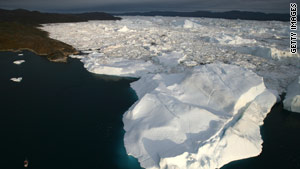
Melting Arctic: Forget About Polar Bears. Worry About Humans

Here's a well-told story from New Scientist about the great transformation of the Arctic that is currently taking place.  For the most part, the author takes us on a journey through the vast environmental changes taking place.

How is it, he wonders, that so many humans can still be so lackadaisical about such dramatic climate changes? 

For too long, too many fruitless efforts to combat climate change have been billed as "Saving the Planet". Right now, in the last week or two before the climate negotiations at Copenhagen, there are few signs of dramatic action. Perhaps that is because the message is wrong. As the changes in the Arctic show, the planet continues. Species come and species go. The planet does not need saving, even from us.

Far better that the urgent need to reduce greenhouse gas emissions is portrayed as simple self-interest; that we focus on the coming losses of agricultural production, the droughts, the mass migrations and political instability that will follow rapid climate change.

Political will might be better stiffened by listening to generals rather than to environmentalists. As a former head of the US Central Command, Anthony Zinni, explained, if we don't pay the price to reduce greenhouse gas emissions today, "we will pay the price later in military terms".

Add this one to the climate change messaging folder...  Most of the world seems to get it.  It boggles the mind what's happening with the U.S. Republican party's views on the issue -- so long as they continue to ignore the world's best scientists, their ideas don't have a chance of being effective for making our world better.

As a registered Independent, I find it highly frustrating that one party's ideas are so out of step with what our top scientific societies are telling us (see also this recent joint statement from the world's top National Academies of Sciences).

Imagine this was the case with a Congressional minority ignoring the medical science's consensus about causes of and cures for cancer (as happened with the tobacco industry -- a striking parallel)!

As somebody who votes based on ideas and proposed policy solutions rather than by party, I'd much rather have two parties with different, but well-informed, high-quality approaches to choose from.  The current political situation that we have right now in America clearly isn't cutting it for solving society's most pressing problems.


Read more>>
...

Saturday, November 28, 2009

Green Redemption

The Economist has an enjoyable piece about a green path to redemption for all the greedy bastards bankers who caused the financial crisis that has made so many of our lives (including ours) difficult over the last year.

Speaking about the costs required to protect rainforests as a mean to mitigate climate change, the author notes that:


"setting up a formal United Nations scheme to pay for avoided deforestation, which is expected to emerge from a global deal on climate change, will take time. On November 19th a high-level group of representatives from forested nations met at the London home of the Prince of Wales to discuss an emergency package of funding to stop deforestation while the trees are still standing.

The meeting heard how an informal working group on interim finance recently produced a report suggesting that between $22 billion and $37 billion will be needed between 2010 and 2015. Although that might sound like a lot, in the global scheme of things it is not. For comparison, the size of the bonuses to be shared by bankers at Goldman Sachs this year looks set to be about $21 billion.

Which prompts your correspondent to ponder where such short-term finance might be found. Rich-world governments, many of which have record levels of debt, are skint. Bailing out the banks has been costly. Meanwhile the social standing of those bankers who are lucky enough to be getting bonuses, while their fellow citizens face years of higher taxes and cuts to public services, is at an all-time low. The ideal solution, surely, is for those bankers to shun a new Ferrari in favour of rainforest conservation.

I love it!

It just boggles my mind that in the year after the banking sector's greed and irresponsible swindling of the public caused the greatest financial crisis since the Great Depression, Goldman Sachs executives stand to receive $21 Billion in bonuses.  It is nauseating, and in itself, is cause for President Obama to demand the resignations of Treasury Secretary Geithner and Economic Adviser, Lawrence Summers. Clearly, we need sheep dogs guarding the hen house, not wolves.


Read the full Economist article>>
...

Consevation is Seen As Key to Dealing with California's Water Woes

One thing many of us know well in California -- due to droughts and water restrictions -- is the value of water conservation.

The L.A. Times offers a nice summary of the state's current situation, in which conservation is really the main immediate solution.

In a warming world, the Sierra snowpack is predicted to gradually shrink as a key water reservoir.  With it melting earlier in the spring, more of the water that it releases into reservoirs will be lost to evaporation.  This impact will be further exacerbated by poorly planned logging operations that aren't designed to maximize shading of logged sites (e.g., by planning cuts in east-west facing strips that reduce exposure to solar radiation).

For homeowners and municipalities, our water supplies are only going to become more uncertain, and we're best off preparing now.

That SHOULD mean that something serious is going to have to be done about all the golf courses, green grass lawns, and swimming pools in hot, deserty southern California.

What do we do?

  • We have an energy efficient dishwasher, which we run only when full and only late at night -- usually about once every 5 days (fortunately, ours has a setting that allows us to set it to go on in 3 or 6 hours, so it goes on at 2AM and we are greeted to fresh dishes in the morning)
  • We take relatively short showers
  • We rent our home, and have to deal with a small lawn in our front yard.  So we set the timer to go on for 15 minutes per week at 2AM, when evaporation is lowest.
  • Being a rental, we also can't install rain barrels. However, we have set up a tube from one of our gutters to direct rainwater down a hill into an extra plastic garbage bin can we have.  We use this water all winter to water our house and garden plants.
  • Our fairly large back yard is not landscaped, and while we have a garden, it is composed of four 4x4-foot raised beds that we plant with a square foot grid, as well as barrel planters for our cooking herbs (about 12 different kinds).  These are highly space-efficient, and with no plant more than two feet from the edge, they are easy to water directly on to the base of each stem.  Of course, I usually water early in the morning (for food plants, watering at night can lead to mold issues).  A future goal is to add drip irrigation, but with square foot beds, it isn't entirely necessary.
I can't wait to have a home of my own so we can redirect our gray water to our garden and fruit trees, and add rain barrels that will likely last us well into the summer.

I find that conservation is actually not only money saving, but is FUN!
...

The Language of Sustainability: Why Words Matter

Here's a new post about the language of sustainability, "Why Words Matter", ironically authored by a fellow whose last name is 'Jabber'.

A few highlights:

In applying framing to the issues that many of us are typically dealing with, examples might include:

1. Change "natural resource management" to "regeneration of nature" or "natural resilience." "Management" reinforces a false sense that we know exactly what to do and how nature is going to respond to our actions. We clearly have a wealth of knowledge on work with natural processes, and it is clear that our actions very often have unintended consequences, to due to the complexities of natural systems. "Resource" conveys that nature is something to be used, rather than our life-support system. As alternative terms, even restoration, a decent improvement, doesn't conceptually support the dynamic ongoing process that is ecology, but, rather, restoring to some static state. Terms like regeneration and resilience better illustrate the end goal of re-establishing the capacity to adapt, flexibility, and ongoing processes that can evolve over time.

2. Change "proper stewardship" to "proper interaction" or "healthy relationship," for the same reason as the above. Our relationship with nature is rightly a dynamic, two-way relationship, and so we shouldn't communicate that we are managing or stewarding nature.

3. Provide context for "sustainability," in that it means the ability to continue into the indefinite future by respecting the Earth's ecosystems, its limits, and providing space for the other beings on the planet to exist. Otherwise, we create perverse concepts like sustainable growth, as if we can continue unlimited growth in the face of limits.

4. Change any language that implies economic growth is always good. In an economy predicated on unsustainable uses of nature, is economic contraction and recession necessarily bad? Or is recession a necessary correction guided by the laws of feedback? During this relatively serious recession of 2008 and 2009, these questions never entered mainstream media or politics in a significant way, yet are the real questions that we as a society need to work through.


Jabber then jibbers (sorry, couldn't resist) about the importance of using the right indicators to measure progress in achieving sustainability goals, and gets into a few good ones offered by Gil Friend.

Read more>>
...

Green Seal's New Business Certification Aims to Catalyze the Green Marketplace

As huge proponents of measures to improve the credibility of the green marketplace, we at CVI were thrilled to hear about GreenSeal's new business certification, which aims 'to catalyze the green marketplace.

As GreenBiz reports:

Green Seal, the nonprofit certification group, is celebrating its 20th anniversary by undertaking a dramatic shift in its operations: In addition to continuing to certify individual products and services as environmentally friendly, the group has just launched a company certification pilot project that aims to measure, verify and push for continuous improvement of a company's entire operations.

The group is aiming high as well: Weissman said they've been talking primarily to Fortune 1000 and Fortune 500 companies, rather than just already-green firms that would likely have an easy time earning certification.

"We want to have a balance -- if this program just became the Seventh Generations of the world, it's not going to change much in the marketplace," Weissman said. "That's not to denigrate them at all, a green-oriented company does a great service, but if they were the only ones to participate in the pilot I don't think we'd be very effective in trying to do a rapid transformation of the consumer marketplace."

The certification will feature three levels -- Bronze, Silver and Gold -- and Weissman anticipated that all companies will enter the certification at the Bronze level, leaving plenty of room for improvement, a key element of the project.

Among the impacts under assessment in the certification are greenhouse gas emissions, water use and conservation, biodiversity impact, and other issues. (The nearly 70-page standard laying out the entire process is available for download [PDF] from GreenSeal.org.) But in another big shift for Green Seal, the process will look beyond companywide environmental practices and lifecycle assessments to factor in issues of governance, supply chain, and labor and human rights. In so doing, Weissman said that the certification will also cover Walmart suppliers, who as a result of the recently launched Sustainability Index are already facing these issues.

I really look forward to seeing these standards in action.  We'll keep you posted as this story develops, so stay tuned to CV Notes...

Read more>>
...

Nature's Success Inspires Green Building Mimics

The Oregonian reports on how a building designed to mimic the passive cooling action of a termite mound helped save billions:

A small but growing number of architects, building engineers and scientists who design building products are looking to animals and plants for inspiration to address the challenge of being kind to the Earth while retooling the manmade environment.

Wild creatures have been adapting to their natural worlds longer than us and may have answers to the riddle of building shelter while conserving resources. And avoiding pollution. And slowing down the burning of coal and oil for electricity and so many modern comforts.

An Oregon State University chemist studied mussels clinging to rocks at a Newport-area beach and found a naturally occurring chemical model for a new adhesive to replace the formaldehyde that commonly emits toxic fumes in kitchen cabinets.

Farther afield, in Zimbabwe, where searing summers boost sky-high air-conditioning costs, architects looked to termites. They found that the tall dirt termite mounds we see only on the Discovery channel may well be situated in 100-plus-degree environments but have interior tunnels, top to bottom, averaging 87 degrees Fahrenheit.

That would be called passive air conditioning, in which hot air is naturally expelled, trapping cool air within. Buildings can do that, the architects figured, so they designed and built a shopping mall/office center that cools itself, mimicking the mound.

Result: $3.5 million saved, 75 percent less energy needed for cooling, and no A/C as we know it. Yet everyone's comfy.

Read more about the amazing economic promise of biomimicry>>
...

Tuesday, November 24, 2009

Capitalize On A Narrow Window of Opportunity to Advance the Green Economy

Dear Conservation Value Notes reader:

As a smart, conscious citizen, you know the difference between talk and action when it comes to Green Economy solutions. 

You know that to achieve the policy victories needed to simultaneously reduce America’s oil dependence and solve climate change, we need an informed electorate that demands bold Green Economy solutions from our political leaders.

The time to act is NOW.  With President Obama and a majority in Congress favoring a transition to clean energy, and society rapidly approaching tipping points in climate change and shrinking oil supplies, we have a narrow window of opportunity to achieve Green Economy policy solutions. 

Your support helps CVI advance:

•    Our shared vision of a society transitioning to a clean technology-powered economy,
•    Sustainable land use that makes conservation both possible and profitable, and
•    The best emerging Green Economy solutions that benefit the earth and make our lives better.

What YOU Can Do Now
As 2009 draws to a close and you consider how you’ll direct your year-end charitable giving, please consider how much more you can do to help advance the Green Economy by sending a special, tax-deductible gift to support our blogging here at Conservation Value Notes, and the other projects of Conservation Value Institute.

Because we’re stretching every dollar, every donation helps more than ever this year – whatever its size. 

By sending your year-end gift so we have it in hand by December 31st, you’ll help CVI effectively plan for each of our urgent and critical action programs.

Click here to donate online now: http://www.razoo.com/story/Conservation-Value-Institute


To Donate by mail: please download this form and send it to us with your check

With my warmest regards, and my best wishes for your health and happiness in 2010.

Jonathan L. Gelbard, Ph.D.
Executive Director and Founding Fellow
Conservation Value Institute

P.S.  The rest of the week, I'll be traveling with my wife and 11-week-old daughter to visit with family and share cherished times.  I'll be back at the blog first thing next week.

What Our Partners Say

Just wanted to say a quick thank you for everything you did to put together a fantastic Think Tank at Rothbury. I was thrilled to take part. Rothbury and the Think Tank are really good for spreading the word about energy/enviro issues, and great for Michigan. Your efforts help make that happen.”
- Jeff Sharp, Communications Director, Congressman Ed Markey and the House Committee on Energy Independence and Global Warming
...

Companies to Reward and Avoid on Black Friday

Getting ready to head out shopping first thing Friday, and want to reward good companies who are truly taking significant green steps?

Here's an article about the release of Climate Counts' new green scorecard -- see who ranks the greenest and who would draw the ire of ol' Woodsy Owl.

At the top of the list: Nike (83 points out of 100) and topped the Climate Counts list.

At the bottom (dirty companies to avoid): Jones Apparel Group (7), VF Corporation (6), Viacom (3), Burger King (10), Wendy's-Arby's Group (2), PNC Financial Services (3), SunTrust (2), Regions (1), ExpressJet (7), AirTran (5) and SkyWest Air (0).

Says GreenBiz author, Marc Gunther:

In the argot of the NGO world, this is known as "rank 'em and spank 'em." And it seems to work.

So long as we're keeping score, let's also note that Coca-Cola beat PepsiCo, Microsoft outperformed Google, HP nosed out IBM and Marriott crushed Starwood in the 2009 Climate Count rankings.

More meaningful is the fact that many companies made dramatic improvements to their scores. Among the big gainers were Levi Strauss, eBay, Disney, Nokia, PepsiCo, Yum! Brands, Darden Restaurants and US Airways. (Thanks to Mother Nature Network blogger Shea Gunther for pointing this out and, no, we're not related, at least as far as we know.) The entire electronics sector scored above 50, Turner noted, as did consumer shipping.

Something very interesting to consider:

One last thought about this list -- it's signal that "green products" by themselves aren't enough to signal a company's sustainability commitment. Clorox, for example, has its GreenWorks line of products, but it ranks last in the household products category, far behind P&G. Green companies Method and Seventh Generation aren't rated but it's a safe bet they would do well. Climate Counts plans to come out with an iPhone app soon to help environmentally conscious shoppers.

I don't plan to buy much on Friday -- not much that constitutes new "stuff" anyway.  But I'll definitely keep this scorecard in my back pocket, so to speak, when I do need to make some purchases...

Read more>>
...

Monday, November 23, 2009

Sustainability and Employee Engagement: Anything Goes

Thinking about ways to introduce sustainability into your business and get your employees both involved and excited?

The Triple Pundit, reporting from a Net Impact Conference panel on employee engagement, says that what works typically differs from company to company, so take what you know about sustainability and think about how to plug it into your business's culture.  On encouraging employee involvement, the post recommends:

  • provide opportunity for employees to generate ideas (green teams)
  • allow employees the freedom to run with and implement their ideas (encourage passion!)
  • provide a format for sharing ideas across departments, locations, and countries (intranet, electronic newsletters)
  • start with initiatives that everyone can participate in (establish recycling programs, remove all Styrofoam products from cafeteria)
  • develop ongoing training programs (videos, podcasts, lunch & learns)
  • leverage the diversity of your company – allow for different ways to engage in sustainability initiatives (recycling, volunteering, leading a team)
  • communicate early and often and in different formats (signs, newsletters, conference calls, meetings, pod-casts, tweets)
  • make sustainability part of every employee’s job description
They provide additional recommendations for how to launch your program and change employee behavior.

The most important thing, the Net Impact conference panelists emphasized, is to do something, and not be afraid to get creative!

Read more>>
...

Coastal Ecosystems a Powerful Carbon Sink

We know that coastal ecosystems such as mangroves, salt marshes and sea grass provide valuable environmental services such as protection against storms and floods, filtration of pollutants, and crucial fishery breeding grounds.

However, says Conservation International's Emily Pidgeon, it turns out that they are also quite powerful carbon sinks -- absorbing the heat-trapping gas, carbon dioxide (CO2) and storing the carbon deep in sediments:

PIDGEON: (One) way that plants sequester carbon is by burying it in the soil or the sediment below them. And these marine plants, or marine ecosystems, seem to be incredibly effective at the second type of carbon sequestration. This burying it in the sediment below them.

LIVING ON EARTH: Why is that?

PIDGEON: There's a couple different ways they do it. The two main ones are they have these incredibly deep root systems. If you can imagine they're all living in the sort of tidal or wave dominated part of the coast and they're holding on for dear life with these deep root systems. And it's through this deep root systems that they can pull carbon out of either the water or the air and then pump it down in to the sediment and push it out. There is also these areas that are really good for capturing sediment that is in the shallow water, and by doing that that settles down and also captures lot of carbon that way.

More good reason to protect and restore these valuable ecosystems...

Listen to the Living on Earth Story>>
...

Sunday, November 22, 2009

Bottled Water Sucks

A new documentary film illustrates the environmental, economic and health damage caused by the proliferation of bottled water:

With style, verve and righteous anger, the film exposes the bottled water industry's role in suckering the public, harming our health, accelerating climate change, contributing to overall pollution, and increasing America's dependence on fossil fuels. All while gouging consumers with exorbitant and indefensible prices.

Claire Thompson summed up the problem well in her post on the movie at Grist:

"Not only is it [bottled water] a clear waste of resources (only 20 percent of plastic water bottles used in the United States are recycled, and far too many of the rest probably end up in the Pacific Garbage Patch), it's an incredible waste of money for consumers, who pay more than the price of gasoline for water that's marketed as "pure," but in reality is largely unregulated, full of harmful toxins like BPA, and far less safe for drinking than free tap water. (In fact, 40 percent of the time, bottled water is nothing but municipal tap water, freed from the government oversight that keeps it safe.)"

The main excuse that I hear from people who abuse bottled water is convenience.  For example, in my martial arts dojo, they offer bottled water for $1, and almost every student uses it.  I bring my own stainless steel water bottle, and have never had to purchase a single plastic bottle. So to me, the 'convenience' line doesn't hold water (no pun intended).

My Sensei agrees that we should try to find a better solution, but the owner of the dojo apparently insists on the disposable plastic water bottles for the convenience of kids classes, in particular.  That's the excuse he received for why the solution I proposed wouldn't work: changing to a water cooler and re-fillable 5-gallon jugs, with compostable plastic cups.  Apparently, the cups would make too much of a mess.  Plus, it wouldn't be as easy to re-coup the costs by charging per cup as it is to charge for a water bottle.

Then again, if she charged $1 per 12 ounce CUP (usually filled to 11 oz), she'd bring in about $58 per 5 gallon jug -- and with bottled water delivery services, these jugs cost about $5-8 each. Even with the added cost of cups and disposal, it would still be a money-making green solution!

Well, I'll keep trying... 

Read more>>
...

Deforestation Emissions Should Be Shared Between Producer and Consumer, Argues Study

Should China take the full blame for its skyrocketing emissions of carbon dioxide (CO2) and other heat-trapping gases that cause global warming? Or should these emissions be split with the U.S., EU and other countries that are outsourcing their manufacturing -- and their emissions -- to China?

The same question can be asked of Brazil, where deforestation accounts for 75% of the country's carbon footprint, and the major causes of deforestation are cattle ranching and soy production to produce products that are exported to Europe, Asia and Africa.

Mongabay.com reports on a new study that explores these questions:

Brazil's high annual deforestation rates are currently supporting a massive agricultural industry that exports most of its product abroad: Brazil is the world's largest exporter of both beef and soybeans. Between 1990 and 2006, exports of beef increased by 500 percent. The soy boom, which began in the 1990s, did not cause as much direct deforestation, but pushed cattle farmers and small-land holders deeper into the forest.

From 1990-2006, EU countries and Asian countries were the primary importers of Brazil's soy, while importers of Brazil's beef came from around the world, including Eastern Europe, the EU, the Middle East, Asia, Africa, and other South American nations. Yet so far none of these nations have had to pay a cent for the environmental damage, including high carbon emissions, caused by the deforestation of the Amazon.

Zaks and his team have proposed a model to change this. According to their study when a product is exported half of the emissions should be the responsibility of the producing country and half of the importing country and its consumers.

"There is no 'right way' to proportion emissions between consumer and producer, but we did not think that assigning the burden of emissions to either Brazil OR the importing country would be logical," explains Zaks. "If emissions are assigned only to the importing country, there is a reduced incentive to decrease deforestation in the exporting country."

He adds that the study "chose to split them 50/50 as more of an illustrative example than a definitive answer."

This is some good lifecycle-type thinking here, and I definitely agree that we can't blame countries like Brazil and China for all the emissions.  That said, this type of thinking also shows how important it is that we (1) reduce our beef consumption (or at the very least choose more locally raised, grass fed beef from sustainably managed ranches), and (2) choose local and organic.

Perhaps it also indicates that consuming nations need to contribute conservation funding, in an amount in proportion to their imports from Brazil, to REDD-type forest protection initiatives.

Read more>>
...

Agriculture and Global Warming: Making it Better, Making it Worse

Did you know that agriculture contributes about 20% of America's emissions of carbon dioxide (CO2) and other heat-trapping gases that cause global warming?  For the entire planet, agriculture contributes about 12% of these emissions.

How are the impacts of our food, fiber and biofuel production systems so severe, and what are some ways that we can revolutionize our agricultural practices to turn them from a source of carbon emissions to a sink?

Treehugger explores these questions:


If we consider some of the embodied energy required for industrial ag, it gets worse. According to Will Allen, green farmer extraordinaire, including all the "manufacture and use of pesticides and fertilizers, fuel and oil for tractors, equipment, trucking and shipping, electricity for lighting, cooling, and heating, and emissions of carbon dioxide, methane, nitrous oxide and other green house gases" bumps the impact up to between 25 and 30 percent of the U.S.'s collective carbon footprint. That's a big jump.

(However), Organic agriculture can remove from the air and sequester 7,000 pounds of carbon dioxide per acre per year. The Rodale Institute study that found that staggering number also found that, when properly executed, organic agriculture does not compromise yield. As a matter of fact, in drought years, it increases yield, since the additional carbon stored in soil helps it to hold more water. In wet years, the additional organic matter in the soil wicks water away from plant roots, limiting erosion and keeping plants in place. Both of those attributes will also benefit organic ag's ability to adapt to the higher highs (and lower lows) of climate change.

Obviously, there are some very powerful economic interests -- the multinational corporations who make all the fertilizers, pesticides and even crop types -- who are going to try to fight these types of positive changes tooth and nail.

That's why it's up to people like you and me to vote with our everyday choices (the more of us choose organic, the more land will need to be farmed organic to meet our demand), and contact our state and federal decision-makers and demand change -- for the earth and for ourselves.  You can reach your Congressional representatives at 202-224-3121.

Read more>>
...

Saturday, November 21, 2009

The Challenge of Making Solar and Wind Power More Reliable


We know about the environmental, economic, security and health benefits of solar and wind power: lower emissions, cleaner air, reduced dependence on foreign oil, abundant job opportunities as these technologies get installed far and wide.

What we don't hear about too often are the very real challenges of our transition to a clean energy-powered economy.

These are crucially important to be aware of, as our engagement will help spawn fresh ideas that drive innovation.

The NY Times gets into these challenges.

We'd love to hear your thoughts!
...

Global Biodiversity Conservation: Gloom, But Some Promise

While the world's efforts to sustain biodiversity continue to fall short, the journal Nature reports that there are some silver linings to the continuing cloud of biodiversity loss:

Since the 2010 target was adopted in 2002, the Brazilian government has increased the proportion of land designated as protected by 25% and deforestation rates have been reduced by 60%. It plans to identify further priority areas for conservation over the coming year.

And in Sweden, 9 new marine nature reserves were established between 2007 and 2008, bringing the nation's total to 21 sites. A further seven marine protected areas and six no-fishing areas are planned by 2010.

A surge of further efforts can be expected before next October to ensure that countries will be able to report some positive news.

Read more>>
...

Biodiversity's Bright Spot


The journal, Nature, has an outstanding success story about efforts to protect Brazil's Atlantic Coastal Forest:

Stemming the deforestation required a broad set of measures: new laws and governmental incentives, the commitment of researchers and conservationists, increased funding from international donors and the Brazilian government, and a growing community awareness. Lately, a boost has come from efforts to emphasize the forest's value as a source of water, a draw for ecotourism and a generator of other ecosystem services.

International pressure has also helped. Through the Convention on Biological Diversity, countries have committed to slow the rate of biodiversity loss and to protect 10% of their ecoregions by 2010. Although few nations will meet these goals, Brazil has set aside 16% of its land. Most of this is in the Amazon, but the biodiversity treaty has put pressure on Brazilian authorities to establish state parks in the Atlantic forest southwest of SĂŁo Paulo, says Oliver Hillel, an officer in the convention's secretariat in Montreal, Canada.

Read more>>
...

Friday, November 20, 2009

When Behavioral Economics Meets Climate Change

Here's a fun little anecdote from Marc Gunther that has bigger implications for how we advance our transition to a Green Economy:

At the Net Impact conference last week, a waiter stopped by before lunch to ask if anyone at our table wanted a vegetarian meal instead of chicken. Just one or two people did.

This, as it happens, is typical. When a meat-based entrée is being served, and people are offered a vegetarian alternative, about 5 to 10 percent will request it.

But what if the choices were reversed? Organizers of the 2009 Behavior, Energy and Climate Change Conference, which began Monday in Washington, tried an experiment: They made a vegetarian lunch the default option, and gave meat eaters the choice of opting out.

Some 80 percent went for the veggies, not because there were lots of vegetarians in the crowd of about 700 people but because the choice was framed differently. We know that because, at a prior BECC conference, when meat was the default option, attendees chose the meat by an 83 percent to 17 percent margin.

As for the larger implications of the above findings, reports Gunther, these are what Behavioral Economists talk about:

Might there be broad-based ways to promote a vegetarian diet, while giving people the freedom to choose what they want? How can smart-grid technology be designed to encourage people to conserve energy? Which green marketing messages work, and which don’t? Can the insights of behavioral economics help fight climate change?

Those are the questions that engaged the policy makers, academics, and business executives at this BECC event, which differs from most conversations about climate change. Typically, when politicians, environmentalists or corporate executives discuss the issue, they focus on technology (solar, wind, electric cars) or regulation (cap-and-trade, the UN climate talks). The BECC crowd focuses on another powerful lever, albeit one that doesn’t get as much attention: human behavior, and in particular the irrational, emotional, self-defeating, short-term, inconsiderate and plain old silly human behavior that most of us engage in every day.

It's a fascinating topic -- one that we'll continue to follow for you here at CV Notes.  You can find related posts under our "Motivating Change" category...

Read more>>
...

Solar's Rapid Evolution Makes Energy Planners Re-Think the Grid

With the rapid rise and proliferation of solar technologies, could cities become generators of electricity rather than consumers of power?

If we put solar panels on the untold millions of acres of roof-tops that are essentially wasted space right now, can we dramatically reduce our need to spend $billions of taxpayer dollars on new power lines that transport electricity from the Mojave desert to urban centers?

Apparently, according to this Grist article, the answers to these questions are "Yes" and "Yes".

..the rapidly evolving solar photovoltaic market may moot the need for some of those expensive and contentious transmission lines, requiring transmission planners to rethink their long-term plans, according to Black & Veatch, the giant consulting and engineering firm that does economic analysis for RETI (Renewable Energy Transmission Initiative).

In short, solar panel prices have plummeted so much as to make viable the prospect of generating gigawatts of electricity from rooftops and photovoltaic farms built near cities.

“This has pretty significant implications in terms of transmission planning,” Ryan Pletka, Black & Veatch’s renewable energy project manager, told me last week. “What we thought would happen in a five-year time frame has happened in one year.”

That’s prompted Pletka to radically revise the potential for so-called distributed generation—solar systems that can plug into the existing grid without the construction of new transmission lines—to contribute to California’s need for 60,000 gigawatt hours of renewable electricity by 2020.

When Black & Veatch did its initial analysis last year, it predicted that photovoltaic solar could contribute 2,000 gigawatt hours, given the high cost of conventional solar modules and the fact that a next-generation technology, thin-film solar, had yet to make a big commercial breakthrough.

Pletka’s new number is a bit of a shocker: Distributed generation could potentially provide up to 40,000 gigawatt hours of electricity, or two-thirds of projected demand.

“Certainly some of the new transmission lines will be needed but not as many as before,” he says.

That analysis also calls into question the need for as many large-scale solar power plants. Currently there are about 35 Big Solar projects planned for California that would generate more than 12,000 megawatts of electricity.

“I’ve worked in renewables since the ‘90s and I myself had written off solar PV for years and years and years,” Pletka says. “That’s a firmly rooted mindset among everyone who works from a traditional utility planning perspective.”

“We present this new information on photovoltaics to people and it’s still not sinking in,” he adds. “It would cause a major shift in how we plan.”

“It brings up questions people haven’t had to talk about before,” says Pletka.

Get the feeling that change is happening fast on the clean energy front, whether Congress can keep up or not?

I've long asked many of these same questions that this article addresses, and noted that going in the direction of distributed generation would help reduce the major economic and security risks posed by, for example, terrorist attacks on major power plants.  But I've been told it's simply not a viable solution for meeting the bulk of our power needs.

We're getting into times where the inconceivable is happening -- both on the bad news front of climate change (which is getting worse much faster than expected), and on the good news front of solutions -- as described here.

Let's do our best to focus on the solutions, and do whatever we can to create the world we'd like to see!  I think I can, I think I can...

Read more>>
...

U.S. and China Announce Plan For Collaboration on Clean Energy and Climate Change

In a very good piece of news to head into your weekend with, the U.S. and China actually did MORE than expected in their announced plan for collaboration on Clean Energy and Climate Change.  As Grist and Climate Progress report:

Tuesday, a comprehensive plan for U.S.-China cooperation on clean energy and climate change was announced in Beijing by President Obama and President Hu Jintao. The overall plan is much more ambitious in scope and depth than we had anticipated and contains directives to create various institutions and programs addressing a wide array of cooperation on clean-energy technologies and capacity building, including very important efforts on helping China build a robust, transparent, and accurate inventory of their greenhouse gas emissions.

These efforts include cooperation in the following areas:

1. Greenhouse gas inventory.
2. Joint clean energy research center.  (Factsheet)
3. Electric vehicles. (Factsheet)
4. Energy efficiency.  (Factsheet)
5. Renewable energy. (Factsheet)
6. 21st century coal.  (Factsheet)
7. Shale gas. (Factsheet)
8. Nuclear.
9. Public-private partnerships on clean energy.

In a joint statement, Obama and Jintao agreed on a common approach to achieve a successful outcome in international climate negotiations (emphasis added in bold):

Regarding the upcoming Copenhagen Conference, both sides agree on the importance of actively furthering the full, effective and sustained implementation of the United Nations Framework Convention on Climate Change in accordance with the Bali Action Plan. The United States and China, consistent with their national circumstances, resolve to take significant mitigation actions and recognize the important role that their countries play in promoting a sustainable outcome that will strengthen the world’s ability to combat climate change. The two sides resolve to stand behind these commitments.

It's a good thing we currently have strong Executive Branch climate and clean energy action to help offset the intractability of the U.S. Senate, which through its bickering is only making itself irrelevant on these critical issues.

Read more>>
...

Asia Outspending the U.S. 3:1 in Clean Energy Investment

This new report from The Breakthrough Institute should really rub all you patriots the wrong way (it sure left me frustrated!):

Asia is poised to dominate the fast-growing clean energy industry by outspending the United States by at least three-to-one on infrastructure and technology, according to a new report, Rising Tigers, Sleeping Giant, which was released today by the Breakthrough Institute and Information Technology and Innovation Foundation at an event hosted by the Senate Energy & Natural Resources Committee.

"Should the investment gap persist," the report warns, "the United States will import the overwhelming majority of clean energy technologies it deploys."

"Rising Tigers, Sleeping Giant" is the first report to comprehensively benchmark clean energy competitiveness and government investments in clean tech by China, Japan, South Korea, and the United States. These Asian governments will invest $519 billion in clean technology between 2009 and 2013, compared to $172 billion by the U.S. government. Climate and energy legislation, which passed the House in June, would contribute $28.7 billion of the $172 billion five year total. China alone will spend $440 billion to $660 billion over the next ten years on clean tech.

The direct, immediate, and coordinated nature of Asian government investments stands in contrast to the sporadic regulatory approach pursed in the United States. The report suggests that government investments will allow Asian nations to create innovation "clusters" of manufacturers, universities, R&D labs, suppliers and other firms, much as the Pentagon helped create Silicon Valley in the fifties and sixties. These clusters will be attractive to U.S. firms, the report argues, which are already making large investments in China.

It is painful to watch the Senate put off critical economic, security and environmental solutions bold Clean Energy legislation legislation until the spring.  Not to mention the idiocy of mainstream media outlets who keep referring to the Senate Bill as "environmental" legislation.

What's the solution?

"Small, indirect and uncoordinated incentives are not sufficient to outcompete Asia's clean tech tigers," the report says. "To regain economic leadership in the global clean energy industry, U.S. energy policy must include large, direct and coordinated investments in clean technology R&D, manufacturing, deployment, and infrastructure." 

Read the full report>>

Read Grist's Coverage of the Breakthrough Report, and Winning the Clean Energy Race>>
...

Study Shows Toxins Present at Birth

For all those people who think that reducing pollution is an "environmental" issue that we don't have time for in a recession, give this article a good read:

Pregnant women are often extra careful to avoid toxic products, like certain plastics and chemicals in household cleaners. But a new study of West Coast mothers shows those efforts only go so far. Babies are born already exposed to toxins linked to serious health problems. KUOW's Liz Jones reports.

A handwritten note on Kim Radtke's front door says "Please wash hands before holding baby." Her son, Konner, was born just about two weeks ago.

Radtke is one of nine women who took part in this recent study by the Washington Toxics Coalition. It's a non–profit that lobbies for tougher restrictions on toxic chemicals.

For years, Radtke's eaten organic food. She buys natural products, diligently reads labels and tries to avoid any toxic products.

Schreder: "You know ultimately, this isn't a problem that women can shop their way out of."
That's Erika Schreder. She's a scientist with the Washington Toxics Coalition. She says most people are exposed to toxins through food and everyday products.

Schreder: "So ultimately what we really need are new policies that will ensure that only the safest chemicals can be put in products. And that's really the only sure way to eliminate exposures."

As the father of an 11-week-old daughter, I find it infuriating that companies are still allowed to get away with using chemicals that accumulate in our bodies -- to the point that they are even in newborns.  Once again, what befalls the earth, befalls the people of the Earth...

When will we learn..?

Read more>>

Here's news of a solution-oriented campaign from Seventh Generation...
...

Physicians Group Details Health Hazards From Coal


Among the people benefits of the Green Economy is the boon to public health that we will receive by transitioning from burning fossil fuels like coal to clean energy.

According to a new report from the Physicians for Responsibility:

"Coal pollutants affect all major body organ systems and contribute to four of the five leading causes of mortality in the U.S.: heart disease, cancer, stroke, and chronic lower respiratory diseases," the report (PDF) begins.

Could it be any more clear that solving our climate crisis and our oil dependence crisis is also a great way to help solve our health care crisis?

Read more>>
...

Thursday, November 19, 2009

Keeping the Pressure on SFI's Greenwash Forest Certification

Kudos to ForestEthics for their work exposing the greenwash in the Sustainable Forestry Initiative's unsustainably harvested lumber.

For forest products to be truly sustainable, they should be certified by standards that reflect the best available science regarding how to reduce logging's impacts on biodiversity and ecosystem services.  For example, the certification standards should minimize the size of clear-cuts, provide adequate buffers of unlogged habitat alongside streams, and avoid logging on steep slopes above streams.

SFI has always fallen far short of it's much greener counterpart, the Forest Stewardship Council (FSC), when it comes to these types of metrics.

For example, check out this compilation of reports comparing the two sets of standards.  I always liked how plainly this UC Berkeley PowerPoint comparison conveyed their differences (I'd love to see an updated version of it). 

Still, SFI is working hard to break into the green building marketplace.

The swirl of green claims can get confusing to businesses who are working hard to do well by doing good, but don't necessarily have the environmental background, themselves, to know how to separate the green from the greenwash.

I'm glad that organizations like ForestEthics are doing what they are doing to help ensure accountability in the green forest products and building marketplace.

Read more>>

Read the NY Times coverage of the battle between SFI and FSC>>
...

Climate Change Threatens Our Livelihoods and Yours


The heads of the Aspen skiing company and the outdoor apparel company, The North Face, say their businesses are threatened by climate change, and so are you.

For them, it strikes right at the heart of their businesses--affecting even their namesakes:

As CEOs of two of the most widely known consumer brands in the outdoor recreation market -- Aspen Skiing Company and The North Face -- it gets our attention when our companies' namesakes start to vanish before our eyes.

In the summer of 2003, one of the most legendary and fearsome mountaineering routes in the world –– the North Face of the Eiger –– fell victim to climate change. An unusually warm summer melted much of the ice that makes this route in Switzerland passable. As temperatures continue to warm, this iconic passage may only exist in winter.

Meanwhile, in Colorado, aspen trees have begun dying off in huge numbers. Aspens can fall victim to many diseases, but science suggests that a warmer climate will lead to increasing tree mortality as a result of sickness, insect infestations and other pests.

In their line of business, say the CEO's, they are seeing and hearing about climate change from the athletes from around the world who they sponsor:

As our athletes and customers travel the globe, they tell us they see firsthand the changes taking place, from the recession of glaciers to the effects of severe drought. These impacts are having dramatic effects on the people and places many of us have come to love.

So what are they doing about it?  Lots...

And they are strongly in favor of strong climate change legislation:

We also know that these efforts are a drop in the bucket compared to what needs to be done. And that is why a strong global and national climate and energy policy is so important. America is at a critical crossroads on climate change: We can lead the world and jumpstart our economy by spearheading the transition to a low-carbon global economy, or we can delay and fall further behind China and other nations that already have cleaner, more efficient cars, and more established wind and solar power industries.

We pick the first choice, not because we are idealists, but because we are businessmen, and because solving climate change and creating a clean energy economy is a business imperative.  We believe that far from being a drag on economic growth as some fear, comprehensive climate and energy legislation will prove an economic stimulus for the long haul, creating millions of new jobs, spurring technological innovation and stabilizing business. This issue is not an abstraction to people like us. Aggressive action on climate change will preserve and protect the source of our profit and our passion: the stable climate, and the beautiful earth.

That is why we urge the Senate to take action now on a new and comprehensive climate change policy. This is the time for us to be the world leaders that we know we can be, and should be.

I am standing in my office applauding.  I'm also glad that my ski pants are North Face, and that I've spent many a powder day shredding Aspen Highlands and Snowmass.

Read more>>
...

Wednesday, November 18, 2009

Obama's Balancing Act on Climate Change Messaging

NPR has a well-penned article about the messaging balancing act President Obama faces as he works to advance climate change and clean energy legislation.

In public, the president never makes the case for addressing global warming in environmental terms alone. That bothers Damon Moglen, who works on climate change for Greenpeace.

"You do not see the president doing what he has done on health care: going out into the public and explaining the problems of climate change, and demanding from the Congress a science-based policy commensurate with the risks we face," Moglen says. "So, we need to see much more leadership from Mr. Obama."

Another environmental activist, Jonathan Lash of the World Resources Institute, says the White House approach makes political sense — especially today. He says the president is being pragmatic.

"We're in the depths of the most serious recession that the United States has faced since the Great Depression," Lash says. "We're at 10 percent unemployment, and that's what Americans are concerned about. They need to know that taking action now is not something that will prolong the recession but will help us out of the recession."

Overall, I agree with Lash about the need for pragmatism. However, studies in environmental messaging point to dangers of emphasizing economic benefits alone, and failing to tie in credible, concrete and emotive environmental appeals -- the type Moglen is saying Obama should be using. For example, in my October Yale Forum piece, I noted that:

Studies find that emphasizing the people benefits (e.g., economic, health, etc.) of taking an action is important. However, some researchers point out that emphasizing people benefits alone can actually lead to weaker behavioral changes than emphasizing both environmental and people benefits. Others recommend encouraging fans to imagine themselves as climate change and clean energy trendsetters, and to base their choices on that mission and identity.

Presenting messages in moral terms helps strengthen their influence. For example, an advocate of legislation might argue: "With the incredible environmental, economic, health and security benefits of climate solutions, it's wrong to not support the bill. Taking action is the right thing to do, and you are a good person for doing it!"

President Obama still has some work to do on the messaging front.  Granted, we all do!

Read more>>

Update: Bill McKibben jumps into the mix with a pointed critique of President Obama's approach to climate change messaging - phew!

Update 2: Read David Roberts' response to McKibben -- he says McKibben is wrong to blame Obama, and the real problem is the U.S. Senate.  Is your head spinning yet?  
...

Global Warming and Forest Protection: Making Sure We Get REDD Right

Speaking of the law of unintended consequences...

Scientists have sounded the alarm about the need to properly design schemes to pay countries to protect their tropical forests as a means of slowing global warming.

Deforestation is estimated to contribute about 20% of global emissions of the heat-trapping gas, carbon dioxide (CO2).

In a paper published in Current Biology magazine, the scientists warned that the market may target forests that are cheap to protect and rich in carbon and neglect those that have less carbon but more endangered animals and plants.

"We are concerned that governments will focus on cutting deforestation in the most carbon-rich forests, only for clearance pressures to shift to other high biodiversity forests which are not given priority for protection," said the team's joint leader, Alan Grainger, of the University of Leeds.

The scientists, from Britain, the United States, Germany, Switzerland and Singapore, said concentrations of carbon and biodiversity in tropical forests only partially overlap.

They said up to 95 percent of damage to REDD-protected forests could be displaced to nearby unprotected forests.

Their report cited the example of the Peruvian Amazon, where the creation of forest reserves contributed to a 300 to 470 percent rise in damage to forests in adjacent areas.

State workers and public money may be switched to REDD forests, leaving unprotected areas at risk, the paper said.

The scientists also fear that REDD could, perversely, lead countries to delay forest protection measures that they might otherwise have taken anyway, as they await the new agreement and the rewards it might bring.

 What's the solution, then?

They urged countries meeting in Denmark to add rules on safeguarding biodiversity to the text of any deal and consider giving incentives to poor nations that address the issue.

"Despite the best of intentions, mistakes can easily happen because of poor design," Grainger added. "A well designed REDD can save many species."

Read more>>

Some suggestions on how to get REDD right by including private landowners - From Mongabay.
...

Biotech Crops Cause Big Jump in Pesticide Use

The law of unintended consequences is at work in the world of genetically modified crops, reports Reuters:

The rapid adoption by U.S. farmers of genetically engineered corn, soybeans and cotton has promoted increased use of pesticides, an epidemic of herbicide-resistant weeds and more chemical residues in foods, according to a report issued Tuesday by health and environmental protection groups.

The groups said research showed that herbicide use grew by 383 million pounds from 1996 to 2008, with 46 percent of the total increase occurring in 2007 and 2008.

The report was released by nonprofits The Organic Center (TOC), the Union for Concerned Scientists (UCS) and the Center for Food Safety (CFS).

Um, shouldn't these things be thought out BEFORE releasing the genetically modified crops into the marketplace -- so that we can be sure that stuff like this doesn't happen?  Oops...

There is a bit of good news:

The groups said that while herbicide use has climbed, insecticide use has dropped because of biotech crops. They said adoption of genetically engineered corn and cotton that carry traits resistant to insects has led to a reduction in insecticide use by 64 million pounds since 1996.

But the big picture remains:

Still, that leaves a net overall increase on U.S. farm fields of 318 million pounds of pesticides, which includes insecticides and herbicides, over the first 13 years of commercial use.

The rise in herbicide use comes as U.S. farmers increasingly adopt corn, soy and cotton that have been engineered with traits that allow them to tolerate dousings of weed killer. The most popular of these are known as "Roundup Ready" for their ability to sustain treatments with Roundup herbicide and are developed and marketed by world seed industry leader Monsanto Co.

With farmers screaming bloody murder about how much climate legislation is going to drive them out of business by raising their fuel costs, you'd think they'd be a little bit more efficient with their herbicide use...

We are all in favor of food supply solutions that help reduce the amount of land, water, fertilizers and pesticides that need to be used in agriculture.  But for the lord's sake, somebody should have seen this toxic mess of a problem coming and taken steps to prevent it.

Read more>>
...

Wall Street Journal Fails America On Climate Change

In its reporting on the Senate's postponement of action on global warming and transitioning America to a clean energy economy, The Wall Street Journal (WSJ) today rolled out the shallow and false line of messaging that Congress doesn't have time for environmental issues:

Senate Democratic leaders said Tuesday they would put off debate on a big climate-change bill until spring, in a sign of weakening political will to tackle a long-term environmental issue at a time of high unemployment and economic uncertainty.

A "long-term environmental issue"?  Really?  That's all?

Former World Bank chief economist, Lord Stern -- among many others -- make clear how action is very much in the interest of a more secure economy.  For just about all of us, America's oil dependence is an economic and national security train-wreck that keeps coming back to bite us in the ass like an energy crisis version of the movie, Ground Hog Day.  Our public health experts tell us that fossil fuel pollution costs our nation untold billions in health care costs -- from direct costs like paying bills for childhood asthma treatments to indirect costs like companies having to pay workers who are home sick with pollution-aggravated maladies.

It's good that the WSJ reporter at least promoted the administration's line that:

"This is an economic opportunity for the nation that will create millions of clean energy jobs while reducing our dangerous dependence on foreign oil, and it's an opportunity that other countries like China and India are racing to take advantage of," Mr. LaBolt said in an email.

But then he gave equal weight to the tired storyline that:

Momentum for a climate bill has been undermined by fears that capping carbon-dioxide emissions -- the inevitable product of burning oil and coal -- would slow economic growth, raise energy costs and compel changes in the way Americans live.

"It's really big, really, really hard, and is going to make a lot of people mad," said Sen. Claire McCaskill (D., Mo.).

Oh woe is me.  Phew -- somebody get me a towel, it's so really really hard it's like like climbing Mt. Everest while in a sauna with all these fears flying around everywhere!  Have a sip of some positive vision for America, will you, Senator McCaskill?  Then maybe you can help pass smart legislation that revitalizes America and enables us to catch up to the Asian countries that are poised to whoop our ass in the world's most important emerging industries.

The Wall Street Journal is doing the public a huge disservice with crappy, narrow-minded reporting like this, which makes its climate change coverage useful only as toilet paper.
...

New "Electrification Coalition" Calls for 75% of Vehicle Miles to be Powered by Electricity by 2040 - Emphasizes Security Benefits

More than a dozen energy, transport and shipping company executives have just announced the launch of the Electrification Coalition, which calls for 75% of all miles driven in the U.S. to be powered by electricity by 2040.

Woohoo!

Following up on our last post, it probably sounds like smart strategy that rather than focusing on the environmental and global warming-related benefits of electric vehicles, the group's call to action focuses on the national security and benefits first, and (invisible) carbon emissions last.

Here's a clip from their press release:

“It is time for business leaders and policymakers alike to step up,” [FedEx's] Smith said. “Our unrelenting dependence on oil has threatened our nation for too long. Up to now, electrification seemed like a pipe dream. But we are offering a realistic, practical, achievable plan to build a transportation system that will enhance our national security, propel economic growth, and reduce carbon dioxide emissions.”

Sounds good to me -- and the reality is that this is the type of message that seems to resonate most strongly with the most people.

We'll keep you posted on the progress that this group makes...

Read more>>
...

Is Apocalypse Fatigue Losing the Public on Climate Change?

Is the apparent decline in public concern about global warming a result of "Apocalypse Fatigue"?

That's what Breakthrough Institute rabblerousers, Ted Nordhaus and Michael Shellenberger, argue in their latest Yale Environmental 360 piece:

The lesson of recent years would appear to be that apocalyptic threats — when their impacts are relatively far off in the future, difficult to imagine or visualize, and emanate from everyday activities, not an external and hostile source — are not easily acknowledged and are unlikely to become priority concerns for most people. In fact, the louder and more alarmed climate advocates become in these efforts, the more they polarize the issue, driving away a conservative or moderate for every liberal they recruit to the cause.

These same efforts to increase salience through offering increasingly dire prognosis about the fate of the planet (and humanity) have also probably undermined public confidence in climate science. Rather than galvanizing public demand for difficult and far-reaching action, apocalyptic visions of global warming disaster have led many Americans to question the science. Having been told that climate science demands that we fundamentally change our way of life, many Americans have, not surprisingly, concluded that the problem is not with their lifestyles but with what they’ve been told about the science.

These factors predate but appear to have been exacerbated by recession.

If this is the case, they ask, then "What will it take to rally Americans behind the need to take strong action on cutting carbon emissions?"

At the same time, significant majorities of Americans are still prepared to support reasonable efforts to reduce carbon emissions even if they have their doubts about the science. They may be disinclined to tell pollsters that the science is settled, just as they are not inclined to tell them that evolution is more than a theory. But that doesn’t stop them from supporting the teaching of evolution in their schools. And it will not stop them from supporting policies to reduce carbon emissions — so long as the costs are reasonable and the benefits, both economic and environmental, are well-defined.

This piece reflects a lot of why Conservation Value Institute works to advance a positive vision of sustainability as the smart path to achieving wealthier, healthier, and safer communities.  People don't like to listen to very much gloom and doom.  It's a buzz kill.  But they love to hear about solutions that will save them money, help them live healthier and longer lives, and protect the safety of their children -- especially if it's stuff that they can brag about, and have their esteem boosted by telling their friends about the important things they're doing.

It also reflects why we have a category of posts about "motivating change" on this blog.  It's here to help you follow the rising numbers of recommendations for solving global warming that are coming out of the environmental messaging fields -- from conservation psychology and conservation sociology to neurolinguistic programming.

At the end of the day, we know what we need to, technically, to slow and reverse global warming.   It's just a matter of motivating people to do it.

It's been a long, tough slog over the last few years for many of us, from the incompetence of the disastrous Bush presidency to skyrocketing oil prices to the Great Recession.  The trick for proponents of the Green Economy is to clearly and positively convey how climate change and clean energy solutions can offer us a path to a better economy, more and better-paying jobs, a healthier environment that is safer for our families, and a re-inspired America that leads the world's most important emerging industries.

We have quite a ways to go, but I do feel that we are on the right track...

Read more>>
...

Tuesday, November 17, 2009

National Security and the Threat of Climate Change

A new report details the threats to our national security posed by climate change -- threats that can be avoided by passing bold climate change and clean energy solutions legislation:

Global climate change presents a serious national security threat which could impact Americans at home, impact United States military operations and heighten global tensions, according to a new study released by a blue-ribbon panel of retired admirals and generals from all branches of the armed services.

The study, “National Security and the Threat of Climate Change,” explores ways projected climate change is a threat multiplier in already fragile regions, exacerbating conditions that lead to failed states — the breeding grounds for extremism and terrorism.

The CNA Corporation brought together eleven retired three-star and four-star admirals and generals to provide advice, expertise and perspective on the impact of climate change.

The report includes several formal findings:
  • Projected climate change poses a serious threat to America's national security.
  • Climate change acts as a threat multiplier for instability in some of the most volatile regions of the world.
  • Projected climate change will add to tensions even in stable regions of the world.
  • Climate change, national security and energy dependence are a related set of global challenges.
The report also made several specific recommendations...

If only our political system wasn't so strictly partisan -- and people would actually vote on the what's best for their constituents, and Harry Reid would do to the Republicans what they'd had done if Democrats had so abused the filibuster when in the minority -- maybe we could get a solution out of Congress.

Which Senatorial leaders or fence-sitters are ready to be bold here..?

Read more>>
...

Spanish Wind Power Supplies 50% of Its Electricity (Last Sunday Morning)


Spain has progressed enough on the renewable energy front that wind power provided 50% of its electricity last Sunday morning.

Ok, so it was for just a few hours, but still, says this Treehugger post:

Averaged out of the year, wind power accounted for 11.8% of Spanish electricity demand in 2008.

Why is Spain dusting America -- with our Great Plains ready to become "The Saudi Arabia of wind power" -- in renewable energy? 

America is clearly falling behind and I'm embarrassed.

It's time for America to buck up, for our citizens and government to wake up, and us all to achieve some victories in renewable energy.  We can still win it in overtime! (even if it takes Al Franken tricking James Inhofe into locking himself into a closet in the Capitol basement)
...

Companies More Likely Than Ever to Invest In Energy Efficiency Retrofits

From GreenBiz.com:


Seventy-four percent of corporate real estate executives now say they would be willing to pay a premium to retrofit the office space they own to achieve sustainability goals, a new survey has found.

That figure compares to the 53 percent last year who said they would make such an investment, according to results of the 2009 CoreNet Global and Jones Lang LaSalle sustainability survey.

The survey findings released today showed that despite persistent tough times, corporate real estate execs continue to embrace and act upon sustainability values -- and some do so more strongly than ever.

So what's holding them back (as it does individuals)?  But of course...

Sixty-seven percent of the respondents conceded that securing funds to carry out sustainability strategies is a "difficult" or "extremely difficult" challenge.

So would it really 'wreck the economy' if pollution taxes, or proceeds from sales and auctioning of government-issued pollution permits (as in the case of cap and trade), were used to establish a fund to help people and businesses cover energy efficiency retrofit costs?

Sounds like smart policy to me.  Especially since covering these one-time costs will essentially serve as an investment into economic recovery: by providing businesses and families with long-term cash savings, such a policy approach would free them up to spend their former energy dollars broadly throughout the economy (or to save it)...

Read more>>
...

Biodiversity - Insurance Against Hunger

If we are to feed a growing population in a warming world, protecting biodiversity is key, says this article in the Guardian:

(B)iodiversity can act as a natural "insurance policy" against sudden environmental changes and a buffer against losses caused by them (as well as by pests and diseases). Biodiversity is essential for reliable and stable long-term food production. The famines in Ireland in the 19th century and in Ethiopia in the late 20th century provide clear evidence of the vulnerability of undiversified crops to environmental changes, and the dramatic consequences of such vulnerability for the population.

Crop diversity can also deliver important ecosystem benefits. Varieties that are tolerant to drought and flood can not only increase productivity, but also can prevent soil erosion and desertification. In southern Ghana, for example, farmers have managed to reduce crop failures arising from rainfall variability and unpredictability by cultivating several drought-tolerant types of the same crop species. In addition, crop diversification has reduced the need for costly and environmentally damaging pesticides.

So I am convinced that we should raise the profile of biodiversity in tackling climate change and food insecurity, and that we need more high-level attention to this subject.

Amen!

Read more>>
...

Clean Energy and Climate Policy For U.S. Growth and Job Creation - A New Report

A new report evaluating the costs and benefits of bold climate change and clean energy solutions claims that a strong regulatory approach will not only cut the costs of our transition to a Green Economy, but it will save consumers oodles of money.

The Triple Pundit reports:

A new report out of UC Berkeley argues the stricter the regulation of greenhouse gases, the better it is for state economies, from California to Connecticut, and everywhere in between.

The report, entitled “Clean Energy and Climate Policy for U.S. Growth and Job Creation,” argues that improvements in energy efficiency, as well as a government mandated shift away from fossil fuels, will result in increased income for Americans, and higher job growth, as less income is spent on energy and new technologies spur industry.

That pretty much echoes what we say here -- the more efficient our buildings and homes and vehicles become, the less we have to spend on energy and gasoline and the more we have to spend on everything else, from the shopping mall to the restaurant to the concert hall.

The question is -- will these savings offset fossil fuels becoming more expensive?  I'd guess that this is more likely to be the case if climate and energy policies add adequate incentives to make clean energy and efficiency sufficiently cheap -- and help people and businesses transition to new technologies, which will in turn drive the growth of these industries.

What I find interesting is the point that states in the conservative U.S. heartland -- where Congressional Representatives are generally against strong climate change and clean energy legislation -- have more to gain from these solutions than coastal states:

States in the “heartland,” aka “the real America,” actually spend more of their income on imported fossil fuels, according to the report, and thus have more to benefit from reducing their consumption.

Contrary to what is commonly assumed, comprehensive national climate policy does not benefit the coasts at the expense of the heartland states. In fact, heartland states will gain more by reducing imported fossil fuel dependence because they are generally spending a higher proportion of their income on this low employment, high price risk supply chain. Demand side policies make a bigger difference for more carbon-dependent states, and carbon reduction opportunities represent riper and lower hanging fruit.

Ultimately, it would seem that if the legislation contains smart measures that make renewable energy and energy efficiency upgrades cheap, and help farmers transition to new, more efficient equipment that doesn't cost an arm and a leg's worth of oil to operate, Midwestern states should want to support it.

But it won't possibly be that simple, will it..?

Either way, this report makes for an interesting addition to our library.

Read more>>
...

Adam Werbach's Strategies for Sustainability

Among my favorite posts from Triple Pundit's coverage of the 2009 Net Impact Conference was their coverage of Adam Werbach's talk.  Who would have thought, even 5 years ago, that things like this would be happening in the corporate world:

Companies are starting to create North Star Goals, which are very ambitious objectives that a company aspires to that may be very difficult or impossible to achieve and are aimed at solving a major global human challenge. According to Adam, these goals should be:
  1. actionable by every employee,
  2. core to the business,
  3. solve a global human challenge,
  4. achievable in 10-15 years,
  5. inspirational.
This is so simply put, yet it feels right, doesn’t it? I know I want that. To give you an example, Walmart’s North Star Goals are:
  1. to have 100% renewable energy powering their stores,
  2. to have only sustainable products in their stores,
  3. to be zero waste.
Toyota’s are: to have cars that never crash and that clear the air as they drive. Ambitious and far-fetched? Definitely inspirational.

For employees who work long, hard hours, doing it all for a company that puts forth inspirational goals like this must really help boost morale.  Not to mention that you get your company's brightest minds daydreaming about related solutions on their own time.

I really enjoyed how 3P ties the post up by relating corporate sustainability initiatives to the science underlying how to make people happy (something we can probably all use a bit of):

All of this really boils down to is basic human psychology and the science behind human happiness, which suggests that all humans really need to be happy is: close relationships, experiencing flow and being of service to others. Albert Bandura is an interesting psychologist that talks about some of these social behaviors.

“Change begets change,” Adam said in conclusion. So, choose the battles that are worth fighting and set your expectations high, but also realize that sometimes change comes from those combined small steps that we take and a healthy dose of optimism.

Well stated.  I might add that a key element critical to being an effective changemaker is to keep in balance -- knowing when to put it all down and 'empty your cup' by going for a hike, to the gym, to a martial arts or Yoga class, or for a long camping trip.  It may be all you need to rejuvenate your soul with "a healthy dose of optimism" or to fresh insights into how you can help your company achieve change "from those combined small steps that we take."

I know when my cup is full -- my ideas become stale and passion starts to wane -- all it often takes is a good hike up in Marin or the East Bay hills.  Sometimes it takes 10 minutes, sometimes a couple of hours, but reconnecting with nature never fails to empty my clogged cup so that I start receiving fresh ideas again and launch into the upcoming week full of inspiration.

Let us know how reconnecting with nature inspires you to help your company achieve its North Star Goals...

Read more>>
...

Monday, November 16, 2009

Biggest Obstacle to Climate Change and Clean Energy Progress is America's Farmers, Says the Economist

Oy -- here's another story about how the costs of solving climate change are hindering progress.  In this case, The Economist focuses on how farmers are scared that solving climate change will make fossil fuels so expensive that it puts them out of business:

AMERICA will not pass a cap-and-trade law in time for the global climate-change summit in Copenhagen next month. To understand why, it helps to ask a farmer. Take Bruce Wright, for example, who grows wheat and other crops on a couple of thousand acres near Bozeman, Montana. His family has tilled these fields for four generations. His great-grandfather built the local church. He loves his job and the rural way of life. But he fears that higher energy prices will endanger both.

To grow his crops, Mr Wright needs fertiliser, fuel and pesticides—all of which are derived from oil. When the price of oil hit the sky last year, Mr Wright’s operating costs nearly trebled. He survived because the oil-price surge also forced up the price of grain. But such wild swings make him nervous. If he has to invest three times as much in his crop and the crop fails, he says, he will be buried in debt.

Ooooh boogy boogy boogy. Sounds pretty scary. But should the costs of climate change and clean energy legislation to farmers really be the storyline here?

I don't see a single milliliter of ink in this story dedicated to the benefits to farmers of passing climate change legislation, such as reduced exposure of our economy to increasingly unstable oil markets, reduced health care costs, reduced need to spend trillions of our tax dollars on military operations defending oil supplies, and the like.

Nor do I see a speck of ink talking about how the high costs of agricultural fuels, fertilizers and pesticides actually reflect inefficiencies in our food production system that are harming people and ecosystems alike.  And how farmers can offset a lot of the costs they fear simply by making their operations more efficient.  After all, studies estimate that over 30% of nitrogen fertilizer application is wasted (causing a whole host of environmental problems), and food with too much nitrogen in it has been shown to contain higher levels of disease-causing compounds (which in turn helps drives up health care costs -- see the linkages here?  The Economist didn't...).

This Economist piece gets a big "gong" from Conservation Value Notes.  It does a scarily good job of conveying the challenges and hardships we face in enacting climate change solutions.  Then it shamefully ignores examples of the ways that transitioning to a clean energy-powered economy will also be a transition to a more stable economy characterized by more efficient energy and agricultural systems, reduced pollution-related health care costs, and less money being funneled to regimes that don't like us (among many benefits).

Read more>>
...

How Will Clean Energy Legislation Affect Electricity Prices -- And What Can You Do About It?

As we've pointed out here recently, the media is spending a lot of time talking about how much climate change and clean energy solutions legislation is going to cost, and very little time talking about how much it's going to benefit America.

But how much is it really going to affect your energy bill each month?  And what can you do to minimize the costs of transitioning America off of our dependence on oil, and on to a clean energy economy?

This blog post digs in:

How much more money per year should a typical American household expect to pay if clean energy legislation were to pass?  

It helps to learn where the information is coming from.  Analyzing the House’s proposal, the U.S. Government’s Environmental Protection Agency found that, “the overall impact on the average household, including the benefit of many of the energy efficiency provisions in the legislation, would be 22 to 30 cents per day ($80 to $111 per year).” Meanwhile, the Congressional Budget Office estimated the cost to be about $175 per household.  On the other hand, an August report by the conservative Heritage Foundation claims that “a typical family of four will pay, on average, an additional $829 each year for energy-based utility costs” after the passage of Waxman-Markey.

Hmmm, who might be exaggerating there, and what industries might fund the Heritage Foundation..?

Although it may be difficult to agree on how many more dollars Americans can expect to pay from clean energy legislation, nearly every study concurs on one fact – we can expect energy prices to increase in the future with the passage of a clean energy act.  For anyone in the country paying utility bills, from homeowners to property managers to retail owners, this means they can expect to see their electricity prices rise.

So what should we do?  Fight legislation?
Hardly.  Aside from ecological and health arguments for reducing greenhouse gas emissions and mitigating global climate change, there would be catastrophic impacts on the world’s economy were we to proceed at our current pace of fossil fuel consumption.  In fact, most scientists argue that we need to take much more drastic and strict measures at combating climate change than even the more ambitious proposals worldwide are suggesting – meaning many feel that the House and Senate acts would not go far enoughin reducing greenhouse gas emissions. 


A better solution: Energy efficiency!
A better solution: start using less electricity and less energy as we make the shift from fossil fuels to renewable energy.  The best way to do this is by reducing energy demand and using energy more efficiently. How does one do that?

A good place to start is with an energy audit of a home or building, which analyzes the energy usage of a building and recommends measures to improve efficiency. 

Read more>>
...

Sightline Interview of WorldChanging's Alex Steffen

Sightline has an insightful interview with one of our favorite thinkers in the Green Economy movement, Alex Steffen of WorldChanging.

I really liked Steffen's response to the interviewer's question of "How do you convince people that they need to ignite a cultural shift?"

I think we have inappropriately focused on personal behavior when we talk about sustainability. It’s not that personal behavior doesn’t have its place, but we have really privatized responsibility for a lot of these issues—the polar bears are dying and it’s your fault. The fact of the matter is that a lot of people are in situations where they simply cannot live sustainably no matter how hard they try. They can do every simple, small thing that they can get their hands on and they’re still just built into an unsustainable system.

The big shift that I see happening is individual people starting to take responsibility for the systems around themselves. It’s not going to be everybody and it doesn’t need to be. But the people who are really aware of these issues are starting to look more at how their communities are designed and how they can influence that. What transportation choices are available to them and how can they influence that? It’s not just a matter of whether or not they own a car, but do they live in a place that supports a variety of transportation choices for everybody? Supporting businesses that offer better solutions, being more involved with politics, community-based organizing—these things that take us out of our individual abilities and limitations and allow us to re-connect in important ways.

There is a core of people out there who not only get it but who are actively engaged already. The issue is how do we really super-charge the efforts of those who are already trying to do something different. And that’s where there are a lot of really interesting possibilities emerging that we’re going to be talking a lot about in the next couple of years.

Good stuff!

If you follow this blog, you'll know that in spite of the positive developments Steffen talks about -- such as the mainstreaming of sustainability -- recent polls indicate that much of the public remains unconvinced of the urgency with which we need climate change and clean energy solutions.

A big reason for these recent poll numbers may well be that the media has been covering other issues, like Health Care, and utterly failing to help the public see linkages, such as how solving climate change will also slash our health care costs.

As Steffen notes, the storyline is too often focused on the challenges posed by the problems (including the challenges we face in enacting solutions) than on the promise offered by the solutions.

This needs to change.

Read more>>
...

Sunday, November 15, 2009

Big Profit From Nature Protection

Good news, from a new UN report:

Money invested in protecting nature can bring huge financial returns, according to a major investigation into the costs and benefits of the natural world.

It says money ploughed into protecting wetlands, coral reefs and forests can bring a hundredfold return on capital.

The Economics of Ecosystems and Biodiversity study (Teeb) is backed by the UN and countries including the UK.

"We have now evaluated 1,100 studies ranging across different countries and different ecosystem services," said study leader Pavan Sukhdev, a Deutsche Bank economist.

"And we find that with protected areas, for example, no matter how you slice the figures up you come up with a ratio of benefits to costs that's between 25-to-one and 100-to-one.

"Now we can say quite confidently that there is a solid benefit from investing in protected areas," he told BBC News.

Other examples given in the report include:
  • a Costa Rican study showing that areas of intact forest increase the yield of coffee farms by 20% because they shelter pollinating insects
  • a grassland conservation area in New Zealand that supplies the Otago region with free water that would cost $100m per year to bring in from elsewhere
  • in Vietnam, planting and protecting nearly 12,000 hectares of mangroves cost the government $1.1m but saved annual expenditures on dyke maintenance of $7.3m
Who was talking about this stuff 15 years ago?  These are exciting times...

Read the full article>>

Read the C.S. Monitor's Coverage>> 

Read the Triple Pundit's coverage of this report>>
...

Sea Level Rise Impacting Vietnam -- Right Now


It's not just the arctic that is experiencing dangerous impacts of climate disruption already.

Check out this news from Vietnam:

In late April 2009, thousand of people in Vi Thanh commune, Hau Giang province had to buy fresh water because sea water encroached into all rivers and canals in the area. This phenomenon had never happed so far in the region. Experts attending the Mekong Delta Climate Change Forum said in the future it will happen more frequently.

The Department of Agriculture and Rural Development of Kien Giang Province reported that since 1997, many coastal areas in this province have been eroded. Meanwhile the mangrove forest area has narrowed by over 25 percent.

In Ben Tre province, sea water has encroached into the mainland, causing a serious shortage of fresh water in the dry season in many districts.

In Dong Thap, climate change has changed river flows, and has resulted in the losses of over 30 hectare of land annually.

According to the Ministry of Agriculture and Rural Development, if the sea level rises by 1m, around 70 percent of the Mekong Delta will be infected with salt water, resulting in the loss of around 2 million hectares of rice fields. 

Add this story to the evidence docket that global warming is happening now, folks.  It ain't some future possibility.  Articles like this are important for turning the abstract impacts of invisible greenhouse gases into concrete, emotive stories of people experiencing harmful effects of climate disruption now. 

Read more>>
...

New Study: Current CO2 Levels Could Result in Much More Dramatic Sea Level Rise Than Thought


As the U.S. Senate fiddles and the world puts off agreeing to a legally-binding global treaty, proponents of climate change solutions just got a new, alarming piece of data supporting their calls for bold action.  Writing in the esteemed journal, Science, experts say a new historical record of carbon dioxide levels suggests that even current political targets on climate may be "playing with fire". 

Reports the BBC:

Researchers used ocean sediments to plot CO2 levels back 20 million years. Levels similar to those now commonly regarded as adequate to tackle climate change were associated with sea levels 25-40m (80-130 ft) higher than today.

"What we have shown is that in the last period when CO2 levels were sustained at levels close to where they are today, there was no icecap on Antarctica and sea levels were 25-40m higher," said research leader Aradhna Tripati from the University of California at Los Angeles (UCLA).

"At CO2 levels that are sustained at or near modern day values, you don't need to have a major change in CO2 levels to get major changes in ice sheets," she told BBC News.

According to Jonathan Overpeck, who co-chaired the Intergovernmental Panel on Climate Change (IPCC) work on ancient climates for the organisation's last major report in 2007, this provides a more accurate look at how past CO2 values relate to climate than previous methods.

"This is yet another paper that makes the future look more scary than previously thought by many," said the University of Arizona scientist.

"If anyone still doubts the link between CO2 and climate, they should read this paper."

This is pretty breathtaking -- powerful new evidence that we're approaching critical thresholds regarding the stability of Antarctica and Greenland ice sheets.  Do we really want to find out what happens if the best the U.S. can do ends up being a "compromise" bill with CO2 targets that scientists tell us are inadequate?

In that case, there's a significant risk we'll be spending a whole lot of effort and money on strategies that could well fail to prevent catastrophic impacts to civilization as we know it.  Isn't it better to get it right now, and avoid the potentially devastating costs of failure?

America can do better.  Perhaps those of us working to insure a happy ending to the climate change saga just need to get more vocal -- about reminding those currently in power about the campaign promises they made to us.  

A message to Congress and President Obama: focus on results, and you'll get re-elected.  Focus on getting re-elected rather than on achieving results, and you may well be shooting yourself in the foot.

Read more>>
...

Systemic Barriers to Progress on Climate and Energy: The U.S. Senate

With the entire planet waiting for the U.S. to step up and lead on climate change solutions, why couldn't America get our act together in time for Copenhagen?

One key problem, argues David Roberts of Grist, is the institutional roadblocks put up by the U.S. Senate.

In an infuriating post, Roberts points out how just 7.4% of Americans can block humanity's efforts to save itself:

Senate ratification of an international treaty requires not just 60 but 67 votes. Say 34 senators rally to block such a treaty—senators from, oh, Wyoming, Vermont, North Dakota, Alaska, South Dakota, Delaware, Montana, Rhode Island, Hawaii, New Hampshire, Maine, Idaho, Nebraska, West Virginia, New Mexico, Nevada, and Utah. Thus can representatives for 22,540,352 people—7.4% of the population—block the will of the other 281,519,372. Indeed, senators representing 7.4% of Americans can thwart the entire world’s efforts to address the climate crisis.

With climate disruption accelerating faster than expected, and our next major oil crisis no doubt not far away, something's got to give here.  With the world waiting, the Senate's Majority leader, Harry Reid, needs to show much bolder leadership than he has to date.  Most importantly, Reid needs to find a way to stop allowing the opposition Republicans, who are clearly both behind and out of step with the public majority on climate and energy, to use the filibuster to thwart progress.  I have no doubt that if the tables were turned, Republicans would absolutely not be allowing Democrats to so abuse the filibuster.

CVI is a non-partisan organization, and so rather than speaking out on a partisan basis, we speak out in support of policies that reflect the best recommendations of top experts, and offer the greatest prospects for success. 

Clearly, what the top experts are saying we need is for you to be creatively bold, Senator Reid, and do what Americans elected your party to the majority to do: pass bold legislation that moves American and the world forward on solving our crises in climate disruption and fossil fuel dependence (and in doing so helps address the problem of our skyrocketing health insurance costs, many of which are related to pollution caused by fossil fuel burning).

To Republicans, we'd love nothing more than for you to rediscover the spirits of Abraham Lincoln and Teddy Roosevelt and get with the program here.  It's one thing to offer a different set of smart, practical approaches than Democrats. But to deny and ignore the consensus of the world's top scientists, scream "Drill Baby Drill" when our own Energy Department says that's not a viable policy solution, and liken President Obama's policies to those of Hitler makes your party's ideas on these issues irrelevant.

Read more>>
...

Michael Pollan Talks About the Linkages Between Energy, Health Care and Food

The other day, I talked about the media's overall failure to adequately educate the American public in the linkages between solving our crises in climate disruption, energy security, and health insurance costs.

In this short Grist interview, Michael Pollan talks about the linkages between boosting our food security and solving our energy and health care crises.
...

Eat Meat, Ditch Factory Farming, Save the Planet Says Friends of the Earth Report

The latest in the line of reports proposing means of revolutionizing the sustainability of our global food production system is Friends of the Earth.

Treehugger takes a bite out of their new report.

I look forward to giving the report a read, and will comment more when I do...

Enjoy!
...

Saturday, November 14, 2009

Turning to Biomimicry To Meet Our Energy Needs

Could termites help save humanity from global warming?

It turns out that in the quest to figure out how to cheaply convert wood and other fibrous materials, including agricultural waste, into ethanol, the answer may lie with figuring out how termites do it so effectively.

This article gets into the story:

With present technology, it takes so much energy to convert plant material to ethanol that many scientists wonder if it's worth it. If they were as clever as termites, it would be a piece of cake. And wouldn't termites be a surprising ally? According to Ohio State University, termites cause about $2 billion in damages across this nation every year. It's about time they came to our aid.

So Scharf and his colleagues have spent a lot of time over the past five years picking termites apart to see exactly what's involved in their dietary process. It turns out that it's a lot. And learning about it is a bit challenging.

"First, you have to be really good at pulling out their guts so you can isolate them from the rest of the body," Scharf said in a telephone interview. "Their gut is about the size of half of our eyelash. So you work under a microscope and you get really good with your hands." After that, it's all biochemistry and molecular biology.

The Florida researchers have isolated 6,555 genes involved in the digestive process of more than 2,500 worker termites. So they now know which genes are important in converting wood's cellulose and lignin into sugar, which can then be converted into ethanol. But the termites can't do it alone.

The article goes on to reveal how special symbiotic relationships with bacteria in termites' guts are key to converting the wood into sugars and ethanol.

Will scientists find the magical key that unlocks the potential of cellulosic ethanol to help us fuel our vehicles?  It seems that this technology is always a few years away...

Read more>>
...

How to Seal Up Your House On the Cheap - To Save Money and Guilt

Is your home full of air leaks that cause your heating bills to rack up, but you don't have the thousands of dollars needed to install new insulation and double-paned windows?

The Oregonian does a great job of summarizing your options for you.  They are nice and cheap options that you can complete in a single weekend...

See, reducing your household's greenhouse gas emissions isn't gonna wreck the economy.  It's actually going to save you bundles of money!

Read more>>
...

Friday, November 13, 2009

Study: Green Building Can Provide 8 Million U.S. Jobs in 4 Years


More good news on the promise of Green Economy solutions:

Despite a challenging economic outlook, green building will support 7.9 million U.S. jobs and pump $554 billion into the American economy – including $396 billion in wages – over the next four years (2009-2013), according to a new study from the U.S. Green Building Council and Booz Allen Hamilton. The study also determined that green construction spending currently supports more than 2 million American jobs and generates more than $100 billion in gross domestic product and wages.

The study also assessed the U.S. Green Building Council’s 19,000-plus member organizations and found that they generate $2.6 trillion in annual revenue, employ approximately 14 million people, come from 29 industry sectors and include 46 Fortune 100 companies.

The full report can be downloaded at www.usgbc.org/greeneconomy

Wait, you mean that the proliferation of green buildings that both help solve global warming and slash our energy bills isn't going to wreck the economy?!  Where did Senator James Inhofe, former VP Dick Cheney, and (fill in the blank in the comments below) go so wrong..?

Read more>>
...

The Merida Message: A Call for Increased Wilderness Protection to Combat Climate Change

From Mongabay:

Meeting this week in Merida, Mexico, the 9th World Wilderness Congress (WILD9) has released a declaration that calls for increasing wilderness protections in an effort to mitigate climate change.

Entitled the Merida Message, the declaration put forth by the Chairman and Executive Committee of WILD9, describes the humanity's current situation as such:

"runaway carbon emissions are driving the climate towards irreversible tipping points; we are contaminating our planet with pervasive toxicity, destroying the diversity of life on our planet, exhausting freshwater supplies and causing acidification in our oceans, and over-exploiting our oceans, causing fisheries to collapse. As a result, we are deepening poverty, weakening social structures and threatening global security."
   
The declaration states that protection of critical wilderness areas will help alleviate these global problems and combat climate change. While reducing fossil fuel emissions is a must, WILD 9 points out that approximately 30 percent of emissions over the past 250 years has come from deforestation and land-use change. Therefore the Merida Message calls for new protections of forests, wetlands, grasslands, and peatlands, all of which store large amounts of carbon.

I almost went to this conference.  Reading this declaration sure makes me wish I could have made it -- sounds like it was an inspiring gathering...

Read more>>

Read more coverage of Merida's accomplishments - North American governments agree to protect wilderness>>
...

Boreal Forests Ignored in Climate Change Fight


With all the talk of stopping tropical deforestation as a means of slowing global warming, CBC reminds us of the climatic importance of the boreal forests of the great north:

When climate change negotiators consider forests' carbon storage potential, they usually look at tropical forests because they are being logged at a faster rate than the northern boreal, said ecologist and report co-author Jeff Wells.

But soil in boreal forests — like those found in Canada's north — is much deeper than in tropical forests and hence stores much more carbon, said Wells, a visiting fellow at Cornell University.

Yet scientists have only recently taken into account the boreal's deeper soils and slower rate of decay of leaf litter, which also stores carbon.

"There were a series of estimates around 2000, 2001 that put the amount of carbon in boreal regions at between about 400 and 700 gigatonnes. And in the last year, the published estimates place it at two to three times that," said Wells. "But those 2000 to 2001 estimates have been what people have been using."

Oh boy...  Well, all that unaccounted for carbon might help explain why as the northern latitudes warm, accelerating decomposition rates (which rise with rising temperatures), climate change is happening faster than expected... 

You know how sometimes, I write that when it comes to destabilizing the biosphere, we really have no idea what we're messing with?  It's stories like this that provide an example of why I say that.

Will the earth's current advanced primate populations human civilizations learn to live more sustainably the easy way or the hard way?  That's essentially the question we're dealing with in Copenhagen.

Read more>>

Read Mongabay's take>>
...

Air Pollution Takes a Toll on Young Lungs

Here's some lovely news from Discovery for new parents:


New parents already have plenty of potential hazards to worry about, from flame-retardants in footed pajamas to hormone-disruptors in breast milk. A new study now adds air to the list of environmental concerns.

Chronic exposure to air pollution, the study found, increases a baby's chance of developing bronchiolitis -- a lung infection that is the most common cause of hospitalizations in the first year of life.

The findings suggest that parents and pediatricians need to work together to reduce infants' exposure to traffic and other sources of dirty air, said study author Catherine Karr, an academic pediatrician at the University of Washington, Seattle.

Please repeat after me:
  • Solving our energy and Peak Oil crises via a clean energy and transport revolution will help solve the crisis of our skyrocketing health care insurance costs.  
  • Solving our energy crisis will help solve our economic crisis by creating millions of jobs, and will help solve climate change.  
  • Solving our energy and health care crises with clean energy and transport technologies will revitalize our economy and help solve climate change. 
Get the drift? 

We've cataloged -- both here on this blog and on CVI's online library of sustainability -- overwhelming evidence in support of these ideas, which has lead us to these conclusions.  Please send us your favorite supporting details -- we always love to learn more about how sustainability is benefiting people!

Read More>>
...

Food: Is Monsanto the Solution or the Problem?

Reuters has a very interesting article exploring the role of Monsanto -- and its opponents -- in solving the global food crisis.

In this new paradigm, traditional plant breeding is giving way to the high-tech tools of rich corporations like Monsanto, which are playing an increasingly powerful role in determining how and what the world eats. It is also generating controversy, as critics continue to question the safety of biotech crops, and fear increasing control of the global food supply by giant corporations.

Still, few dispute that something needs to be done. The United Nations has said that food production must double by 2050 to meet the demand of the world’s growing population and that innovative strategies are needed to combat hunger and malnutrition that already afflict more than 1 billion people.

Jump right in>>
...

Energy Secretary Steven Chu Talks Bold Climate Change Solutions


It's comforting to know that at a time of great energy and climate challenges, we have a Nobel Prize-winning physicist heading up the U.S. Department of Energy.  Writing for ClimateBiz, Marc Gunther reports on a recent PowerPoint presentation in which Energy Secretary, Steven Chu, outlines his approaches to solving climate change:

He argued for three broad approaches to the climate crisis – a major commitment to energy efficiency requiring government regulations and financing, changes in forestry and agricultural practices and still-to-be-discovered breakthroughs in clean energy technology. Some highlights:
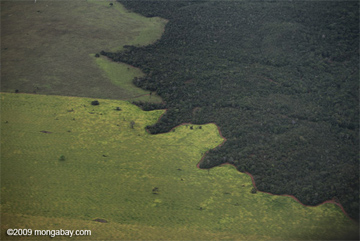
Energy efficiency: Chu said market failures –- among them lack of knowledge and lack of financing – stand in the way of efficiency to commercial and industrial buildings and to homes which deliver relatively quick paybacks.

"How many University of Chicago economists does it take to change a light bulb?" he asked.
"None," he replied. "If the light bulb needed changing, the free market would have done it."

Calling himself "an energy conservation nut," Chu displayed a chart showing that efficiency standards for refrigerators adopted years ago in California had reduced annual energy costs, on average, from $1272 to $462 a year. "Even though refrigerators have gone up in size, energy usage has gone down by 70%," he said.

The simple step of painting roofs white could cut air conditioning costs by 15% in warm weather regions, he noted.

Forestry and agriculture: Together, deforestation and agriculture account for about 31% of annual greenhouse gas emissions, Chu (and his pie chart) said. "To achieve our energy and climate goals," he said. "We've got to solve deforestation and change our agricultural practices."

Some of this can be quite complicated: Rich countries, rather than cutting their own emissions, could finance alternative livelihoods for people in the tropics so they don't cut down trees. Other ideas are simpler: If you provide poor people in the global south with solar or highly-efficient cook stoves, then they don't have to burn as much wood to heat their homes or cook food. An efficient stove avoids the equivalent of two tons of carbon emissions, about half the amount emitted by a typical car in a year.

Protecting forests is "the least expensive way to decrease carbon emissions," Chu said.

Technology breakthroughs: The energy department recently announced $151 million in grants for transformative technology under a program called ARPA-E, which stands for Advanced Research Projects Agency-Energy, and is modeled after the federal defense spending project that led to the invention of the Internet. "We don't have all the technologies we need," Chu said.

Interestingly, I listened to Chu chat with several venture capitalists just before the dinner in Union Station and he asked them how they thought his department was doing at reviewing grant applications from startup firms. He said he had a feeling that the DOE staffers who review the grants might be too conservative and risk-averse, and that he intended to urge them to take more chances on long-shot ideas that could deliver big breakthroughs.

I really liked the end of this article.

Only near the end of his talk did Chu revealed a bit of the passion that he brings to the topic of climate change.

The costs of enacting climate-change legislation, he said, are about 45 cents a day for a family of four.

And the cost of doing nothing?

One is that the U.S., which recently fell behind China in high-tech manufacturing, will fall even farther behind. "Very recently, China turned a corner," he said. "China and other countries will pass us by."

"And the other cost," he said, "is that we will expose our children and grandchildren to unconscionable risk."

Read more>>
..

Is The U.S. News Media Failing to Do It's Job on Global Warming?

Is the U.S. Media failing America on global warming and Peak Oil, potentially causing us to miss our window of opportunity to solve these urgent problems before they become civilization-destabilizing crises?

We've said as much in some recent posts, and now ClimateBiz weights in:

It sure seems that America is out of touch with the rest of the world regarding global warming, and that the world is slapping us in the face to awaken us from our stupor.

Delegates at last week's Barcelona climate talks were frustrated that U.S. negotiators came to the table unable to commit to concrete steps to reduce greenhouse gas emissions due to our seized legislative engine.

The notion that the U.S. is out of touch also was borne out by the Pew Research Center survey that was widely reported on in the past few weeks. Pew found that fewer Americans (57 percent) believe that the earth's atmosphere is warming versus two years ago (77 percent).

That statistic for many validates the view that we are in denial. But there was another statistic in that study that may suggest WHY the U.S. may be so out of touch. Pew also found that a majority of Americans -- 55 percent -- have heard nothing at all about the proposed cap-and-trade policy to establish limits on carbon dioxide emissions.

Come AGAIN?

That's right, 55 percent of U.S. citizens have heard NOTHING AT ALL about cap and trade. With a jaw-dropping statistic like that we must ask ourselves this question: Is the U.S. news media adequately doing its job as regards global warming?

At a time when climate science is urgently screaming to the American news media to mediate coverage of climate change in a way that will mobilize society, at a time when it's telling us that we just have a few short years to drastically cut greenhouse gas emissions or we seriously threaten the planet with chaos, misery, death and extinction, at a time when climate science warrants that we create an atmosphere of grave threat and crisis, and at a time when it tells us that, in the words of Maldives President Mohamed Nasheed, "…we need emergency action all around the world to curb (greenhouse gas) emissions" -- our delegates in Barcelona couldn't commit to any kind of plan just a month before Copenhagen, and the Pew Center has found that only 57 percent of Americans, down from 77 percent, believe that global warming is occurring, and that 55 percent have never heard anything about cap and trade. This suggests that the news media is not doing what it could and should be doing to keep us focused with the clarity and urgency that global warming requires, and that our global neighbors demand of themselves. 

Many are acknowledging that the media has cooled on global warming in the past year or more. A common refrain echoed recently is that the recession and healthcare reform have crowded out coverage of global warming.

For example...Juliet Eilperin, who covers the environment for the Washington Post, in her September 17 appearance on The Diane Rehm Show's "Preparing for Copenhagen" segment, said "… in the immediate past we've seen such a focus on healthcare you haven't seen as much altitude to those (climate change) stories."

But we should be seeing serious altitude on climate change stories. The lives of our children, and our children's children, are threatened. We can't wait until healthcare and the economy have become memories to return to climate change; we know that we have a few short years to dramatically reduce our greenhouse gas emissions.

Regardless of what other issues enter and exit our realm of concern, global warming must remain the dominant central issue. Therefore, the U.S. News media should step up and mobilize the nation to take dramatic action on global warming. To that end the media should do the following:
  1. Dramatically increase the frequency and extent of coverage of climate change; fill the papers, websites, airwaves and television with lots and lots of coverage of climate change every single day;
  2. Fill the content of that coverage with current climate facts, suggest the future implications of those facts, including their social and economic consequences, and illustrate how those consequences will impact us at a personal level;
  3. Deliver that content with a grave tone of crisis and emergency;
  4. Institutionalize coverage of climate change by creating standard, daily news sections and departments in our print, radio, television, Internet and other media.
To blame issues like health care and the economy for pushing climate change coverage to the side is not an adequate justification.  Rather, it is a lame and shallow excuse that reflects an utter lack of critical thinking about how to accurately educate the public about the benefits of solving climate change.

Something this ClimateBiz piece misses out on completely is that the media is failing to make key connections for the American people.  For example, as we point out here time and again, the sources of pollution that cause climate change are also making millions of people sick, driving up health care costs.  By transitioning to a clean energy-powered economy, including electric vehicles, we will save billions of dollars on our nation's health care costs.

Similarly, much has been written about how our transition to a clean technology economy will spur the growth of whole new economic sectors and create millions of new jobs.  In addition, more efficient energy technologies and vehicles will help save Americans hundreds of billions of dollars on our energy and transport costs each year -- freeing up that money (which is now just going to energy companies) to be spent widely throughout diverse sectors of the economy (clothing, travel, restaurants, hotels, electronics, recreation, music -- you name it!)

Similar connections can be made on the national security front and fight against terrorism, where our dependence on oil helps fund regimes that strongly dislike America, compromises our foreign policy stances, and overall threatens our economic security.

The media is, in our opinion, failing miserably to relay these types of key linkages between solving climate change and solving other key challenges of our day.  Invite us on to your program and we'll be glad to tell your audience all about them.

Read more>>
...

Solving Global Warming to Avoid a Global Food Crisis

It's pretty clear that more and more people are realizing the crisis in the global food supply that is coming down the pipe compliments of global warming.

Here, Lester Brown lays out how the upcoming Copenhagen climate change treaty negotiations will impact global food security for decades to come (for better or for worse):

It is the disappearing glaciers in the Himalayas and on the Tibetan Plateau that are of most concern, because their ice melt sustains the flow of the major rivers of India and China—the Indus, Ganges, Yangtze, and Yellow rivers—during the dry season. This ice melt thus also sustains the irrigation systems that depend on these rivers.

Yao Tandong, one of China’s leading glaciologists, who predicts that two thirds of China’s glaciers could be gone by 2050, says “the full-scale glacier shrinkage in the plateau region will eventually lead to an ecological catastrophe.”

It will also lead to a humanitarian catastrophe. China is the world’s leading producer of wheat. India is number two. (The United States is third.) In contrast to the United States, most wheat grown in China and India is irrigated. With rice, these two countries totally dominate the world harvest. The projected melting of these mountain glaciers in Asia represents the most massive threat to food security the world has ever seen.

The prospects for the harvests of wheat and rice, in these two countries, each with over a billion people, are of concern everywhere. We live in an integrated world food economy, one where harvest shortfalls anywhere can drive up food prices everywhere.

It's not just the melting of glaciers that are the source of Asia's agricultural and drinking water that we have to be worried about.  It's also the impacts of rising temperatures:

Rising temperature also directly affects crop yields. In a study published by the U.S. National Academy of Sciences, an international team of scientists confirmed the rule of thumb emerging among crop ecologists that for each 1 degree Celsius rise in temperature above the norm during the growing season, we can expect a 10 percent decline in wheat and rice yields. In a world with limited grain stocks—a world that is only one poor harvest away from chaos in grain markets—a crop-shrinking heat wave in a major grain-producing region could lead to politically destabilizing food shortages.

Does anybody still have any doubt that our transition to a Green Economy powered by clean energy technologies (not to mention transition to a more sustainable food supply and other land uses) is crucial for maintaining our economy, health, security and quality of life?

Food security is right up there at the top of Maslow's hierarchy of needs, so hopefully this line of messaging helps us gain some traction on solutions...

Read more>
...

Time For the Media to Face the Factory Farm / Swine Flu Link?

Grist's Tom Philpott takes us for a journey back to 2003, when an article in Science described a new strain of swine flu that had started hitting North Carolina pig farms in 1998:

For years before the current outbreak, scientists openly worried that CAFOs (concentrated animal feedlot operations) provided excellent arenas for the generation and spread of dangerous new flu varieties.

Yet another bit of evidence on this score crossed my desk this week: a “News Focus” piece that ran in Science back in 2003 called “Chasing the Fickle Swine Flu.” (PDF) It’s jumping-off point is the very incident Foer pointed to on Ellen—the outbreak of a novel strain of flu, genetically related to the current strain, on a North Carolina farm in 1998. The opening is worth quoting at length:

One of the first signs of trouble was a barking cough that resounded through a North Carolina farm in August 1998.  Every pig in an operation of 2400 animals
sickened, with symptoms similar to those caused by the human flu: high fever, poor appetite, and lethargy. Pregnant sows were hit hardest, and almost 10% aborted
their litters, says veterinary virologist Gene Erickson of the Rollins Animal Disease Diagnostic Laboratory in Raleigh. Many piglets that survived in utero were later born small and weak, and some 50 sows died.

The culprit, a new strain of swine influenza to which the animals had little immunity, left veterinarians and virologists alike puzzled. Although related flu strains in birds, humans, and pigs outside North America constantly evolve, only one influenza subtype had sickened North American pigs since 1930. That spell was suddenly broken about 4 years ago, and a quick succession of new flu viruses has been sweeping through North America’s 100 million pigs ever since. This winter, for example, up to 15% of the 4- to 7-week-old piglets on a large Minnesota farm died, even though their mothers had been vaccinated against swine flu, says veterinary pathologist Kurt Rossow of the University of Minnesota, Twin Cities. [Emphasis added.]

Here we have a phenomenon I’ve written about before: the flu strains circulating through the U.S. swine herd didn’t mutate much after 1930—until 1998. The novel strain that emerged in a North Carolina CAFO then was devastating for pigs, whose immune systems did not recognize it; but luckily, it didn’t have the genetic chops to jump to humans.

By 2003, scientists were actively worried that would soon change, the Science article reveals.
“Within the swine population, we now have a mammalian-adapted virus that is extremely promiscuous,” one researcher told the magazine. “We could end up with a dangerous virus,” i.e., a mutation that jumps to humans.

And researchers were looking to the CAFO as the site where such a thing could rear up. In the 1990s, hog farming underwent an unprecedented process of intensification and consolidation. As Science put it:

In the past decade, big swine producers have gotten bigger, and many small producers have gone out of business. The percentage of farms with 5000 or more animals surged from 18% in 1993 to 53% in 2002, according to Rodger Ott, an agricultural statistician at the National Agricultural Statistics Service in Washington, D.C.

Back in 2003, there was no taboo about stating the obvious:

“With a group of 5000 animals, if a novel virus shows up, it will have more opportunity to replicate and potentially spread than in a group of 100 pigs on a small farm,” [University of Minnesota veterinary pathologist Kurt] Rossow says.

Wow... Fascinating.  Frightening.  Maddening.  Is it surprising that people saw the writing on the wall and did little to stop the problem, causing senior citizens and other high risk folks in the fall of 2009 to spend their mornings elbow to elbow on line waiting for their H1N1 vaccinations?

Swine flu seems to be yet another instance of humanity's polluting, unsustainable activities coming back to bite us in the ass.  The irony is -- we're lucky it's not nearly as virulent as the 1918 bird blue, which from everything I've read, was shockingly lethal in comparison to H1N1.

Read more>>
...

Thursday, November 12, 2009

Land Use Change An Overlooked Cause of Global Warming

Did you know that even if we completely eliminated our fossil fuel emissions, we'd still not solve global warming?

That's because land use change -- deforestation, urbanization, conversion of lands to agriculture, and agriculture itself -- contribute over 30% of global greenhouse gases (about 20% are commonly attributed to deforestation and 12-14% to agriculture).

Science Daily gets into how nations attending the upcoming Copenhagen climate change treaty negotiations will need to come up with solutions to this crisis in global land use:

Across the U.S. as a whole, approximately 50 percent of the warming that has occurred since 1950 is due to land use changes (usually in the form of clearing forest for crops or cities) rather than to the emission of greenhouse gases," said Stone (Georgia Tech City and Regional Planning Professor Brian Stone). "Most large U.S. cities, including Atlanta, are warming at more than twice the rate of the planet as a whole -- a rate that is mostly attributable to land use change. As a result, emissions reduction programs -- like the cap and trade program under consideration by the U.S. Congress -- may not sufficiently slow climate change in large cities where most people live and where land use change is the dominant driver of warming."

According to Stone's research, slowing the rate of forest loss around the world, and regenerating forests where lost, could significantly slow the pace of global warming.

"Treaty negotiators should formally recognize land use change as a key driver of warming," said Stone. "The role of land use in global warming is the most important climate-related story that has not been widely covered in the media."

What are the solutions?

Stone recommends slowing what he terms the "green loss effect" through the planting of millions of trees in urbanized areas and through the protection and regeneration of global forests outside of urbanized regions. Forested areas provide the combined benefits of directly cooling the atmosphere and of absorbing greenhouse gases, leading to additional cooling. Green architecture in cities, including green roofs and more highly reflective construction materials, would further contribute to a slowing of warming rates. Stone envisions local and state governments taking the lead in addressing the land use drivers of climate change, while the federal government takes the lead in implementing carbon reduction initiatives, like cap and trade programs.

Somebody should also tell Stone about the potential for carbon intensive farming methods to help us reduce agricultural emissions of the heat trapping gas, carbon dioxide (as well as of the powerful greenhouse gas, nitrous oxide, which is emitted from farms that overuse nitrogen fertilizers).

Read more>>
...

EPA Study Finds High Levels of Mercury in Lake Fish Nationwide

It's not just global warming that makes burning coal bad for people.  As the Oregonian reports:

A study by the U.S. Environmental Protection Agency found high levels of the neurotoxin mercury in game fish in 49 percent of lakes and reservoirs nationwide.

Burning fossil fuels, primarily coal, accounts for nearly half of mercury air emissions caused by human activity in the United States, the EPA says.

A Green Economy, powered by clean energy technologies, continues to look better and better for more and more reasons...

Read more>>
...

Coral Reef Troubles Indicate Broader Ecological (and Economic) Problems

No ecosystems on Earth are declining as rapidly as coral reefs, reports Mongabay, and their decline doesn't bode well for humanity:

By revealing what could be in store for other natural systems, reefs resemble the proverbial canary in a coal mine.

Why might we humans be concerned here?  Well, consider the benefits humanity enjoys compliments of  coral reefs:

Reefs sustain many commercial fisheries and reduce the impact of large storms on coastal populations, saving communities more than $9 billion every year. New drugs developed from natural sources, both above and below the waves, are used to treat everything from heart disease to leukemia. In fact, the renowned AIDS treatment drug AZT is based on chemicals discovered in a Caribbean reef sponge. Researchers also recently discovered a compound in a species of coral near Taiwan that could help patients with severe nerve damage.

To give reefs and other ecosystems a chance, it's crucial that world leaders embark upon a combined effort to protect earth's remaining natural areas, beyond even international attempts to control global warming emissions.

Wow!  I had no idea that AZT came from a compound discovered in a reef organism.  Nature continues to amaze -- and to provide us with new justifications for taking much better care of our planetary home...

Read more>>
...

Climate Change and China's Food Supply


I wonder if the officials in China approving all their new coal-fired power plants are aware of the predicted impacts of global warming on their country's food supply:

Over the past decades, the Yangtze River Basin has become hotter. It is expected that the temperature will increase by up to 2 degrees Celsius, by 2050, relative to 1950 temperatures.

Researchers warn that the temperature change alone would reduce rice production by up to 41 per cent by the end of this century, with corn and winter wheat production declining more rapidly — a corn reduction of up to 50 per cent is estimated by 2080.

What are the solutions in this, yet another story exploring how in tarnation we are going to feed a growing human population in an overheating world?

Read more>>
...

Climate Change: The Cost of Inaction Continues to Rise

Following up on yesterday's post about the media failing to accurately inform the public about the costs of inaction on global warming, we have this from the Triple Pundit:

According to the International Energy Agency (IEA), the world will have to spend an extra $500 billion to cut carbon emissions for each year it delays implementing serious action on global warming. This would be on top of the $10.5 trillion investment needed from 2010 to 2030 to boost renewable energy development and improve energy efficiency.

Of that $10.5 trillion, the IEA states that about 45 percent, or $4.7 trillion in investment will be in transportation. Just one more reason we continue to remain so bullish on the electrification of our transportation infrastructure, mass transit and high speed rail.

The IEA report also pointed out that to continue current trends of energy demand and burning fossil fuels would lead almost certainly to massive climate change and irreparable damage to the planet.

When I hear people complain that we can't solve global warming because it will wreck the economy, I think about whether, around 1900, people complained that we can't transition to automobiles because it would wreck the horse industry.

Just as the transition to cars revolutionized our economy in a way that improved lives for generations, so will the transition to a clean technology-powered economy.  In this case, as we frequently note here, the transition to a Green Economy will also help to alleviate many of our most pressing economic, health and security problems to boot!

Read more>>

Read the L.A. Times coverage of the IEA Report, titled, "No Time to Waste on Climate Change, report Declares"...
...

Rebuilding a Green New Orleans: An Interview WIth Matt Petersen, President of Global Green U.S.A.

It would certainly make sense that the post-Katrina rebuilding of a city like New Orleans -- which is below sea level and thus severely endangered by global warming -- would take a green angle.

How have efforts to green the rebuilding of New Orleans been working out?

Treehugger reports, in an interview with Global Green President, Matt Petersen (the one who got Brad Pitt involved).  Responding to Treehugger's question about what Global Green will take away from its experience in New Orleans -- the most powerful part of the project, Petersen says:

The commitment of the Holy Cross neighborhood. We'll look back in 20 years and say this is where this shift, this turning-around started: these citizens and residents saying we need to become carbon-neutral. That's what allowed us to come into that neighborhood and build the project we're building. It's that commitment of the community and people taking pride in their own neighborhood That has only reinforced my belief in the green schools initiative. We need people to relate to something in their own backyard.

And other than their neighborhood, think about the entity that's in every neighborhood, a school. How do make that a connecting point to both improve the lives of school children and create a better educated workforce as well as solving global warming. That connection to your neighborhood, that you need to love where you live. That starts not with your home, but with your community. If you love where you live, and have a bold vision to go along with it, and a sense that you can influence what your neighborhood can do, then you can begin to make a real difference. How can we do more as an organization and as a society to empower individuals to act?

This reclaiming of the role of citizens in New Orleans, that was crucial. When every level of government was broke, it was this neighborhood planning progress that really helped drive the sense of civic participation. How do we reclaim our role as citizens and not just be consumers anymore in this country?

If there's one city that knows how to have fun going about reclaiming our role as citizens and not just be consumers, it's New Orleans -- and it's phenomenal musical and culinary heritage.  A story like this -- in which solving New Orleans' climate change problem is also helping to solve its economic and health problems -- is definitely worth some horn playing!

Read more>>
...

Wednesday, November 11, 2009

Media Ignores Massive Costs of Inaction on Climate

As the climate change debate ramps up here in America, I've heard quite a bit of coverage of opponents of progress whining about how solving climate change is going to wreck the economy.  So, they say, we can't take action.

That's like saying that since treating your cancer is going to drain your bank account, it's better to just do nothing about it.  We know what the outcome of that decision would be...

Lest we forget, as David Suzuki point out in this article, that when it comes to solving climate change, the costs of inaction are likely to dwarf the costs of taking bold action now:

Former World Bank chief economist Lord Stern has estimated that to keep heat-trapping greenhouse gas emissions below levels that would cause catastrophic climate change would cost up to two per cent of global GDP, but failure to act could cost from five to 20 per cent of global GDP.

And those are just numbers. In the real world, runaway climate change could have devastating impacts on our water and food supplies, could lead to waves of refugees escaping uninhabitable drought-stricken areas or vanishing islands, and could wreak havoc on the world’s oceans and cause major extinctions of plants and animals. Some of this is already happening.

With all of the promise offered by solutions, we can't stand by and let the traditional media continue to roll out the hackneyed -- and false -- line that taking action on climate change is going to wreck the economy.

Those of us who are familiar with the promise offered by climate change and clean energy solutions need to step up -- in our schools, communities, states and country -- and write letters to the editor, contact your Congressional representatives, and contact your major news networks.  Let them know them what former World Bank Chief Economist, Lord Stern, said about the costs of action vs. inaction.  Tell them that for the sake of all of our well-being, they'd damn well better accurately inform the public about the importance -- and benefits -- of taking bold action now.

If a story on CNN, NPR, MSNBC, Fox, ABC, you name it mentions the cost of the climate bill and its impact on the economy, it should also mention not only the benefits of the solutions to our environment, economy, health and security.  It should point out the costs of doing nothing.  Otherwise, the reporter is guilty of dereliction of duty. 

Read more>>
...

Smart Grid Technology Gives You Power Over Your Power Costs


What, you may wonder, is all this "Smart Grid" business all about?  Well, it's not a set of new robotic, satellite-connected powerlines that's going to be operated by R2D2 right outside your home.

It's a system for your home that gives you control over how much energy you use -- and thus control over how much of your hard-earned paycheck you have to shell out each month to cover your energy bill.

The Idaho Statesman reports on how homeowners are getting to test out this exciting new technology, which will sooner than later be available to help YOU save energy and money:

Imagine you could log on to the Internet to find out how much power you used this week.
If you have one of Idaho Power's new smart meters, you already can.

And what if you could pay less to wash your dishes or dry your clothes by simply doing them at a different time of day?

If you live in Emmett (Idaho), you already can. The Public Utilities Commission pushed Idaho Power to install the new meters there in 2004 and since 2005 the company has offered three different rates there for different times of the day and the week to help people reduce their own bills and the utilities' demand for power at peak times.

These are the first steps Idaho Power has taken to move it toward the potential savings and efficiency offered by so-called "smart grid" technology. Thanks to a $47 million stimulus grant from the Obama administration's Department of Energy, all of Idaho Power's customers will have similar tools for reducing their power bills by 2012.

"This is giving you as a customer more control over your rate," said Theresa Drake, Idaho Power's manager for customer relations and energy efficiency.

I can't wait  until we have one of these in our home.  PG&E, if you are listening, we volunteer to test Smart Grid technologies for you!

Read more>>
...

Norway Leads the Way to Save South America's Rainforests

Big props to Norway for stepping up and leading the way as the world tries to figure out how to save the tropical rainforests that serve humanity as the lungs of our planet.

Reuters reports that Norway has now ponied up as much as $250 million to help compensate the country of Guyana for the conservation value of their forests:

"Saving the world's remaining tropical forests is a crucial element in the battle against climate change," Norwegian Environment Minister Erik Solheim said of a memorandum he signed in Guyana with President Bharrat Jagdeo.

"Provided that the expected results are achieved and that other elements of the partnership fall into place, our support for the years up to 2015 could add up to as much as $250 million," he said in a statement.

Plants soak up carbon dioxide as they grow and release it when they are burnt or rot. The United Nations says deforestation accounts for about a fifth of all greenhouse gas emissions from human activities.

Until now, nations with high levels of forest cover have attracted less cash than worse performers promising to slow high rates of deforestation.

"Success in the global fight against deforestation means that both the countries that have high deforestation rates and those with low rates should obtain incentives to preserve their forests," the Norwegian ministry said.

I love how in this case, Norway is moving proactively to reward a country that still has the majority of it's forests standing.

Read more>>
...

The Fight Over the Future and Sustainability of Food Production

The number of articles exploring how we are going to feed a growing human population -- while at the same time reducing agriculture's devastating impacts on the very ecosystems (and people) that support food production -- continues to tick up.

The latest is a major article by way of Reuters titled, "The Fight Over the Future of Food."  It begins with the story of the owner of a sustainable farm in Italy:


A charismatic 40-year-old, he dropped out of an agricultural school after growing disillusioned with the farming methods being taught there. Today, he lets nature run its course as he grows cereals and legumes on his small family farm in Belcreda di Gambolo, about 20 miles southwest of Milan.

He does not use any chemical, or even natural fertilizers or pesticides. He does not weed his fields. "All you need to do is observe nature, listen to it, do what nature suggests and it will take care of everything," he said.

His fields, in a low-lying plain that has a long history of growing rice used for risotto, replicate patterns found in nature. For example, clover and millet grow together, feeding each other with necessary minerals.

Oglio said his farm is eco-sustainable. He has slashed operating costs by eliminating expensive commercial products like herbicides and by reducing the use of agricultural machinery to a minimum. Such cheap and low-maintenance farming could be adopted in Africa and other regions hit by poverty and hunger, he said.

Just earlier this week, my colleague, Jamie Reaser, posted this article to her FaceBook page -- reporting on farming methods that can dramatically increase carbon storage in soils, while at the same time reducing the need for expensive agricultural inputs like fertilizers and pesticides:

Rich-soil farming increases soil organic matter and microbial life by maintaining a balance between the organic matter removed from the land as crops and that returned to the land as compost or manure. Nitrogen-fixing crops are used to fertilise the land and support soil life, and their high growth rates rapidly sequester carbon. Natural pest controls avoid poisoning microbes and promote insect and animal diversity, in turn sequestering more carbon dioxide because the very bodies of Earth’s life forms are made of carbon. Maintaining soil cover and adopting minimal tillage avoids the oxidisation of carbon from the soil and keeps microbes alive with a constant supply of food from plant roots.

The prototype growers’ carbon calculator showed that even on a small scale a farm employing rich-soil practices can sequester so much carbon that even if the farmer uses diesel tractors and four-wheel drive vehicles and engages in other fuel-intensive activities, soil sequestration will still make it a net carbon sink.

Further calculations suggest that on a global scale, rich-soil farming could have a sequestration potential so powerful that it could turn back the carbon clock. These figures are backed up by the latest science. A 2007 study for the Intergovernmental Panel on Climate Change estimates that if world agriculture adopted best practices to increase soil organic matter content, it could mitigate 6 to 10 billion tonnes of carbon dioxide equivalent per year by 2030, which is between 20% and 35% of current annual global emissions (29 billion tonnes per year). As the world has approximately 5 billion hectares of agricultural land, this equates to a sequestration rate of between one and two tonnes of carbon dioxide per hectare, which, considering the growth rates of many plants, could be conservative. For example, recent research has found that forests can absorb over 8 tonnes of carbon dioxide per hectare every year for hundreds of years, and if very best practices were adopted, rich-soil farming could potentially match this.

These are exciting times in which the solutions to many of our major crisis -- in food production, climate disruption, unsustainable land use, energy, economy, and even terrorism -- are merging.  It's tough just to keep pace with the latest developments.  They are as inspiring as the problems we confront are frightening. 

The trick, as we emphasize here, is to motivate people to change to more sustainable practices... 

Will  politics bring down this civilization, or will we pull through in overtime?  It's getting very very late in the game...

Read more>>
...

Tuesday, November 10, 2009

The Vulnerabilities of Complex Systems


One of the things we are seeing with climate disruption is that its impacts, such as the disappearance of polar ice caps, are happening much faster than predicted.

Phenomena like this serve as a reminder that we humans are just, as EO Wilson points out, a tribal and aggressively territorial species of primate, and as we impact the earth's systems, we really have no idea, ultimately, what we are messing with.  As Jared Diamond details in Collapse, all we need to do is look to the history books to know what's happened to past civilizations that have failed to live sustainably.

Providing further food for thought about the darker path that humanity faces if we don't get our acts together on climate disruption and other challenges to our well being, is Chris Nelder's latest GetRealList post.  Nelder reports on insights about complex systems presented at the 2009 ASPO-USA Peak Oil Conference, including the interdependencies of energy, food, and water.

Of the security of our current food system, Nelder reports that:

Dr. Jason Bradford, the biology brains behind Farmland LP (more on that here), ticked off a few of the key vulnerabilities of the U.S. food system in his presentation on sustainable agriculture:
  • Commercial agriculture consumes 10.3 quads (quadrillion BTUs) of primary energy in order to produce 1.4 quads of food energy. The inputs are mainly fossil fuels used in running tractors, producing artificial fertilizers, producing seeds, trucking, refrigeration, processing, freezing and cooking.
  • Commercial agriculture not only depletes non-renewable resources and degrades soil, air, and water, but it also releases 5 billion pounds of harmful chemicals and massive amounts of greenhouse gas emissions into the environment per year.
  • Animal waste provides critically important fertilizer to small distributed farms, but in the modern massive feedlots of concentrated animal populations it becomes an environmental hazard. All the feed transported to the feedlots uses petroleum fuels, and the hay is grown using ancient “fossil water” pumped from deep, essentially non-renewable aquifers.
  • Over the last four decades or so, runoff from commercial agriculture has resulted in massive “dead zones” near our shorelines caused by algae blooms that suck the oxygen out of the water and create anoxic environments where nothing can live. (The dead zone in the Gulf of Mexico has grown to an estimated 8,500 square miles.)
  •  Just three crops comprise 71% of U.S. crop acres: corn, soybean, and wheat.
  • Monsanto, Pioneer, and Syngenta — all basically chemical companies — dominate the seed industry with patented GMO seeds. Those seeds are finely tuned to the temperature, rainfall, and so on of the recent past, making climate change a major threat to the whole food regime (more on that here).
  • Likewise, a handful of giant companies now control the vast majority of the food supply system — a stark contrast to the millions of small family farmers who dominated it prior to the 1960s.
  • Nearly all of the food delivery system uses just-in-time inventory methods, so there is only one to three days’ supply at any point in the distribution chain.
In short, Bradford explained, we have built a complex food supply system with very low diversity and strong connectivity. Yet in nature, those characteristics lead to instability. Stable systems are highly diverse with weak connectivity. The very complexity and interconnectedness of our food web is, in itself, a dangerous vulnerability.

Bradford aptly compared our blithe faith in the food supply system to “the hubris of Wile E. Coyote” just before he realizes he’s about to plunge into the canyon.

The rest of the piece looks at the energy-water nexus (complications that could arise from the fact that we use water for energy, and energy for water), and the relationship between Peak Credit and Peak Oil.

What's the take home, in terms of how to navigate and solve the challenges we face?  Says Nelder:

My guiding lights here include the likes of E. F. Schumacher, Paul Erlich, Paul Hawken, and Thomas Malthus — they were right, if a little (or a lot) early. And of course Henry David Thoreau, who exhorted us to simplify.

They would tell us to focus on simplicity in our investing strategies: Think locally, not globally. Small and distributed is more resilient (and more beautiful) than big and centralized. Using less energy to accomplish the same thing will succeed over trying to produce more energy. Imitating nature’s low-energy, low-impact, non-toxic methods in our industrial activities — a study now known as biomimicry — will succeed over inventing wacky new chemicals that nature has never seen before.

From now on, we should let the K.I.S.S. principle be our guide: Keep It Simple, Stupid.

It's worth your read.  If you approach it with a solution-oriented mindset and get some good ideas in response, I'd love to see 'em in the comments below.

Read more>>
...

Oceans Give Warning Signs About Climate, Pollution

Unexpected warning signs from the ocean are providing experts with further indication that the earth is essentially screaming at humanity to live more sustainably -- or else...

Off the coast of Washington state, mysterious algae mixed with sea foam have killed more than 8,000 seabirds, puzzling scientists. A thousand miles off California, researchers have discovered the Great Pacific Garbage Patch, a swirling vortex roughly twice the size of Texas filled with tiny bits of plastic and other debris.

Every summer, a dead zone of oxygen-depleted water the size of Massachusetts forms in the Gulf of Mexico; others have been found off Oregon and in Chesapeake Bay, Lake Erie, and the Baltic and Black seas. Some studies indicate that North Pole seawater could turn caustic in 10 years, and that the Southern Ocean already might be saturated with carbon dioxide.

A recent bird kill off the coast of Washington came without warning, said Jane Lubchenco, administrator of the National Oceanic and Atmospheric Administration. “There will be more surprises than that,” she said.

That's the rub -- one of the types of consequences we face is "unexpected surprises".  Do you really want to find out what they might be? 

Remember -- more and more we are learning that what befalls the earth befalls the people of the earth...

Read the full article>>
...

Can States Become Energy Self-Reliant?


Can regionally appropriate energy solutions like wind power in the Great Plains and solar in the Southwest help America's states become energy independent?

Treehugger reports that:

The Insitute for Local Self-Reliance (ILSR) has released a second version of its study titled Energy Self-Reliant States. In it they look at various ways that U.S. states could generate clean electricity locally (rooftop solar PV, onshore wind, offshore wind, etc). Just from the name of the institute, it's pretty obvious that they aren't in favor of centralized solutions to our energy problems, but at least they aren't all ideology: They back up their claims with a lot of data.

Among other things, the report claims:
All 36 states with either renewable energy goals or renewable energy mandates could meet them by relying on in-state renewable fuels. Sixty-four percent could be self-sufficient in electricity from in-state renewables; another 14 percent could generate 75 percent of their electricity from homegrown fuels. [...]

More than 40 states plus the District of Columbia could generate 25 percent of their electricity just with rooftop PV. [...]
much of the West and Midwest can be entirely self-sufficient by harnessing in-state [onshore] wind power [...]

Nine states could produce at least 10 percent of their domestic electricity consumption from conventional geothermal. Nevada could satisfy 40 percent of its electricity needs. [etc]

Now that's some interesting food for thought, backed up by pretty maps -- always a good selling piece (even if they don't necessarily tell the truth).

The report also claims that the cost savings on building and maintaining long-distance transmission lines helps make this type of local-to-regional energy solution economically competitive.  I'm going to have to take a good hard look at those numbers and ask my energy expert friends what they think.

What's your take?

Read more>>

Update: just got this response from one of my energy expert colleagues who I sent this out to -- Chris Nelder of GetRealList:

Even if they're right about the potential (and they could be) there's one hell of a difficult road between here and there. I don't think there's any practical alternative to building a HVDC grid, and potentially nationalizing the entire grid system, if only because without it, policy can't be formulated in time, capital can't be sufficiently mobilized (right--all those states struggling to pay a few cops & firefighters are going to spend hundreds of billions to build local renewable energy capacity without federal help?), and capacity can't be built in time. We're just plain outta time. Accordingly, projections like this drive me nuts. They paint a pretty picture about a goal without having any clue how you get there, and without any awareness that you have an extremely short period of time to do it. 
...

Cautionary Science Note: Planting Trees Can Shift Water Flow

While it's all the craze to plant trees to absorb the heat-trapping gas, carbon dioxide (CO2), a new article in the esteemed journal, Nature, notes that if not planned smartly, large-scale tree plantings can negatively impact water supplies:

According to two new studies, planting forests in areas that currently don't have trees — a process called afforestation — can reduce the local availability of water.

One key measure of water flow is 'base flow', the proportion of a stream or river not attributable to direct run-off from precipitation or melting snow. Base flow is often seen as the minimum supply of water on which people can safely rely. But in basins that contain small rivers, afforestation can reduce base flow by up to 50%, says Esteban Jobbágy, an ecologist at Argentina's national scientific council (CONICET) and the National University of San Luis.

Less base flow means less water for local populations. "It's a concern especially in drier regions, where the differences in base flow may be more noticeable," says Dan Binkley, a forest ecologist at Colorado State University in Fort Collins who was not involved in the research.

However, planted smartly -- choosing the right species, planted at the right densities -- trees can help protect communities from flooding and erosion:

Tree roots help to filter water into the soil, thus slowing the rate at which water levels rise after rain. "This is actually a good thing," he says. "It could reduce flood flows, particularly from small watershed areas." According to his team's observations, the afforested parts of watersheds also prevent the erosion and sediment-leaching that were seen in their grassland counterparts.

Read more>>
...

LEED For Landscapes Aims to Green The Nation's Greens (and How We Green Our Lawn)


A new certification system will help maximize the eco-friendliness of the nation's lawns and other developed green spaces, reports GreenBiz:

The American Society of Landscape Architects, Lady Bird Johnson Wildflower Center and the U.S. Botanic Garden partnered to develop the rating system as part of the Sustainable Sites Initiative, which they plan to test through a series of pilot projects over the next two years.

I just downloaded the guidelines doc and look forward to seeing how well it reflects my love of native landscaping and xeriscaping.

It's not just the wasteful everyday 'monoculture grass lawn' that I want to see go the way of the Hummer (many people don't even use the lawn that they wastefully spend money, water, artificial fertilizers, herbicides and fossil fuels to maintain).  I've had enough of Japanese Maples and invasive African Acacia trees here in California, let alone European shrubbery and Eurasian ornamental flowers.

We at CVI love landscapes that reflect the public's pride in our local natural heritage.  In my yard, I plant native wildflower and bunchgrass plots (essentially mini native California grassland plots), which require little water or fertilizer and attract pollinators for my garden plants and fruit trees.  I expand these plots bit by bit each year, in the quest to convert my entire yard over to a native California grassland.  It's a ton of fun!

Each summer, I collect the seeds from our wildflower plots and save them for next year.  This holiday season, I'm going to package a bunch up and give away little native California wildflower seed packets as eco-friendly gifts.  Want one?

Read more>>
...

Vegetarians vs. Enlightened Meat Eaters vs. Status Quo


This post in Treehugger responds to a N.Y. Times op-ed by Nicolette Hahn Niman (of Niman Ranch fame) in favor of 'enlightened meat eating'.  Enjoy this, um, food for thought:

Last week's NY Times featured an op-ed entitled "The Carnivore's Dilemma"--an ostensibly enlightened response to the chorus of voices promulgating a vegetarian diet as a way to significantly reduce one's emission of greenhouse gasses (not least amongst these voices is

Michael Pollan, author of "Omnivore's Dilemma"). Unlike "The Omnivore's Delusion"--a fluff piece by the industrial agriculture lobby that defends the status quo--the author of the Times' piece, Nicolette Hahn Niman, is no great defender of current industrial agricultural practices; she's a rancher and advocate of "traditional", grass-fed livestock production. Hahn Niman's argument focuses on debunking the notion that vegetarianism is inherently the most beneficial way of eating for the environment.

While Hahn Niman has several valid points, her arguments often fall short of a sale. She frequently compares best-case scenario meat consumption and worst-case scenario vegetarianism. She states, "It could be, in fact, that a conscientious meat eater may have a more environmentally friendly diet than your average vegetarian."

Read more>>
...

'We Have Already Entered Peak Oil', IEA Source Reportedly Claims

Holy Peak Oil, Batman!  If we needed any more impetus to get sweeping clean energy and transport legislation passed through Congress ASAP -- and solve climate change disruption in the process -- here it is:

Two International Energy Agency whistleblowers have come forward with startling claims about the world's supply of crude oil, according to a report published Tuesday.

"We have [already] entered the 'peak oil' zone," an unnamed former IEA official told British newspaper The Guardian. "I think that the situation is really bad."

A second whistleblower reportedly claimed that the IEA's current figures are inflated due to pressure from the United States and a pervasive fear that the announcement of falling oil output in the future could cause markets to respond with panic.

The claims come on the same day the IEA plans to publish its annual "World Energy Outlook" report for 2009.

It's getting to the point where Congress either has to show some serious 'balls' or be ready to be held big-time accountable if we fail to prepare ourselves for the coming Peak Oil crisis -- which will not be pretty.

The good news, which we repeat time and again here at CV Notes, is that the clean tech revolution-rooted solutions to Peak Oil, like the solutions to climate disruption, are exactly what the doctor ordered for our economy, our security, our public health, and overall quality of life.

Read more>>
...

Monday, November 09, 2009

God's Green Earth

One force that can certainly help spur efforts to solve climate disruption is religion.  Fortunately, an increasing number of religious leaders are getting involved.  Living on Earth reports that:

There may be a prayer for climate change prevention. Major world religious leaders and conservation organizations recently gathered in Windsor, England for the Many Heavens, One Earth conference to advance the fight against climate change. Host Jeff Young speaks with Martin Palmer, Secretary General of the Alliance of Religions and Conservation, about why these initiatives might have a greater impact on stewardship than scientific or political efforts.

Hey, if people can't believe in the threats posed by invisible heat-trapping gases, at least we know (all too well) that they can listen to the message of invisible deities... 

Listen to the story>>
...

Climate Change: Threat or Opportunity?

Should efforts to convince the public and Congress to support climate change (aka "climate disruption") and clean energy solutions legislation focus on the economic, security and other benefits offered by solutions or the dire consequences of inaction -- be they climate disruption or Peak Oil-related?

The Washington Post reports on how this very question is splitting environmental groups across America -- excellent capture of this moment in environmental messaging.

One poll done this fall for the Pew Environment Group found 76 percent of likely 2010 voters think global warming is happening now or will happen in the future, and 71 percent called it a serious threat. But another survey, done about the same time by the Pew Research Center, caused a stir after it found that the number of people who saw solid evidence that warming is happening had shrunk from 71 percent to 57 percent since April 2008.

Now, given the slow progress in the Senate, some green groups say they want to broaden their appeal beyond committed environmentalists, to the skeptical, the agnostic and the distracted.
That means minimizing doomsday predictions and focusing on positives: A climate bill will create jobs in the renewable-energy industry and keep money away from oil-state villains.

The messaging data doesn't only show that motivating the American public to action on climate disruption is a challenge.  Showing consistent majorities of the public favoring solutions, it also paints a picture of a Congress -- tied to big-moneyed fossil fuel interests -- that is far behind its constituents on both the threats posed by destabilizing Earth's climate system and the promise offered by the solutions.

The key, then, would seem to be to build up a sufficiently strong level of public clamor for solutions to convince Congress to act.  With big moneyed interests funding efforts to instill doubt, Americans were recently found to prioritize solving Climate Change lower than even Iraqi's and Palestinians!  So we have a huge challenge here.

How to you build a stronger majority?  While it's tough to get many conservatives to become concerned about the threats posed by climate disruption, the opposite side of the coin, which we emphasize, is that it's easier to get them to agree on solutions such as a transition to a Clean Energy Economy than it is to focus on the details of climate disruption.  As the Washington Post article notes:

On Tuesday night, climate activist Nancy Jackson addressed one of the most climate-skeptical audiences in the country: Kansans. She was speaking to college students here in Manhattan -- a town where one religious leader was able to draw congregants to screenings of "An Inconvenient Truth" only by passing out Nerf balls, so they could hurl them at the image of Al Gore.

"Take climate change off the table, okay?" Jackson said, after reciting evidence that the climate really is changing. "You don't have to buy it for everything I'm about to say, because everything we do [to combat climate change] is a good idea for at least three other reasons."

She told the students that Kansas has an abundance of wind, sun and crops such as corn and prairie grasses -- all potential sources of renewable power. The message worked, at least on 21-year-old student Matthew Brandt. He said he doesn't believe in climate change, but -- after hearing Jackson's talk -- he was interested in windmills.

Fortunately, there's been a tremendous recent surge in recommendations coming out of the environmental messaging fields (e.g., conservation psychology, sociology), which are beginning to filter into efforts to motivate the public to action.  No matter what the right answer proves to be, the debate seems to be proving fruitful.

On our end, CVI currently favors a balanced approach of emphasizing BOTH the very real dangers of inaction and the promise of a brighter, more secure future offered by the solutions.

I do believe that WWF's Carter Roberts nailed it on the head when he says in the Post piece that:

"The reality is, we need to save ourselves.  The connection between an intact planet and people's well-being . . . is the part of the equation that's missing."

Read more>>
...

Cap and Trade Explained: The Short Attention Span Version

Most people who I talk to about climate change solutions get bleary-eyed at the mere mention of "cap and trade".  Now I can forward them this Planet Green article, which explains it simply...

1) Government set a limit on the total amount of pollution that is permitted to be emitted into the atmosphere. In terms of cap-and-trade in regards to climate change, that's carbon dioxide. That's the cap. Emissions above that level result in fines.
2) Permits then get distributed to industry for a given amount of pollution. They can either be auctioned off (better, but polluters don't so much like this), given away for free based on historic levels of pollution (seemingly rewarding polluting industries) , or some combination of the those.
The idea is to set the initial allotment slightly below what's already being emitted -- the whole point of this is to reduce the amount of pollution, not just keep it at current levels.
3) If a company can reduce its pollution below the amount of credits it already has, it can sell those credits to some other company that's not doing so well on the reduction front.
4) This system essential creates an economic market where polluters have financial incentive to reduce pollution in the form of spare credits which can be sold or traded.
5) Over time the cap can be reduced -- hopefully at predictable intervals so everyone can prepare for it -- further constraining the amount of pollution that industry can emit.


Any more questions?

Read more>>
...

Sunday, November 08, 2009

Climate Psychology in Cartoons: Clues for Solving the Messaging Mystery

Yet another new report is out that recommends messaging solutions for motivating the public to action on climate change.

This one, featuring leading research on how our minds respond to the threat of climate change, is neatly synthesized in a new guide, “The Psychology of Climate Change Communication.”  Says Grist:

The 43-page booklet was released Wednesday by the Center for Research on Environmental Decisions (CRED) at Columbia University, which conducts fascinating laboratory and field research at the intersection of psychology, anthropology, and behavioral economics (The New York Times Magazine profiled it last spring).

Aimed at scientists, journalists, educators, political aides, and “the interested public,” the guide begins with the blunt admission that climate communicators are failing. Global warming slipped to the bottom of a list of Americans’ concerns in a January Pew poll. CRED offers reasons why and suggests how to do better.

For example, people work harder to avoid losses than to seek gains, so “save money” might not be the best pitch for convincing people to buy efficient home appliances. A message like “avoid losing money on higher energy bills in the future” does better at appealing to this loss-aversion instinct.

CRED’s (principles) include using:
  • data plus narrative storytelling
  • analogy and metaphor
  • a trusted local messenger
  • a group setting
  • an experiential scenario
Happily, the guide has cartoons. CRED graciously allowed us to reprint them.

Read more -- and check out the cartoons>>
...

One Year Later: Obama's Green Accomplishments

Joe Romm of Grist and Climate Progress details Obama's progress on green issues.

Future historians will inevitably judge all 21st-century presidents on just two issues: global warming and the clean energy transition. If the world doesn’t stop catastrophic climate change then all presidents, indeed, all of us, will be seen as failures and rightfully so.

In that sense, what team Obama has accomplished in the year since he was elected is nothing less than an unprecedented reversal of decades of unsustainable national policy forced down the throat of the American public by conservatives. Three game-changing accomplishments stand out:

  1. Green Stimulus: Progressives, Obama keep promise to jumpstart clean energy, economy—conservatives keep promise to jumpstop the future. The stimulus represents the single biggest increase in clean energy investment in U.S. history—$100 billion public investment aimed at driving, which is pulling in another $100 billion in public investment. Huge investments in energy efficiency, renewables, transmission and smart grid, and mass transit and train travel are already having a big impact, for instance, helping the wind industry survive and thrive in the great Bush-Cheney recession.
  2. Regulatory Breakthroughs: Obama will raise new car fuel efficiency standards to 35.5 mpg by 2015, which is the biggest step the U.S. government has ever taken to cut CO2.  And the Obama EPA declared carbon pollution a serious danger to Americans’ health and welfare requiring regulation. The EPA has begun the process of developing regulations, and while that is a very imperfect way to address global warming, it ensures that the country will take some action in the event Congress can’t.
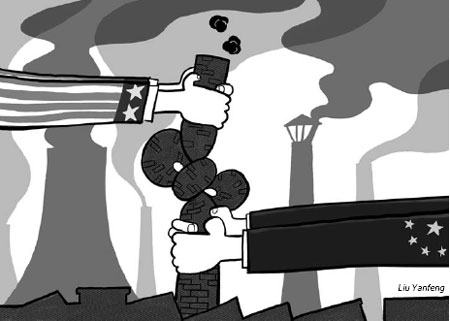
  3. First-ever climate bill advances:  In June, the U.S. House of Representatives approved a landmark bipartisan climate bill, 219 – 212. It would complete America’s transition to a clean energy low-carbon economy, begun in the stimulus, ultimately driving $100 billion a year in total U.S. investments in clean energy technologies and industries.
We don't hear about all this day in and day out, so it's a nice reminder that our vote is, indeed, making a huge difference in spite of the powerful forces resisting change.

While you can give yourself a pat on the back for helping make all this happen, we have a LOT of work to do in the next year, while strong progressive majorities exist in Congress. 

Those of you in swing states, especially, please call your Senators and ask them to support and strengthen the Kerry/Boxer Clean Energy Jobs and American Power Act: 202-224-3121.

Read the full Grist article>>
...

The Nitrogen Fix: Breaking An Addiction That Harms People and Planet


Humanity's exorbitant use of artificial nitrogen fertilizers has literally doubled the global nitrogen cycle -- the amount of this ecosystem-altering chemical flowing through our soil, plant, air, waterways...and ourselves.

Excessive nitrogen has contaminated water supplies, contributed to the formation of acid rain, created massive oceanic dead-zones such as the one in the Gulf of Mexico, and caused and exacerbated noxious weed invasions.

This piece in Yale Environment 360 explores why and how we must greatly reduce the amount of nitrogen we put into the planet's ecosystems.

In 1908, the German chemist Fritz Haber discovered how to make ammonia by capturing nitrogen gas from the air. In the process he invented a cheap new source of nitrogen fertilizer, ending our dependence on natural sources, whether biological or geological. Nitrogen fertilizer fixed from the air confounded the mid-century predictions of Paul Ehrlich and others that global famine loomed. Chemical fertilizer today feeds about three billion people.

But the environmental consequences of the massive amounts of nitrogen sent coursing through the planet’s ecosystems are growing fast. We have learned to fear carbon and the changes it can cause to our climate. But one day soon we may learn to fear the nitrogen fix even more.

A major international survey published in September in Nature listed the nitrogen cycle as one of the three “planetary boundaries” that human interventions have disturbed so badly that they threaten the future habitability of the Earth.

The problem is that we waste most of Haber’s fertilizer. Of 80 million tons spread onto fields in fertilizer each year, only 17 million tons gets into food. The rest goes missing, washing into ecosystems.

This seems to be headed towards a classic instance in which solving an environmental problem ends up saving oodles of money by reducing waste.  The solutions the article cites include breeding crops that are far more efficient at absorbing the nitrogen in fields, and developing farming systems that manage nitrogen far more efficiently.

Since vehicle emissions are another significant source of emissions, getting more efficient plug-in and electric vehicles out there will also help both slash emissions and benefit people (through lower fuel costs, alleviation of pollution-induced illness, and more). 

As with climate change, this is ultimately a big big problem of motivating people.  Thus, solutions will require as much communications Jujitsu as they will factual information about the benefits of these promising new directions.

Read the full article>>
...

Carbon Trading: How to Save a Forest