Showing posts with label land use planning. Show all posts

Tuesday, September 20, 2011

New Research: Protecting Forests Will Deliver Economic Boom for Southeast Asia


Are forests more valuable to humanity left standing or for what's produced when they're cut?

More and more, we are learning just how much value healthy, intact and sustainably managed forests provide to society.

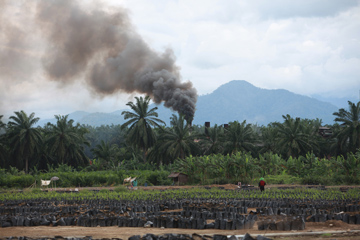
According to this post on Mongabay.com, for example, this lesson is being realized in Southeast Asia, where tropical rainforests face a range of threats, including conversion to palm oil and rubber plantations, illegal logging and poaching, and slash and burn agriculture.  It turns out that ecologically unsustainable practices are proving to be economically ruinous:
  • The Rajawali Institute for Asia at the Harvard Kennedy School of government estimates that by eliminating its natural capital for negligible gains, deforestation caused losses of $150 billion to Indonesia between 1990 and 2007
  • An investigation by a task force set up by Indonesian President Susilo Bambang Yudhoyono found that clear-cutting and conversion of forests to palm oil is so widespread that it's drastically reduced the availability of wood to be cut, costing the Jambai province, alone, 76,000 jobs in the sector.
  • "According to the Rand Corporation, particularly intense forest fires in Indonesia and Malaysia have increased deaths by 22 percent.  Bad air quality can also send people to the hospital and increase asthma attacks, lowering productivity.  One of Southeast Asia's challenges is attracting global companies to locate high-level executive headquarters in the region, in part because of the intense air pollution exacerbated by forest fires."
Clearly, the economic impacts of "unsustainability" reach far beyond agriculture and forestry sectors, influencing public health, safety and economic competitiveness.

Conversely, more sustainable practices are being found to confer wide-ranging socio-economic benefits:
  • Studies have shown that coastal mangrove forests can reduce tsunami flow by as much as 90 percent. During the infamous 2004 tsunami, villages that had cut down their mangroves were often wiped out while those that maintained them fared much better.
So how do we incorporate the conservation value of intact forests, such as the mangroves described above, into our economic system?

In most cases, the only option for landowners to earn income and feed their families is still extractive: clearing, logging, farming, grazing, mining or otherwise converting their forest plots.  The Natural Capital Project, The Economics of Ecosystems and Biodiversity (TEEB) and The Partnership for Wealth Accounting and the Valuation of Ecosystem services (WAVES) are among those making progress developing systems for valuing ecosystem services and compensating landowners whose property provides them. 

But at a time of increasing financial hardship and budgetary constraints, will we be able to deploy these new payments for ecosystem services systems quickly enough to restore and protect the world's remaining hot spots of biodiversity?

If there were ever a time for the emerging field of sustainable business to help conservationists entrepreneurially innovate, this is it.

Read more>>
...

Monday, September 12, 2011

The Forest (Ecosystem Service) Companies of the Future


As efforts grow to better align our economy with our ecology (due to very real biophysical limits of natural resource availability), businesses and landowners are exploring how to generate income via the valuable ecosystem services produced by their property.

The Guardian reports on how forest companies are making the transition from solely extractive-based revenues to diversified revenue streams that capitalize on conservation value:  

Climate change, population growth, and soaring demand for food, energy, water and other resources are changing the way the world sees and values forests. A vision is emerging of a new kind of company – the forest services company. 
Our vision is being propelled by new markets that are emerging for forest services such as carbon storage, wildlife preservation, recreational facilities and watershed protection. This trend is creating huge business opportunities for forest companies with the foresight to reinvent themselves and look beyond the traditional equation of forests equal timber. 
Forest companies of the future will expand their business model beyond delivering products to providing an array of crucial services to communities. Timber revenue will still be important, but successful companies will have supplemented their income from the fast-growing new markets that emerge from the increasing scarcity of ecosystem services.

Sounds rosy. But is this just more unrealized happy talk about the future potential of ecosystem services markets?  I was pleased to find some real-world examples of these types of changes actually happening now -- both at home and abroad:
Sveaskog, Sweden's largest forest company, is doing exactly that. Approximately 15% of annual net sales comes from biomass for energy and non-timber services such as windfarm leases and hunting and fishing licences. In addition, Sveaskog is managing one-fifth of its land for conservation and promotion of biodiversity. The company is also experimenting with ways to maximise carbon uptake through different forest management measures and plans to sell the additional uptake to carbon markets. In 20 years, Sveaskog expects its current sales share of 15% from biomass and different kinds of non-timber services to have doubled. 
Other major companies are similarly shifting focus to incorporate services. Plum Creek, the largest US private landowner, has about a third of the company's 7m acres of timber lands under revenue-generating conservation and wildlife protection agreements. Mondi, a leading international paper and packaging group, recently identified opportunities to tap into growing markets for biomass and ecotourism through a review of ecosystem services at three of its South African plantations. 
The shifting nature of forest companies is a win-win opportunity for governments as well, creating new jobs in struggling rural areas and improving the quality of life for urbanites.

One question I'd love to explore: are these ecosystem services-oriented revenue streams being designed in conjunction with neighboring landowners as part of regional-scale conservation planning efforts?

Read more>>
...

Monday, June 13, 2011

Timberland Documentary About the Conservation Value of Urban Forests - Dig It

I'm proud to share a clip from my first documentary film appearance. The film is named "Dig It" -- about the valuable benefits that urban forests provide to people and biodiversity alike.


Huge props to Danny Clinch, Tim Donnelly and crew for an exceptional job on this, and special thanks to Timberland for their support.


Enjoy...


Monday, May 10, 2010

UN Report Warns of Economic Impact of Biodiversity Loss

Coral reefThe UN today issued a new report that warned of the economic impact of biodiversity loss:

The relationship between nature loss and economic harm is much more than just figurative, the UN believes.
An ongoing project known as The Economics of Ecosystems and Biodiversity (TEEB) is attempting to quantify the monetary value of various services that nature provides for us.
These services include purifying water and air, protecting coasts from storms and maintaining wildlife for ecotourism.
The rationale is that when such services disappear or are degraded, they have to be replaced out of society's coffers.
Loss of coral reefs will reduce humanity's supply of seafood
TEEB has already calculated the annual loss of forests at $2-5 trillion, dwarfing costs of the banking crisis.
"Many economies remain blind to the huge value of the diversity of animals, plants and other lifeforms and their role in healthy and functioning ecosystems," said Achim Steiner, executive director of the UN Environment Programme (Unep).
"Humanity has fabricated the illusion that somehow we can get by without biodiversity, or that it is somehow peripheral to our contemporary world.
"The truth is we need it more than ever on a planet of six billion heading to over nine billion people by 2050."
The more that ecosystems become degraded, the UN says, the greater the risk that they will be pushed "over the edge" into a new stable state of much less utility to humankind.
For example, freshwater systems polluted with excess agricultural fertiliser will suffocate with algae, killing off fish and making water unfit for human consumption.
The main question that I keep coming back to is how we go about enacting land use plans that simultaneously protect biodiversity and human well-being without ticking a lot of people off.

How can we make conservation both possible and profitable, and transform the public's perception of biodiversity conservation from a threat to their economic well being to a new revenue opportunity?  It comes down to creating smart land management and policy solutions that reward property owners for the conservation value that their lands provide to society -- perhaps via some form of payments for ecosystem services system.

The bottom line is that humanity is still working on management and policy solutions for making conservation an economically viable alternative to extractive uses.  We're getting there in some places, but in many others, we've got real work to do.

Read more>>
...

Tuesday, March 16, 2010

Deforestation's Impacts in Africa: "The rains stopped, and banana groves and corn stalks died"

I'm a big fan of pictures and stories of the benefits that healthy ecosystems provide to humanity.  As I drove up toward Redwood Regional Park for my weekly meditative hike on Saturday, I was glad to find Living On Earth airing on NPR.

This quote got me -- a story about a reforestation project in Uganda, where the locals talk about what happened after the government cut down their forests:
HOFFMAN: Jerome Byesigwa chairs the group and explains how it started. In 2003, he says, the weather in the area suddenly changed when the government cut down much of the nearby Central Forest Reserve for timber. The rains stopped, and banana groves and corn stalks died.
[BYESIGWA SPEAKING] VOICEOVER: As soon as it had been harvested we realized there was a change in the weather. Just even ordinary people would tell you that the problems we were experiencing were because our forests there had been harvested.
The fact that these folks are getting carbon credits for planting highly invasive, water-hungry non-native tree species is just wrong.  It's great to see the World Bank funding reforestation projects like this, but it would be nice if they would help the local people by selecting native species, adapted to local environmental conditions (especially water needs) that help to replace the ecosystem services that have been lost to deforestation.

Clearly, we've got a ways to go to better integrate the science of sustainability into the planning of Uganda and the World Bank.

Read more>>
...

Monday, February 08, 2010

Is There Enough Food Out There for 9 Billion People

The New Republic reports on a paper last week from the esteemed journal, Science, proposing how humanity can feed 9 billion people in 2050:

A new paper published this week in Science, written by Britain's chief scientific adviser John Beddington along with nine other experts, outlines a way this could actually be done. The catch? Doing so would require "radical" changes to the current global food system. The paper's a great synthesis of a wide range of different food issues, and I'll just pull out the main ideas:

Boosting crop yields: If the supply of farmland is ultimately finite, then boosting yields is the only way we'll get more food.

Stop tossing out so much food: The study estimates that 30 percent to 40 percent of the world's food is thrown out each year. 


Fewer hamburgers: Can't imagine this one will go over well, but the authors do suggest that people will probably have to reduce their meat consumption slightly to feed nine billion people. This doesn't mean going vegetarian.

A slew of green technical stuff: Of course, all those other measures will only go so far. There are also some serious threats to the long-term sustainability of agriculture lurking out there. Global warming's a big one. But then also water shortages due to over-extraction. Soil degradation due to poor farming techniques. Loss of biodiversity due poor management. The fact that fisheries are being ravaged (so something like a cap-and-trade system for fish could help here). A lot of the fixes here are dry and technical, and they tend to get discussed as wonky enviro ideas that might be nice to do but aren't essential. Except that, as the Science study makes clear, they really are crucial—at least if all those nine billion people want enough to eat.

Not Food Crops and Farmland to Fuel Vehicles: It's probably going to be hard to find enough food for nine billion people if we're still diverting vast swaths of farmland for crop-based ethanol. (Though maybe by then we'll have moved on to algae fuels or electric cars or some other fancy technology.)

It's a fascinating, crucial topic -- one with that tie directly into humanity's other top crises: climate, biodiversity, fresh water.  We sure live in interesting times...

Read more>>
...

Wednesday, January 20, 2010

The Economist: Why It is Important to Put a Price on Nature

 The Economist weighs in on the emerging paradigm of paying people and communities for the ecosystem services provided by their healthy natural habitats.  They report on a gathering of experts in the field who recently met to assess how things are going and plot next steps:

They looked at the progress and prospects of their attempts to argue for the preservation of nature by better capturing the value of the things – such as pollination, air quality and carbon storage – that it seemingly does for free.

Environmental valuations aim to solve a problem that troubles both economists and ecologists: the misallocation of resources. Take mangrove swamps. Over the past two decades around a third of the world’s mangrove swamps have been converted for human use, with many turned into valuable shrimp farms. In 2007 an economic study of such shrimp farms in Thailand showed that the commercial profits per hectare were $9,632. If that were the only factor, conversion would seem an excellent idea.

However, proper accounting shows that for each hectare government subsidies formed $8,412 of this figure and there were costs, too: $1,000 for pollution and $12,392 for losses to ecosystem services. These comprised damage to the supply of foods and medicines that people had taken from the forest, the loss of habitats for fish, and less buffering against storms. And because a given shrimp farm only stays productive for three or four years, there was the additional cost of restoring them afterwards: if you do so with mangroves themselves, add another $9,318 per hectare. The overall lesson is that what looks beneficial only does so because the profits are retained by the private sector, while the problems are spread out across society at large, appearing on no specific balance sheet.

To this end, the Natural Capital Project, a group based at Stanford University, California, has developed a suite of computer programs called InVEST, which will analyse and map ecosystem services. InVEST allows farmers, landowners and government officials to make better-informed decisions about the current and future costs of an activity.

I'm a big proponent of figuring out how to devise smart strategies to make conservation both possible and profitable.  I recognize that without new mechanisms to allow people to make a living off the land by means other than logging, grazing, mining or otherwise destroying natural habitats, the loss of critical ecosystem services and biodiversity will continue.

That said, I also recognize 'Slippery Slope' argument -- the potential that valuing nature will provide new justification for destroying it.  But I haven't heard enough from the Slippery Slopers about constructive suggestions for solutions.  The status quo isn't working.  If you're against payments for ecosystem services, what do you suggest are viable solutions with bright prospects for reversing habitat destruction and biodiversity loss and maximizing the resilience of ecosystems to climate disruption?

Read more>>
...

Wednesday, January 06, 2010

David Suzuki and Faisal Moola: Protecting Nature Has Economic Benefits

Last year, when the Canadian government was debating how to invest in economic stimulus, conservationists at the David Suzuki foundation offered its ideas on how to spend the money.

I've described many of these ideas on this blog before, but there are a few fresh factoids in here:

Protecting nature results in cost savings for governments, because natural areas provide many ecological benefits that sustain the health and well-being of our communities at little or no cost. These include services like clean air, clean water, wildlife habitat and flood control. All are costly to replace if they are degraded or lost due to mismanagement, assuming they can be replaced at all.

The fiscal rationale for protecting nature is not new. Many ambitious policy solutions have come about not because leaders were motivated to protect wildlife habitat, but rather because they were looking for ways to save a buck. In the early 1990s, New York City chose to protect its watershed through land purchase, pollution control and conservation easements, rather than build new infrastructure to filter its water. In doing so, the city has saved billions of dollars.
Providing clean water at an affordable cost is a challenge in many Canadian cities because few draw their drinking water from protected watersheds. They must rely on expensive treatment systems because the ecosystems from which the water is drawn are degraded or tainted by pollution.

In comparison, drinking water for the capital region comes from protected watersheds in the Sooke Hills. These mature forests filter, store and regulate the region's drinking water at no cost to the taxpayer, providing a beneficial natural service that complements engineered solutions like water filtration.

Studies suggest a strong fiscal incentive exists to grow the urban forest cover in B.C.'s cities. For example, a recent joint study by municipal, provincial and federal agencies in B.C. estimated Vancouver and surrounding communities could save about $1.1 million annually in stormwater infrastructure costs if they significantly increased urban forest cover by planting more trees and taking better care of the ones they have.

The economic benefits of nature conservation were also recently profiled in a United Nations report called the Economics of Ecosystems and Biodiversity. It found that protecting natural ecosystems and biodiversity is worth trillions of dollars in annual economic benefits globally. The lead author, banker Pavan Sukhdev, told the media that investments to protect ecosystems can return 25 to 100 times more in benefits from the natural services they provide, such as pollination, climate regulation and water filtration.

This sort of research is important, because policy-makers often ignore the full economic costs of degrading land and the ecological services it provides when making development decisions.

Here's my biggest hope for 2010 and the new decade: that we actually see payments for ecosystem service schemes both become reality, and start to make a real difference in making conservation both possible and profitable -- making a real dent in our efforts to protect and restore both biodiversity and human well being.

Otherwise, we're going to be constantly learning new ways that a service that nature had been providing at low or even no cost -- such as carbon uptake -- is much more expensive to replace with a technological solution.

Just think how much it would cost to build and deploy machines that take up enough carbon dioxide to replace the carbon-absorbing services provided by the millions of acres of forests that are destroyed each year.  Really -- how much do you think it would cost, relative to the economic benefits provided by cutting down all those trees?  Of course, that's just getting into the carbon uptake service provided by forests.  You'd still need to replace the water provisioning services, water filtration services, pollination services, and more...

Read more>>
...

Tuesday, January 05, 2010

In California, Greens and Solar Providers (Unnecessarily) Clash Over Endangered Tortoise

Efforts to install solar projects in deserts are running into problems with conservation organizations who point out that there's no reason to place renewable energy infrastructure in prime endangered species habitat, reports Treehugger:

California's renewable energy providers and utilities are pushing to meet their state's 2020 deadline of providing at least 30 percent of the state's energy from renewable resources. But...one project, scheduled to break ground in the Mojave Desert, is now being challenged after green groups objected to its site, home to several dozen endangered turtles.

BrightSource Energy, the developer of the large solar project, is based out of my hometown of Oakland. They want to create a concentrated solar project made up of 400,000 mirrors on U.S. Bureau of Land Management property, but the Sierra Club wants the site moved closer to the highway to help protect the endangered desert tortoise.

Note to Brightsource (and other renewable energy developers): next time you need a sighting analysis to identify suitable locations for your planned clean energy facility, please hire me and you won't run into expensive, aggravating problems like this.  We will use GIS to identify good parcels of land near roads that are already relatively degraded (e.g., by invasive species, livestock grazing, or ORV's), and thus don't have any endangered species in sight.   We will check in with our contacts both at environmental groups and in agencies, and make sure it all looks good to them. 

I'm all for renewable energy, and it's really not that hard to balance renewables development with biodiversity conservation.  You just need a good, smart, conservation-minded sighting analysis process.

Read more>>
...

Sunday, January 03, 2010

'Back to Nature' Cuts Flood Risks and Costs


Flood plains are some of the most ecologically rich areas on earth, and in the American West, these habitats harbor an amazing 80% of the region's species diversity.  Thus, development of these sites -- both urban and agricultural -- has come at a tremendous environmental cost.

As you probably know, development in flood plains has also come at a tremendous economic cost.

Now, reports the BBC, planners are increasingly looking for economically sensible ways to restore floodplains and allow them to go 'back to nature' as a means of curtailing increasingly exorbitant costs of flood damage:

A study by US researchers said allowing these areas to be submerged during storms would reduce the risk of flood damage in nearby urban areas.

Pressure to build new homes has led to many flood-prone areas being developed.

Writing in Science, they said the risks of flooding were likely to increase in the future as a result of climate change and shifts in land use.

"We are advocating very large-scale shifts in land use," said co-author Jeffrey Opperman, a member of The Nature Conservancy's Global Freshwater Team.

"There is simply no way economically or politically that this could be accomplished by turning large areas of flood-plains into parks," he told the Science podcast.

"What we are proposing in this paper is a way that this strategy can be compatible, and even supportive, with vibrant agricultural economies and private land ownership."

One of the sites that the authors feature as an example, the Sacramento, CA area's Yolo Bypass, is an area of summer farmland that I enjoy watching flood each winter, transforming into a rich habitat for waterfowl and spawning fish alike. 

This type of ecosystem management scheme, which both safeguards human communities and benefits biodiversity, is teeming with potential, and is sure to become more common as we head into the new decade.

Read more>>
...

Wall Street's Worrisome Dive Into Forestlands


The Oregonian takes a look at the disquieting rise of Real Estate Investment Trusts (REIT's) and Timber Investment Management Organizations (TIMO's), which are not required to pay corporate taxes.

Such timber giants as Weyerhauser have recently become REITs.

With timber prices flatlining and real estate values rising, many private forestland owners are shifting their gaze to building homes rather than growing trees. Landowners elsewhere in the country, under pressure to maximize returns, have looked to convert forests into subdivisions and resorts as trees become less valuable than the land they occupy.

The unprecedented change in land ownership raises concerns about the impact on wildlife and natural resources, as well as the increased costs of protecting residents from forest fires. Nationwide, about 1 million acres of forestland are lost to development every year. In the Pacific Northwest, it begs the question: What does the future for forestry look like in a region defined by it?

In timber-dependent towns like Glenwood, the change carries the fear of the unknown. As landowners come and go quickly, their financial decisions could create a patchwork of forests and rural sprawl.

There is something very worrisome about all the ownership changes and fragmentation of ownership described in this article -- treating living, breathing forests as even more of a Wall Street-style tradable commodity than they were as industrial forest lands.

Over the next decade, we'll really need to get the right valuations of these lands in place (i.e. of the environmental services provided by the forests), and to make sure we have smart rules in place for ensuring that the activities of entities like TIMO's and REIT's don't endanger the public interest.

Read more>>
...

Saturday, January 02, 2010

Conservation Groups Buy Working Forests

In a relatively new and interesting trend, conservation groups are purchasing working forests to protect them from permanent housing and commercial developments.

Read more>>
...

Sunday, December 20, 2009

Jane Goodall Excited About REDD's Prospects for Slowing Rainforest Destruction


Via Treehugger comes word that REDD (paying countries to reduce emissions from forest destruction and degradation) has gotten words of support from Jane Goodall:

On her way out the door after a long day, Dame Goodall said she hopes that REDD would draw more money by the end of the conference, expressed wonder at the big commitments flowing in, and explained that people increasingly appreciate that this kind of program is one of the best ways the world can prevent intentional forest fires (and other kinds of deforestation).

This has the potential to be the type of program that rainforest conservationists have sought for decades.  I look forward to doing whatever I can to help make it so.

Read more>>
...

Sunday, December 13, 2009

Agriculture-Based Climate Change Solutions are Poverty and Hunger Solutions

Want another example of how the energy and land use solutions that are needed to solve climate change will improve peoples' lives in many other ways?

In the case of agricultural practices that increase soil storage of the heat-trapping gas, carbon dioxide (CO2), such practices are also hunger and poverty solutions, according to the UN Food and Agriculture Organization (FAO).  The Triple Pundit reports:

“The overall challenge we are facing is to transform the technical mitigation potential of agriculture into reality,” said Alexander Müller, FAO assistant director-general.

He continued: “Many suitable technologies and farming practices to sequester carbon in smallholder agriculture already exist. These include practices used in conservation and organic agriculture, based on no/low tillage, utilizing residues for composting or mulching, use of perennial crops to cover soil, re-seeding or improving grazing management on grasslands and agro-forestry, which combines crops and trees.

“Nearly 90 percent of agriculture’s potential to reduce or remove emissions from the atmosphere comes from such practices. These practices are also known to have a positive impact on hunger and poverty reduction. However, barriers to adoption of these technologies and practices are a key challenge that needs to be overcome.”

Fortunately, major efforts are underway to step up use of these more sustainable farming techniques:

(last week), the FAO moved on a couple of climate change and food security fronts, including the launch of a multi-donor program to support sustainable, low-emission agriculture practices in developing nations.

FAO announced that Finland, the first country to participate in the program, will kick-in $3.9 million over the 2010-2011 period. The agency intends to approach other potential donors for further funding under the five-year initiative.

Read more>>

More from the Toronto Globe and Mail>>
...


Thursday, December 10, 2009

Getting REDD Right: Destruction of Old Growth Forests Looms Over Climate Talks

As delegates at the COP15 climate conference in Copenhagen try to work out a deal that pays countries and communities for conserving the carbon-storing services provided by their forests, there are of course opposing political forces at work, reports Mongabay:

Some environmental groups are pressing for conservation of old-growth forests — the most carbon-dense, and biologically-rich state of forests — to be the centerpiece of REDD, while industry and other actors are pushing for "sustainable forest management" or logging using reduced-impact techniques to be the primary focus of REDD.

Central to the issue are concerns over biodiversity. Logged forests have been shown to be biologically impoverished relative to intact forests, but only temporarily in the case of selectively logged concessions, which under favorable conditions (i.e. reduced impact logging techniques, use of forest buffers, etc) can see a recovery of 70-80 percent of their biodiversity (among conspicuous plant and animal groups) within 30 years. Of course some primary forest specialists — species that cannot tolerate disturbance — lose out, likely heading towards extinction if at least some of their habitat is not preserved at the scale needed for their survival.

Inevitably, there will be compromises, and the solution will vary from one ecosystem type to the next.  Certainly low-intensity selective logging is better than slash and burn that converts rainforests to cattle pastures.  My concern is that especially in tropical countries, logging brings roads and roads bring more illegal logging (among other problems -- like weed invasions, increased fire risk, and other fragmentation-related impacts).  Such issues would make REDD schemes that involve logging of old growth riskier, and likely much more expensive to enforce in many cases.

Just from a moral standpoint, given how little old growth is left in the world and how quickly what's remaining is disappearing, I'd love to see what remains protected (in a way that respects the rights of indigenous peoples), and the interests of maximizing carbon uptake and biodiversity conservation balanced properly across the board via management that reflects the best available science.

Of course, in addition to the value of preserving our rare remaining old growth's valuable ecosystem services and biodiversity, there's also the aesthetic -- anyone who's ever been in an ancient forest knows that their cathedralesque feeling is spiritually uplifting in a way that is unequaled by second growth.

Read more>>
...

Wednesday, December 09, 2009

Federal Forests Could Be Tasked With Fighting Global Warming


The Oregonian provides a nice summary of the various scientific and management arguments regarding use of Oregon's highly productive forests to store carbon.

Regarding Oregon's moist west-side forests:

"Stopping logging in western Oregon alone would be the equivalent of taking every Oregon car off the road," said Erik Fernandez of the group Oregon Wild.

Conservationists base their arguments on recent studies by scientists like Oregon State University's Mark Harmon that conclude forests like those that cover half of Oregon should generally be left alone if you want to maximize their carbon storage.

Harmon likes to compare forests to leaky buckets for carbon. The forest ecologist says forests store carbon like a bucket with holes in it stores water. So long as more is entering the bucket than is leaving through the holes, it's achieved net positive carbon storage.

To increase the amount of carbon a forest holds, you can try to plug some of the leaks or increase how much is coming in. Carbon leaks through processes like decomposition, fire and logging. So letting more time pass between logging operations, for instance, lessens the leakage.

Even so, "we won't have as much carbon storage as if we never touched it again," Harmon said. "That's the least leaky bucket we could design, even with fires."

The story is a bit different in drier east-side forests:

In dry, low-elevation Ponderosa pine forests east of the Cascades. scientists say thinning out of small trees could help. Decades of fire suppression left many of these forests filled with thickets of small and medium-sized trees, which could cause uncharacteristically large and intense wildfires.

Though thinning out these stands can release carbon in the short term, it could increase the forest's ability to capture and store more of the greenhouse gas in the future, said Matthew Hurteau,  a forest carbon expert at Northern Arizona University in Flagstaff.

"You are structuring the forest so that when you have a fire it happens in a way that more trees survive," Hurteau said.

Props to a couple of my former UC Davis grad student colleagues -- Hurteau and Kit Batten -- who are quoted in here.  It's great to see 'em involved in this important work!

Read more>>
...

Monday, December 07, 2009

Amazon is Best Site for Forest Carbon Investments, Which if Planned Properly Could Also Protect Biodiversity


A new Forest Carbon Index, designed by Resources for the Future and Climate Advisers, aims to help investors identify opportunities to profit from protecting the forest ecosystem service of absorbing the heat-trapping gas, carbon dioxide.

Reported in the the British journal, Nature:

Amazon nations will be the early winners in a future market for forest carbon credits, which could grow to US$20 billion annually by 2020, according to a new report.

(T)here is general agreement that the next global climate deal – under negotiation next week in Copenhagen – should include a forest protection plan.

The plan would let rich nations meet their emissions targets in part by investing in forest preservation in developing countries. If the plan goes through, governments will then have to work out where to put their money.

The Forest Carbon Index, released by the environmental think tank Resources for the Future and consultancy firm Climate Advisers, both based in Washington DC, aims to help investors and policy-makers choose between forests around the world.

The index is calculated based on an area's biological potential to store carbon and the local opportunity costs of protecting forests rather than cutting them down for timber, or to clear land for agriculture and grazing. The index also takes into account the investment risk based on each country's capacity to monitor and market its forests, the ease of business, the political stability and local governance conditions.

I like how this study incorporates not only the biological potential of forests to store carbon -- reflecting the measurable ecological process of forest carbon uptake -- but also reflects key weaknesses of forest carbon offsets.

In the past, efforts to use forests in offsets have prompted considerable questions about the long-term stability of protected forests.  For example, how secure are the forests involved in purchased offsets?  What is the likelihood that they will be illegally logged?

This index, which will undoubtedly undergo revision as its inventors track its usefulness and accuracy, will help carbon investors address such questions.

Ideally, efforts to pay communities to protect forests for their carbon storing services will account for the costs required to keep included forest parcels safe from logging.

Read more>>

Efforts will also protect biodiversity

Another benefit of these forest protection schemes, of course, is that they will help protect biodiversity.

However, they must be properly designed if they are to successfully protect this additional -- and crucial -- ecosystem service:

A program aimed at protecting forests in developing countries to save on carbon emissions could also help slow down the rapid loss of the planet's species, say researchers.

But, they add, only if it compromises on the amount of carbon emissions it saves.
Oscar Venter from the University of Queensland in Brisbane and colleagues report their study on the UN-REDD Programme in today's issue of the journal Science.

"Massive increases in biodiversity protection can be achieved at very low cost to carbon outcomes," says Venter, who did the research for his PhD under the supervision of Professor Hugh Possingham and Dr Kerrie Wilson.

Read more about this study>>
...

Sunday, December 06, 2009

Rural Oregon Set to Benefit From Climate Policy


An Oregonian op-ed touts the benefits of climate change policy for environment and economy alike, with emphasis on Oregon's rural communities:

Oregon's more than 149,000 woodland owners and other rural landowners can play a key role in slowing climate change by absorbing carbon dioxide in forests, farms and grasslands. In fact, the U.S. Environmental Protection Agency estimates that America's rural lands can absorb up to 25 percent of our nation's annual greenhouse gas emissions.

Oregon Sens. Ron Wyden and Jeff Merkley, along with several of their colleagues, have developed a program to reward landowners for capturing and storing carbon on their lands. The program, contained in the Forest Carbon Incentives Program Acts would pay owners for practices that will increase carbon uptake beyond usual levels, like reforesting damaged areas, improving forest management, or preventing development with a permanent conservation easement.

This program is an important complement to strong forest carbon offset markets, helping small owners who may not be able to participate in these markets because of high entry costs. Carbon offset markets and incentives such as these are essential components of climate legislation, to fully tap our forests to mitigate climate change. Recently a new Oregon-based company, Woodlands Carbon, was launched to assist family woodland owners who want to sell carbon offsets.

Rural America should not be overlooked in efforts to address climate change. Management of our rural landscape, especially our carbon-rich woodlands, is an essential piece. Ron Wyden and Jeff Merkley should be applauded for their efforts to create this win-win climate solution that will have far-reaching benefits for our economy and our environment.

I remain skeptical of the effectiveness of forest carbon offsets in temperate climates, since researchers have emphasized that we get the best bang for our carbon reduction buck by protecting tropical and, more recently, boreal forests.

But I like the direction that this merging of climate and conservation policy is heading, in terms of creating new income opportunities for landowners that are rooted in conservation, freeing them from economic dependence on logging and other extractive activities.

I can't wait to watch as additional opportunities crop up via the water ecosystem markets that are just now beginning to crop up...

Read more>>
...

Friday, December 04, 2009

U.S. Cap and Trade Payments Could Help End Amazon Deforestation

Mongabay.com reports more good news about the dramatic environmental, economic, cultural and other benefits of climate change solutions:

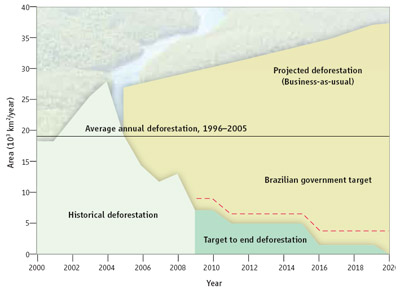
Funds generated under a U.S. cap-and-trade or a broader U.N.-supported scheme to reduce greenhouse gas emissions from deforestation and degradation ("REDD") could play a critical role in bringing deforestation in the Brazilian Amazon to a halt, reports a team writing in the journal Science.

Analyzing Brazil's plan to cut Amazon forest clearing by 70 percent over the next decade and current efforts by major Brazilian beef and soy producers to exclude deforesters from the supply chain, Dan Nepstad of the Woods Hole Research Center and colleagues lay out a scenario under which net forest loss in the Brazilian Amazon could fall to zero by 2020. The external cost of the effort would be $7 to $18 billion, or 13-33 percent of what Americans spend annually on diet foods and beverages.

Roughly half the payments would go towards establishing a forest peoples' fund to pay for "community forest-based economic activities, health, education, and cultural preservation for the region's indigenous, and traditional forest peoples and smallholder farmers."

Ending deforestation in the Brazilian Amazon would reduce global carbon emissions 2-5 percent, safeguard the planet's largest reservoir of terrestrial biodiversity, and ensure the continued provision of critical ecosystem services for Brazil and the world. It would also clearly establish Brazil as the leading player in the environmental services market, a sector expected to be worth hundreds of billions of dollars annually in the next 20 years. Brazil's reduction in emissions from deforestation could alone generate $37 billion to $111 billion between 2013 and 2020 in revenue, some of which could be used to expand the program to end deforestation.

Finally, eliminating Amazon deforestation in Brazil would send a powerful message to other countries, showing that it is indeed possible to protect the environment and benefit economically. 

The boldfaced text is my own emphasis added.  It blows me away that for 13-33% of  what Americans spend annually on diet food and beverages, we can protect the precious ecosystem services and astounding biodiversity of the Amazon.  Better yet, this type of investment in conservation should have tremendous returns for Brazil.  This is because with its abundant rainforest lands, the country stands to become a leading player in the emerging Environmental Services market.

It's almost a land conservation equivalent of investments in energy efficiency and clean energy.  Payments made to successfully protect the Amazon are not a simple costs. They are wise investments that will pay for themselves -- often not only economically, but in terms of human health, security, and other ways that are beneficial to human well-being.

Read more>>
...

Thursday, December 03, 2009

Forest Service Stepping Up Integration of Climate Change, Water Ecosystem Services Into Management Planning

The Forest Service, under it's new Obama Administration leadership, announced that it is radically reshaping its plans to maintain resilience to climate change and to protect water-related ecosystem services.

The NY Times reports:

"Responding to the challenges of climate change in providing water and water-related ecosystem services is one of the most urgent tasks facing us as an agency," (Forest Service Chief, Tim) Tidwell wrote. "History will judge us by how well we respond to these challenges."

He directed regional foresters and station directors to work together to prepare "aggressive and well-coordinated" area-specific action plans for landscape conservation.

"The plans should seize opportunities to integrate activities and be innovative," Tidwell wrote. "They should become blueprints for integrating climate change and watershed management. They should use climate change as a theme under which to integrate and streamline existing national and regional strategies for ecological restoration, fire and fuels, forest health, biomass utilization, and others."

The plans also should address priority landscapes and consider the use of "model" watersheds or landscapes to create showcases for experimentation, collaboration and demonstration, Tidwell said. They should address how the partners work with other agencies and groups and articulate how "science and management will interact to adapt to changing conditions and apply newly created knowledge in the future."

This is is honestly the most exciting and interesting-sounding description of Forest Service plans that I've read in a major media announcement in a long, long time -- perhaps ever.

It is, without question, the first major announcement I've seen that protection of ecosystem services, such as carbon sequestration and water protection, are now national management priorities.  Tidwell's encouragement of innovation reflects the reality that efforts to translate ecosystem services theory into on-the-ground practices are emerging, cutting-edge management paradigms.  They will absolutely require out-of-the-box creative thinking on the part of agency personnel.

The only thing that could get me more excited is an announcement of a national multi-agency ecosystem service protection network that reflects the conservation dreams embodied in The Wildlands Project.  Maybe something akin to the Northern Rockies Ecosystem Protection Act has a chance of becoming reality one day after all...

Read more>>
...