Showing posts with label climate policy. Show all posts

Wednesday, October 26, 2011

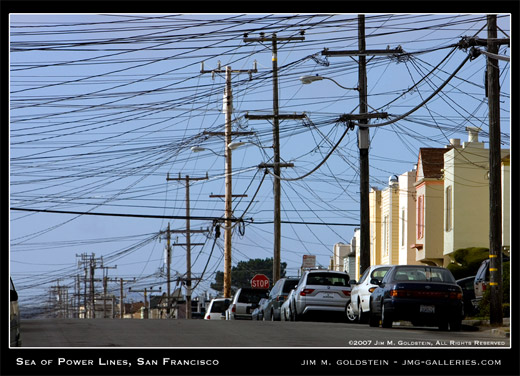
America's Powergrid is an Embarrassingly Inefficient Eyesore


Have you ever walked down the street and gotten just a little bit disgusted by the sheer ugliness of the power grid?  Powerlines dangling everywhere, trees hacked away to make room for dangling wires that inefficiently connect our homes to a power plant that is often tens or even hundreds of miles away.

This is one of many reasons my eyes brighten at the thought of mass deployment of distributed energy -- putting a solar electric and hot water system on every house and building.  As I like to say, "empty roofs = wasted space."

Just think of the tens if not hundreds of millions of acres of empty roof tops out there waiting to be tapped for their energy potential, from homes and apartment buildings, to office buildings, shopping malls and Wal-Marts.

The power grid in America is also so outdated, it makes those tawdry Cadillacs from the '70's look like modern marvels of innovation. As this piece from Green Tech media reports, it is obscenely wasteful compared to what we're seeing from our clean tech competitors (the boldfacing is mine):
China has the world's fastest supercomputer, the fastest high speed trains and is leading the world in building nuclear plants. One of its more remarkable achievements has been modernizing the grid. The country has developed a 1 million AC volt transmission line that loses only 8 percent of its power on a 1,200 mile journey from the power plant in western China to the cities in the east. 
An equivalent U.S. line, with only 760 kilovolts, would lose 80 percent of its power.
That's just embarrassing.

So we destroy ecosystems to mine and smelt megatons of copper to manufacture powerlines that do their job so inefficiently that the majority of fossil fuel used to generate electricity goes to waste.  In effect, we're creating much of our heat-trapping and lung-sickening pollution for nothing, and are wasting untold $$billions in the process.

How might we view this glass as half-FULL?

Where there is waste (in the form of pollution), there is an opportunity to improve efficiencies of resource and energy use, cut costs and straight-up make things better.  It's time to bring America's electricity generation system into the 21st century, not only via a massive deployment of clean energy infrastructure, but with a complete overhaul of our power grid.

Friday, October 07, 2011

Note to Traditional Media: Healthy Environment = Healthy Economy

It seems that almost anytime a traditional media story covers an "environmental" issue, the environmental solution is framed as "VERSUS" the economy.

We hear statements such as, "environmental issues are the last thing the public is thinking about during a difficult economy."  Or "policy solutions for a healthier environment face increasing political resistance in Washington as leaders from both parties focus on ways to create jobs."

It's as if these people are stuck in a 20th Century bubble.

Fortunately, with prominent credible health organizations like the American Lung Association now getting it, the dominant media framing of environmental issues is poised to change. As a recent press release from this esteemed organization stated:
“The Road to Clean Air” is a new report by the American Lung Association in California showing that California could avoid $7.2 billion in health and societal costs and reduce all major air pollution-related health impacts by 70 percent if the state adopts a strong set of new passenger vehicle standards, which are being drafted now. 
That's just in California.

At the national level, a 2009 report by the National Academy of Sciences titled "The Hidden Costs of Energy" estimated that dirty energy costs Americans $120 billion per year in largely health costs alone.  Another study explored effects of air pollution on worker productivity and concluded that:
We find robust evidence that ozone levels well below federal air quality standards have a significant impact on productivity: a 10 ppb decrease in ozone concentrations increases worker productivity by 4.2 percent.
More and more, we are realizing that the solutions to our environmental problems are also solutions to the great economic, health and quality of life challenges of our times.  

...

Wednesday, October 05, 2011

It's Time to Jump Off the Sinking Ship That Is the Fossil Fuel Economy


Could our energy choices moving forward be any clearer?  Fossil fuel prices are climbing.  They are uncertain.  It's really no fun having our transport system stuck on oil.  It's increasingly scary, actually.

In contrast, clean energy technologies like solar are experiencing rapid price declines, as this piece notes:
The truth is that in addition to cutting pollution and reducing our dependence on oil imports, renewable energy has a major advantage over fossil fuels: sharply declining prices over time.  The price of solar energy production, for example, has fallen dramatically as the industry has gained new economies of scale. A recent request for proposals by Southern California Edison (one of the largest investor-owned utilities in the country) found that solar power is already among the cheapest ways for them to generate new electricity. 
America's economy is chained to the sinking ship that is the 20th Century fossil fuel economy.  Do we really want to stay on the sinking ship of dependence on oil and coal?

Or do we want to break free from these shackles and jump on to the rescue ship -- the 21st Century Clean Energy Economy -- that will take us to the destination we all want: the next great era of prosperity..?

Read more>>
...

Monday, October 03, 2011

What we know -- and don't know -- about the safety of eating GMOs

As a conservationist first and foremost, I'm all in favor of agricultural advances that help stem the devastating impacts of farming and ranching on biodiversity and ecosystem services. We badly need to deploy new farming methods and crop strains that enable humanity to produce more food on less land, using much lower inputs of synthetic fertilizers and pesticides.

Importantly, some of the most intriguing approaches I've learned of, such as The Rodale Institute's 30-year farm system trial and The Land Institute's work toward perennial crop varieties, also boost the resilience of our agricultural system to climate change.

When it comes to genetically modified crops, however, my sense as a scientist is that we don't know enough about GMOs' long-term health or environmental impacts to know whether these things are really ready for prime time yet.

This piece by Grist's Tom Philpott sums up a bit of what worries me about GMO's:  
What we do know is that GMOs are not acutely toxic to eat. That is, we know that if you dine on a burger made from cows gorged on GM corn and soy, French fries cooked in oil from GM cottonseed, and soda laced with high-fructose syrup from GM corn, you're not likely to keel over in agony. Tens of millions of people do it every day. 
But what about more subtle, long-term effects -- problems that public-health professionals call "chronic"? Here we enter less certain territory. With our highly processed diets largely deficient in fruits and vegetables, Americans have high and rising rates of chronic diseases like obesity and heart disease. Meanwhile, food allergies, autism, and non-alcohol-related liver disease have rocketed. It's highly plausible that GMOs, which have existed in our diets for less than a generation, have emerged as another of many contributors to such long-term conditions. 
So GMOs could theoretically be unsafe to eat. What does science tell us about the matter? Unfortunately, not much. 

It seems that the body of research in this area lacks depth of credibility due to the intense secrecy of GMO makers. That is, the literature is dominated by findings of agricultural industry-funded scientists, and needs more contributions from independent scientists (who I'm sure would be glad to sign fairly worded non-disclosure agreements or "NDA's").

What is trickling out seems to indicate that there is "smoke" around this issue (and where there's smoke...):  
So where does all of this leave us? Obviously, in need of much more independent research. In April, a bit more trickled out from Quebec, Canada -- and again, the results are unsettling. The study, published in the journal Reproductive Toxicology, focused on corn engineered to possess a trait from the bacteria Bt, which is toxic to a range of insects. So-called Bt corn is extremely common in the United States; according to the USDA, upwards of 60 percent of corn planted here has it. Since its introduction in the '90s, its maker, Monsanto, has insisted that Bt corn must be safe, because the toxin embedded in it cannot survive the human digestive system.   
The Quebec study (here's the abstract) casts serious doubt on that bedrock assumption. Researchers checked blood samples of 39 pregnant women and 30 non-pregnant women for the presence of the toxin. None were exposed directly to Bt, but all had conventional diets. The results: The Bt toxin showed up in 93 percent of pregnant women and 80 percent of their fetuses. It was also present in 69 percent of non-pregnant women in the study.   
So, 15 years after the introduction of GMOs, we know that they pose no threat of immediate, spectacular harm. That is, they won't kill us suddenly. Whether they're killing us slowly -- contributing to long-term, chronic maladies -- remains anyone's guess.

Well that certainly doesn't sound like a crop technology that is ready to be approved for our food supply, does it?  My wife is pregnant with our second daughter, and these kinds of findings indicate to me that our Food Safety regulatory system is dropping the ball in a big way here. Or at the very least is jumping the gun on GMO safety, likely due to intensive political pressures influenced by the Monsanto's of the world.

I hope, for the safety of our children and ourselves, that we aren't looking at a very expensive agricultural, health and environmental catastrophe in the making.

What are your thoughts on GMO safety? What's the best way to grow more food on less land, using lower inputs of synthetic chemicals and fertilizers?

Read more>>
...

Friday, September 30, 2011

Don't Let the Naysayers Get You Down


As you put in the hard work to drive the innovations needed to advance conservation and sustainability, it's inevitable that you'll hear resistance from those who are not comfortable with change -- who like things the way they've always been done.  Let's see how their record looks in this brief historical timeline:
What can be more palpably absurd than the prospect held out of locomotives traveling twice as fast as stagecoaches? - The Quarterly Review, England (March 1825)  
Men might as well project a voyage to the Moon as attempt to employ steam navigation against the stormy North Atlantic Ocean.  - Dr. Dionysus Lardner (1838) Professor of Natural Philosophy and Astronomy, University College, London    
The abolishment of pain in surgery is a chimera. It is absurd to go on seeking it. . . . Knife and pain are two words in surgery that must forever be associated in the consciousness of the patient. - Dr. Alfred Velpeau (1839) French surgeon  
[W]hen the Paris Exhibition closes electric light will close with it and no more be heard of.  - Erasmus Wilson (1878) Professor at Oxford University  
Heavier-than-air flying machines are impossible. - Lord Kelvin, ca. 1895, British mathematician and physicist  
Radio has no future.  - Lord Kelvin, ca. 1897.  
That the automobile has practically reached the limit of its development is suggested by the fact that during the past year no improvements of a radical nature have been introduced.  - Scientific American, Jan. 2, 1909  
I think there is a world market for maybe five computers. - Thomas Watson, chairman of IBM, 1943.  
There is no need for any individual to have a computer in their home. - Ken Olson, 1977, President, Digital Equipment Corp. 
Clearly, even your smartest, most accomplished detractors aren't always right.

If the inventors of the game-changing technologies described above succumbed to their doubters, we'd still be riding horses to work and sailing to Europe!

Think carefully about what this means for where we're headed on clean energy, clean transport and sustainability as a whole.  We ARE going to make this happen.

Remember: as you strive to intelligently and strategically innovate, burning the midnight oil to bring your visions to reality, don't let the naysayers get you down.

Monday, September 26, 2011

'Climate Change' ... and 'Global Warming'? What Next in Climate Communication?


Right now it seems that in Washington D.C., at least, nobody wants to talk about 'climate change' and 'global warming'.

This post from the Yale Form on Climate Change & The Media asks if these are the new dirty words, and "if so...what then"?

Most of those interviewed for this Yale Forum discussion focus on the importance of communicating the economic and health benefits of clean energy technologies. For example, attorney Jim Marston of Environmental Defense states that:
"In the short-term, I think we're focusing more on heath and more on clean energy solutions -- things that get us off fossil fuels, things that get us more efficiency, things that take advantage of the fact that Americans are in love with gadgets coming out of the high-tech sector."
As I relayed in this post -- penned after a successful encounter with a couple of climate change deniers -- energy, economy, national security and patriotism can all be leveraged to offer identity-based arguments that enable bi-partisan consensus.  Why should we send billions of our energy dollars to foreign countries when we can produce our energy from the sun and wind right here in America, and support American companies and jobs?!

As far as I'm concerned, it's not HOW we get to solutions, it's THAT we get to solutions. That's fine, and to be expected.

However, after this spring and summer's record-setting tornados like the one that leveled Joplin, MO, the historic Mississippi River floods, the ongoing hellish Texas wildfires, and catastrophic Hurricane Irene, I'll bet that more people are wondering whether it might be a good idea to take steps to re-stabilize the climate for climate-focused reasons.

It seems more and more people are waking up to the fact that our climate is doing weird (and record-setting) things old timers don't remember it doing, and it's getting more and more dangerous every year.  As more people talk, social forces like peer influence will likely take hold, generating support for the climate change and clean energy solutions that would also be huge boons to our economic recovery and national security.

Let's see...

Read more>>
...

Tuesday, September 13, 2011

New Climate Communication Study: Polar Bears Don't Work

How can we get past America's uber-partisan divide on climate change  to foster political support for bold policy solutions?

According to a new study, images of distant polar bears and melting ice sheets not only don't cut it, messaging-wise, but actually make the problem worse. As reported by Big Think:
Climate change campaigns in the United States that focus on the risks to people in foreign countries or even other regions of the U.S. are likely to inadvertently increase polarization among Americans rather than build consensus and support for policy action.
Fortunately, the researchers found a way to build support for climate policy solutions: to use local stories that make the benefits of action immediately relevant to the community:
Research shows that individuals are more likely to support action on a problem when those threatened or at risk are perceived as more socially similar.  Conversely, when those affected are perceived as more socially distant, support for action is likely to be less.
That certainly makes sense...

Memo to those working to more effectively communicate the need for climate change solutions: use locally relevant pictures and stories.  Enough with the remote images already (in themselves, at least). How does the problem (including as illustrated by stunning remote imagery) really impact the lives of, say, Wal-Mart shoppers? How are the solutions going to protect local communities and improve lives where I live?

These types of messaging improvements are opportunities that Seth Godin talked about back in 2006, but that the climate action community still hasn't fully figured out how to implement.

This new study provides important clues on how to get the important job done of maximizing influence across the political spectrum.

Read more>>
...


Sunday, September 11, 2011

Imagining a Different Response to 9/11


"For every thousand hacking at the leaves of evil, 
there is one striking at the root."
- Henry David Thoreau

Imagine the president had invested all of our post-9/11 war money ($trillions) into a bold transition to clean energy and transport.  The goal would have been to strike at the root of the terrorism problem, while also strengthening America's economic and national security, revolutionizing our aging infrastructure, and creating millions of 21st century jobs.

How different do you think our economy, jobs crisis, deficit and national morale would be right now?

Not to mention our progress -- domestically and globally -- toward solving Americans' growing concern that our climate is doing weird and increasingly dangerous things...

So then, what do you think we should do NOW to strike at the root of the terrorism problem..?
...

Friday, September 09, 2011

Our Economy Depends on Our Ecology


Following yesterday's post, it make sense that a healthier environment not only means healthier people, but also a healthier economy and society.

Ecosystem Marketplace's Steve Zwick sums it up well in this piece:

Neither party really gets it right, because they both -- at best -- see environmental protection as something we should do -- like a bit of housekeeping, akin to trimming the bushes -- as opposed to something we must do -- like shoring up the foundation, which is what it is.
Both parties, in short, seem oblivious to the fact that our economy depends on our ecology, and that everything we buy, sell, eat, and produce is derived from nature. If we destroy nature, we destroy our own livelihoods -- as people living along the Mississippi River and its tributaries learned all too clearly this past Spring, when decades of poor wetland management exacerbated flooding and cost us billions.

This idea was similarly expressed by a 2009 National Academy of Sciences report, The Hidden Costs of Energy: dirty energy (e.g., especially that produced by burning oil and coal) inflicts a devastating $120 billion in "primarily health damages" alone on our economy.

If we want to reduce our skyrocketing health care and health insurance costs, a good place for America to start is by investing in a clean energy revolution.

Read more>>
...

Wednesday, September 07, 2011

Carbon Nation: The Surprising (and Common Sense) Benefits of Cutting Heat Trapping Carbon Pollution


Would well-designed legislation to stabilize our increasingly weird climate and free America from our dangerous oil dependence really wreck the economy, as media pundits and GOP policy positions warn?

Fortunately, as America seeks ways to create millions of jobs and revitalize our national morale and qualify of life, the answer is a resounding "no!"  The story of why is told in the new documentary, "Carbon Nation", according to GreenBiz.

The movie's directors paint a wonderfully positive and non-partisan picture of the promise offered by 21st century technologies and practices that are already helping companies thrive.  They tell the story of how:
"We learned that Dow Chemical had spent just under $2 billion on energy-efficient programs since 1994 and had saved nearly $10 billion so far."
In another story, based in Texas, farmers banded together to form a cooperative that allowed them to establish new income streams via wind energy:
Now, farmers who were solely dependent on their hit-or-miss cotton crops had a steady source of income, derived from the turbines: a royalty that ranged from $3,000 to $15,000 per year, per turbine. This changed lives.
Who wouldn't be happy with this kind of financial boost? On top of the money, of course, these good Americans get bragging rights: they're helping lead America's way off of our dependence on dirty energy like oil and coal.  I'm sure their friends are proud of them!

This is the kind of morale boost America reads right now - and a majority of Americans are ready.  As Carbon Nation's director states:
We know, from hundreds of conversations across the nation, that we are not a polarized country. Especially when it comes to energy efficiency, national and energy security, and even clean energy. There is great agreement for healthy solutions in the middle. It’s just that we’re constantly being told we’re a polarized country, mainly because our political leaders are polarized and TV networks make more money selling the idea of a polarized country. And good people are believing this stuff, and acting as if we are polarized. The old self-fulfilling prophecy.
But when you get down to it, listen to people, respect their opinion, and be open-minded, you will find, as I have, that the middle 60% of the U.S. would be on board if they were hearing the right stories. We’ve been lucky enough to find the right stories while making “Carbon Nation.” The folks in our film are heroes. If enough people hear from them, see them in action, then we can achieve our biggest aspirations: to have this movie influence lawmaking, to inspire companies to tie life-cycle costs to all purchases, and to push clean energy so that it simply becomes cheaper than coal. That would be huge.

Cheers to the folks who have brought us Carbon Nation -- the more folks hear these types of stories, the more the movement to revitalize our economy via a job-creating clean energy revolution will gain momentum.

Read more>>
...


Tuesday, September 06, 2011

Ceres: Fuel Efficiency Standards Benefit the Economy

"Our report makes clear that the stronger the (fuel efficiency) standards, the greater the economic benefits." - CERES

As I emphasize time and again, the less money people and businesses have to spend on gasoline because their cars are more efficient, the more money they have to spend on everything else.  That's broad economic stimulus.

Monday, June 07, 2010

If Global CO2 Emissions Were Black Smoke Coming From a Giant Broken Pipe in Texas

Watching the video of the BP oil gusher bleeding into the Gulf of Mexico, I got thinking about how this imagery (and all the heart-wrenching photos of oiled wildlife) makes the problem so real and easy to comprehend.  We get it, and it makes us sick.

One of the widely-discussed problems with the public's acceptance of the science underlying global weirding is that the heat-trapping gases that are disrupting the climate are invisible.  Plus, these heat-trapping pollutants come from so many different places -- cars, trucks, buses, inefficient homes and buildings, industrial processes, deforestation, landfills, you name it -- that their flow into the atmosphere and their impact on the earth's climate and people is hard to "see".

Which leads me to a question: if all the Earth's heat-trapping pollution was colored black and came from a giant broken pipe in the middle of, say, Dallas, (1) how big in diameter would the pipe have to be, and (2) how long would it take for the plume of black smoke to spread from Dallas to other major metropolitan areas around the world?

If somebody with graphic design skills could put together this kind of computerized imagery, it would be powerful stuff...
...

Monday, May 17, 2010

After the Three Mile Island of the Oil Industry, Time for a Solid Plan for Freedom From Oil

As I continue to watch BP and Halliburton's Gulf of Mexico oil disaster unfold, I am doing my best to focus constructively on the question of "What next?"

What I keep coming back to is the feeling that, as people like Jerome Ringo are saying, this catastrophe absolutely must serve as a catalyst that helps accelerate our transition to clean energy.  Coming from the Gulf Coast, himself, Ringo writes eloquently of the lesson before us, which can become a silver lining to the darkening cloud of oil spreading across the Gulf:

Now, as more than 200,000 gallons of crude oil pour into the Gulf of Mexico each day, I see the jobs that will be lost, the families and communities that will suffer and the impending devastation of our $2 billion seafood industry.
Think about the fishermen, the truck drivers, the restaurant owners and so many others who depend on this industry. Think also about the fish, birds, sea turtles and other marine life whose ecosystem has just been turned on its head.
There is a better way: clean energy.
While many countries have already embraced clean energy and adopted national policies to increase energy efficiency and the use of renewables, the United States continues to suffer from a reactive, outdated energy strategy. It’s been nearly a year since the U.S. House of Representatives passed its energy and climate bill (the American Clean Energy and Security Act), but the Senate has yet to begin serious debate on its own legislation.
Our policymakers are fiddling while Rome burns – or rather, while oil rigs burn and pollute our oceans and coasts.
Not only is America’s refusal to embrace clean energy endangering human health and wildlife, it is also costing us jobs, which are precious commodities in this time of economic hardship. Several energy companies, including GE and BP Solar, recently announced plans to invest millions of dollars to develop and expand clean energy facilities – not in the United States, where such investments and the jobs they bring are desperately needed – but in Europe and China. We need incentives for green energy jobs here at home.
Now is the time for the Senate to act. With photos of the oil spill on the front pages of newspapers across the country, Americans are starting to grasp the dangers of our country’s dependence on oil and other dirty sources of energy, and this awareness is being transformed into support for a new energy direction for our country.
While our unfortunate energy reality right now is that we need to continue to drill for oil, including to power our transition to renewable energy, we need to do so in a manner guided by a bold, long-term plan to achieve freedom from oil.

Between the high costs of our oil dependence (which we are reminded of daily by updates on the underwater oil volcano that BP and Halliburton have created) and the looming threat of Peak Oil, we must get a move on before we are forced to get a move on.

We have a choice.

Perhaps, it's the most urgent choice that humanity has ever faced, as the transport and food supplies of billions hang in the balance if we don't start acting with focused, inspired urgency to transition to clean energy and vehicles.

Climate Progress offered a good update on the Peak Oil situation this past weekend:
A storm is quickly approaching, and the world is not ready for it.

The permanent end of the era of cheap oil is coming as soon as next year, according to a raft of official reports that have made their way into energy media over the last few months.  Governments are now beginning to acknowledge the looming crisis. Yet, perhaps because they waited too long to prevent it, leaders are not yet alerting the public.

The entire world economy is built on cheap oil,  A permanent oil production shortage will thus lead to The End of The World (As We Know It).  What will come on the other side of this — will it be good or bad?

Public Unaware. Except for a few stories in financial pages such as London’s Financial Times, this earth-shaking news has yet to reach the Mainstream Media.  While “Peak Oil” researchers have long warned of approaching oil shortages, the difference now is these dire warnings are being validated by the highest government and oil company officials.  Yet, no political leader has had the courage to make a major announcement to prepare the public for what lies ahead.

This public blindness is tantamount to the isolationism that gripped the U.S. in the years preceding WWII.  While the highest government leaders did their best to prepare for inevitable war, they were hamstrung by the resistance of a public unable to accept what really lay ahead.  Similar to today, some politicians advanced their own careers by feeding on the public’s desire to believe no coming storm could ever reach them.  Yet, the storm came anyway.

The Limits of Oil. The looming crisis we now face is often referred to as “Peak Oil” — a status where global oil production will reach a plateau, then begin its irreversible decline.

We Can Do It. Though Americans resisted the recognition that WWII was coming, once it came they rose valiantly to the call to action. A similar can-do spirit is needed now for the transition to a post-oil world.

This crisis is coming soon.  It is too late to prevent it, so we simply need to get used to it.  Peak Oil is happening.

We will need to adapt – but we can do that.
The good news, which I emphasize on this blog time and again, is that the solutions to Peak Oil and climate change overlap in many ways, and both overlap with the solutions to our economic crisis, jobs crisis, and crisis of skyrocketing health care costs.

It is time for us to rise up as citizens and inspire Congress and the President to take bold action by passing an American Power Act that incorporates the lessons we are learning each and every day as we watch this Gulf of Mexico oil disaster unfold.  Click here for a fun way to write to your Senators, President Obama, and even your local newspaper.

Read more>>
...

Thursday, April 29, 2010

Gulf of Mexico Oil Spill Catastrophe: This Doesn't Happen With Clean Energy


As I've watched the Gulf of Mexico oil spill unfold over the last few days, a few thought have come to mind.

First, a note to God-fearing opponents of the bold climate change and clean energy legislation that will also help us deal with the looming Peak Oil crisis: watching the recent deadly coal mine disaster, quickly followed by this catastrophically costly, headline-grabbing (likely for weeks to come) offshore oil drilling disaster, does it seem kinda like The Lord is pissed about our dirty energy use?

It hasn't been a very good month for those raping Mother Earth for the dirty energy sources that are destabilizing the global climate system, threatening humanity's food and water supplies.

Second, how ironic that this oil spill catastrophe is going to hit the hardest economically in the deep southern U.S., the heart of political support for "Drill Baby Drill!"

The good news, especially given that the Senate is about to start debate on Climate Change and Clean Energy legislation: this type of disaster just doesn't happen with solar or wind power.

Sure, it's going to take a LOT of work and energy (and even fossil fuel use) to transition to clean energy.  But we CAN have energy without these deadly, catastrophically costly, economically destabilizing and toxic risks posed by fossil fuels.

Best of all, the building, installation, sales, administration, transport, you name it of all this clean energy infrastructure is going to create the millions of new jobs our economy badly needs.  They are good jobs that will make people proud -- coming with the badge of honor that they have joined the clean energy revolution that is freeing America from our addiction to dirty oil and other fossil fuels.

Now it's up to Congress to make it happen and unleash the tsunami of clean energy technology investment that's been waiting on the sidelines for the rules of the game to be established.

Let's play ball, and play to win.
...

Monday, April 19, 2010

Google Climate Chief: Price on Carbon Will Be Economic Bright Spot

In about a week, the new Senate climate change and clean energy bill is apparently going to be released by Senators Graham, Kerry and Lieberman.  You can be as certain as the sun's rise and set that we'll immediately hear a chorus of such blather as "it's going to wreck the economy" and "we can't pass an environmental bill like this during an economic downturn -- it will cost too much."

Nonsense, says Google's climate change and clean energy chief, Dan Reicher, in this Grist article:
Google is thinking about the big global picture. Reicher told me that, "in general terms, a carbon price will do a lot to advance the competitiveness of these technologies that offer serious climate reductions, help for our energy security, increase our domestic fuels, and can create all sorts of jobs."

But the search-engine-plus is also thinking about its own bottom line. It's already got products on the market that help consumers save electricity.

As Reicher puts it, "putting a serious price of carbon will both get us closer to the serious energy reductions we need to make, but also accelerate the domestic development and adoption of these technologies." It's that last part that's good for business. When government holds up its side of the "triangle of technology, policy, and finance" that Reicher says is essential for green development, it spurs the private investment and innovation that keeps businesses strong.

That's where Congress comes in. The most important policy is carbon pricing. That's what will change the economic fundamentals, augmented by other programs -- like energy efficiency standards and government revolving loans to bring new ideas  to the market. The technology and finance sides are ready and able; but we've been waiting for too long for the policy piece that can complete the puzzle.

Google hopes the Senate will act quickly to jumpstart what it thinks will be an economic bright spot in the current downturn.
Again, if you're against the Senate's climate change and clean energy bill, what are you for?  More drilling and continued dependence on oil?  Good luck with that one -- talk to me in 2-3 years when gas is $5-10/gallon, and I drive by you smiling in my plug-in hybrid or electric vehicle, which I've charged via my home solar system.  I see what's coming in our energy future and I'm preparing.  It will, of course, get cheaper and easier to prepare with the right incentives in place, such as the ones that will be in this bill.

The bill's supporters in the Senate are going to have to step up, though, and make a strong case about why passing it is going to make our lives and businesses better, and benefit our environment, economy, health, security and quality of life alike.  Let's hope they've learned how to do it by now...

Read more>>
...

Tuesday, March 23, 2010

Climate Change and Clean Energy Next? (Or Wait Until It Gets Really Hot?)

Now that a Historic, yet still inadequate Health Insurance Reform bill has passed Congress (incomplete because premium cost controls still need to be strengthened, as Senator Feinstein is trying to do, and as competition from a fairly-priced Public Plan would do), people are starting to talk about passing climate change and clean energy legislation.

David Roberts penned a good one here.

I personally think that the Senate should strategically wait until the weather gets a bit warmer, and the painful Memorial Day weekend gas price spike is felt across America, before taking up the legislation.  It's silly, but it's smart. People are more likely to support the legislation if they're sweating and gas prices are rising, which they will be in June and July.

I also like Joe Romm's new piece a lot, especially the parts about messaging -- on both health care and climate/energy.  Says Romm:
No serious messaging strategy can possibly be built around the phrase “healthcare reform.”  Why?  First, “reform” is a process, not an outcome.  No one serious about moving public opinion talks about process over and over again.  They talk about the benefits that reform brings, outcomes the public cares about.  Second, most of the public likes their healthcare, so the phrase “healthcare reform” is not intrinsically positive and, in fact, is probably negative for much of the public given the more effective conservative messaging.
If you spend half your scarce messaging time talking about “healthcare reform,” while your opponent spends all of their time messaging on negative outcomes that the public worries about, you are fighting with one hand tied behind your back.
Here's a quiz:
1)  What’s worse from a messaging perspective, “the public option” or “cap-and-trade”?  Hint:  Both are process.
2)  Tell me in one sentence what team Obama says is the benefit of passing a health care reform bill.
3)  Tell me in one sentence what team Obama says happens if we fail to pass the climate and clean energy bill.
On health care, no simple, repeated core message exists, so the whole effort is a muddle.
Like the 99% of people who aren’t expert on health care reform, only very recently — 12 months too late — have I begun to develop a clear idea of what this plan is or what it would actually do.  The problem is, many if not most people could probably care less about the uninsured — they just don’t want to join that group — and while people may say they want cost containment, in fact they don’t want their own costs “contained,” they only want their premiums lower.  They do want security about their healthcare.
Again, the single phrase that the Democrats repeat most often is “healthcare reform” whereas the single phrase that Republicans repeat most often is “government takeover.”  Is it any surprise the polling on this bill is so bad?
That's certainly a thought-provoking analysis.  Romm thinks Health Care Security would have been a much better frame for messaging, and I agree.  Here's what he proposes:
A vote for this bill is a vote for healthcare security.  You get to keep your healthcare coverage if you like what you have — and they can’t throw you off of it if you get some expensive disease or get fired.  And you get access to health care coverage if you don’t have it, and they can’t keep it away from you if you have a pre-existing condition.  And this bill keeps whatever healthcare you have or get affordable, so you don’t have to compromise your health to pay for other necessities.
Fortunately, we're doing better on climate change and clean energy, and there's far more bi-partisan support for passage of a strong bill, even if it tends to be for different reasons for Democrats (environmental, health reasons, green jobs) than for Republicans (economic, security reasons).

But we're going to have to leverage the types of lessons Romm emphasizes above to convey to Americans why our lives will be much better once Congress passes this legislation and President Obama signs it.

With Peak Oil also looming bigger and bigger (second link) right around the corner in 2014, you don't even need to think about climate change to realize that if we're to have a robust economic recovery that is also resilient, we've got to get our asses in gear on weaning America off of our dangerous dependence on oil.

It's a wonderful thing when environmental, economic, energy, security and health care solutions of this magnitude are all linked.  Now let's emphasize these linkages and pass bold climate change and clean energy legislation.  It will help unleash the Glacial Lake Missoula-level flood of pubic and private investment needed to transition America to a more secure, robust, and stable clean energy-powered economy.
...
Tuesday, March 09, 2010

A Green Jobs Revolution


Here's a fun read from Josh Marshall's Talking Points Memo:
Rep. Ed Markey (D-MA) and former FCC Chairman Reed Hundt explain why retooling our carbon-based energy sector for clean growth can spur the kind of investment and job growth that we saw in the telecom industry after the market opening of the early 1990s.
Congressman Markey and FCC Chairman Hundt compare the benefits we can achieve now from passing bold climate change and clean energy legislation to the benefits America reaped from passing 1990's legislation that lead to revolutions in telecom products and services:
In the ten years that followed the spectrum auctions that created competition in digital cellular and the regulatory framework that opened Internet access to competition and the telephone network to innovation - 1997 to 2007 - investors, according to McKinsey and Company, poured more than $850 billion in new capital into mobile, data, and expanded cable networks in the United States.

This investment drove job creation beyond any economist's prediction. Unemployment fell to 4 percent by the end of 1990s, and nearly 65 percent of the population was employed. That's a remarkable contrast to the numbers today: 9.7 percent of Americans are unemployed and only 58 percent of people are employed. The job growth led to national income growth and increased tax revenue, so that the federal budget, contrary to every estimate at the beginning of the 90s, was balanced by 1998.

We can get the same upside surprises if we pass a law that retools the carbon-based energy sector of the last century and encourages private investment in a 21st century energy economy built on alternatives such as wind, sun, biomass and geothermal. That's the purpose of the Waxman-Markey bill, which passed the House of Representatives last June.

Reform in communications stimulated creative destruction. For example, the old long distance industry charged ten cents a minute for a call when we passed the Telecommunications Act. Now people are not even aware that there used to be a long distance charge when they use their phones to call anywhere.

The replacement of the old networks with the new led to waves of innovation. Our reforms permitted everyone to unplug the phone line from the back of the telephone and stick it into the back of the computer. That connection was the first pathway to the World Wide Web - in large part because we did not permit the telephone company to charge extra money for all that extra and unpredicted use. The new demand for data connections drove telephone companies to buy routers and switches, to build data centers, and to upgrade lines. Cable companies were driven to respond by switching some of their capacity from one-way video programs to high speed two-way internet access, giving rise to broadband. In response, the phone companies are now installing fiber, taking broadband to new levels of speed and lower price per bit.

Similarly, in the energy sector we need to retool the existing generation and distribution networks with cleaner forms of generation, open markets to innovators who will build power lines that lose fewer electrons and connect new sources of clean power to users, and reward investors for installing more efficient ways of using electricity. Creating the right framework for our communications networks led investors to commit about $850 billion to rebuild those networks. With the right set of policies, it is reasonable expect a similar explosion of private sector investment in the energy sector. This will result in consumers paying less for heating, cooling and lighting, and America's energy sector will be firmly based on abundant, cheap and clean fuels. Nothing will pull innovation into the energy sector more than wind farms demanding better storage technology, solar farms demanding better ways of capturing and converting sunlight into electricity, and appliances and electric vehicles that can talk to the grid if it is smart enough.

There are other areas of the economy where Americans can and should find new jobs. In the energy sector we not only will need millions of employees, but we also know that those millions will help us achieve independence from foreign oil and an end to the pollution of the environment from carbon emissions. The trifecta of huge employment, national security, and protection of the environment is a winning ticket for America. We have found that winning formula before in hard times that proved to be the dawn of economic growth; we can turn the dark days of the present into sunny optimism about our future once again.
Superb piece -- they've clearly got their messaging down on the importance of passing bold climate change and clean energy legislation.  Note to the Senate: let's make it happen, already!

Kudos for TMP for bringing us this kind of high quality content, which is worthy of the op-ed pages of the world's finest newspapers.

Read more>>
...

Is the Push for New Nuclear Power Plants a Gigantic Waste of Time and Money?

I'm anything but convinced that new nuclear power plants are a practical, cost-effective and safe solution to our climate disruption and Peak Oil problems.  This article, titled "No New Version of Nuclear Power", provides some up-to-date information, including links to recent reports, about why this is my current take on Nuclear Power.

Amory Lovins writes: "Every new reactor in history has been costlier, slower, and harder than projected." He continues: "IFRs (integrated fast reactors) might in principle offer some safety advantages over today's light-water reactors, but create different safety concerns, including the sodium coolant's chemical reactivity (sodium catches fire if exposed to airand explodes if exposed to water) and radioactivity."

Also from the report:

“2009 was the seventh year of the so-called “Nuclear Renaissance,” but it looks a lot like the US nuclear industry of the 1980s, a decade of no new orders, multiple delays and cancellations, hefty defaults, and emerging cheaper alternatives.” (Mark Cooper, Institute for Energy and the Environment, December 2009)

Right now, we really need to be investing our time and funding into low-carbon energy solutions that are cost-effective and can be deployed relatively quickly (like starting now, and up and running starting within the next 5 years).  I'd love for nuclear to work as an addition to our energy mix that really helps our transition off of the 20th Century sinking ship that is fossil fuels -- I really would.  Show me the numbers, the new plants that are being built quickly and cost effectively.  You can't!

Thus, this article certainly doesn't do anything to convince me that we should be investing billions of precious taxpayer dollars in nuclear right now, as President Obama seems to be approving of to achieve "bipartisan" support of climate change and clean energy legislation in the Senate. 

At a time when we need to get as many kWh of low-carbon energy sources in place as soon as possible, it's painful to watch as "bipartisanship" takes priority over "likelihood of success".  I don't give a whale's armpit if policy solutions are Democratic, Republican, bipartisan, or friggin Martian.  I just want them to successfully achieve our climate change and clean energy transition goals.

It boggles the mind how plumb dumb the politics of our transition to clean energy can be sometimes.

Read more>>
...

Monday, March 08, 2010

Pacific Northwest Forests Act As Massive Carbon Storage Banks


A new report by The Wilderness Society identifies 10 Pacific Northwest National Forests as the most prolific for storing carbon in our national forest system.

These forests are my favorite in the U.S. -- unbelievably vibrant, and remaining old growth stands are magically cathedralesque...

Read more>>
...

Sunday, March 07, 2010

Myths and Realities of Cap and Trade


For those of you who'd like to read a quick primer about the Myths and Realities of Cap and Trade, here's a nice simple one.

It's a good response to the confusion out there -- even among those in Congress -- about climate policy.

Enjoy...
...