Showing posts with label security. Show all posts

Sunday, September 11, 2011

Imagining a Different Response to 9/11


"For every thousand hacking at the leaves of evil, 
there is one striking at the root."
- Henry David Thoreau

Imagine the president had invested all of our post-9/11 war money ($trillions) into a bold transition to clean energy and transport.  The goal would have been to strike at the root of the terrorism problem, while also strengthening America's economic and national security, revolutionizing our aging infrastructure, and creating millions of 21st century jobs.

How different do you think our economy, jobs crisis, deficit and national morale would be right now?

Not to mention our progress -- domestically and globally -- toward solving Americans' growing concern that our climate is doing weird and increasingly dangerous things...

So then, what do you think we should do NOW to strike at the root of the terrorism problem..?
...

Monday, April 12, 2010

U.S. Military Warns Oil Output May Dip, Causing Massive Shortages By 2015


We officially now have the U.S. Military issuing dire warnings about the imminent dangers of Peak Oil, reports The Guardian (where oh where are U.S. newspapers on this critical economic and national security issue?!)
The US military has warned that surplus oil production capacity could disappear within two years and there could be serious shortages by 2015 with a significant economic and political impact.
"By 2012, surplus oil production capacity could entirely disappear, and as early as 2015, the shortfall in output could reach nearly 10 million barrels per day," says the report, which has a foreword by a senior commander, General James N Mattis.
It adds: "While it is difficult to predict precisely what economic, political, and strategic effects such a shortfall might produce, it surely would reduce the prospects for growth in both the developing and developed worlds. Such an economic slowdown would exacerbate other unresolved tensions, push fragile and failing states further down the path toward collapse, and perhaps have serious economic impact on both China and India."
The US military says its views cannot be taken as US government policy but admits they are meant to provide the Joint Forces with "an intellectual foundation upon which we will construct the concept to guide out future force developments."
This report adds a whole new angle of urgency to the need for the U.S. Senate to pass bold climate change and clean energy legislation, and for The House to support a far bolder bill than the one it passed last summer.  Whether you accept the facts on climate change or not, America needs to get our butts in gear in weaning ourselves from oil, or we'll be forced to do it the hard (and very painful and scary) way...

The good news -- the solutions to the Peak Oil crisis are also the solutions to our economic, jobs, energy, and climate crises all packaged into one.  Let's do this, people -- let me know how I can be of assistance.

Read more>>
...

Friday, February 05, 2010

Pentagon: Climate Change, Energy Security and Economic Stability Are Inextricably Linked

The military and intelligence communities are getting serious about climate change -- preparing for the problem and advancing the solutions. 

The QDR notes that climate change affects the Department of Defense “in two broad ways:” first, global warming impacts and disasters will “act as an accelerant of instability or conflict,” and second, military installations and forces around the globe will have to adapt to rising seas, increased extreme weather, and other effects of global warming:

Assessments conducted by the intelligence community indicate that climate change could have significant geopolitical impacts around the world, contributing to poverty, environmental degradation, and the further weakening of fragile governments. Climate change will contribute to food and water scarcity, will increase the spread of disease, and may spur or exacerbate mass migration. While climate change alone does not cause conflict, it may act as an accelerant of instability or conflict, placing a burden to respond on civilian institutions and militaries around the world.

The military is working on not just responding to the impacts of global warming, but also mitigating the threat by reducing global warming emissions. Increased use of renewable energy and energy efficiency not only lessens the military’s enormous carbon footprint, but also delivers immediate security benefits:

Energy efficiency can serve as a force multiplier, because it increases the range and endurance of forces in the field and can reduce the number of combat forces diverted to protect energy supply lines, which are vulnerable to both asymmetric and conventional attacks and disruptions.

It's very very good news to see the military and intelligence communities getting behind efforts to deal with climate change and advance green economy solutions.  There's a ton of power there, and this should really help move things forward.  As well as provide the types of evidence that denialists need to see to realize that we've got a very real problem to solve here...

That said, it also makes the opponents of climate change and clean energy solutions look that much more like Ostriches -- with small brains and their heads in the ground. 

Read more>>
...

Saturday, December 12, 2009

No Climate Change Action, No Peace, Says Obama in Nobel Speech


In his speech accepting the Nobel Peace Prize, President Obama touted the importance of climate change solutions to the cause of peace.  As Grist reports:

It is undoubtedly true that development rarely takes root without security; it is also true that security does not exist where human beings do not have access to enough food, or clean water, or the medicine they need to survive. It does not exist where children cannot aspire to a decent education or a job that supports a family. The absence of hope can rot a society from within.

And that is why helping farmers feed their own people – or nations educate their children and care for the sick – is not mere charity. It is also why the world must come together to confront climate change. There is little scientific dispute that if we do nothing, we will face more drought, famine and mass displacement that will fuel more conflict for decades. For this reason, it is not merely scientists and activists who call for swift and forceful action – it is military leaders in my country and others who understand that our common security hangs in the balance. (Text as prepared for delivery)


Cheers to that statement on this Saturday evening!  On that note, time to pour a glass of wine.  Enjoy the rest of your weekends, and get outside into nature if you can!

I'll be heading out for a hike with Qanuk the collie tomorrow afternoon -- I can't wait to see the waterfalls of Mt. Tam raging after this fresh rain...

Read more>>
...


Sunday, November 29, 2009

The First Climate Change Conflicts: Fighting Over Water As Kenyan Rains Tail Off

Climate change -- in combination with political and resource management-related factors -- is causing serious water shortage-related conflicts in Kenya.

The Guardian reports:

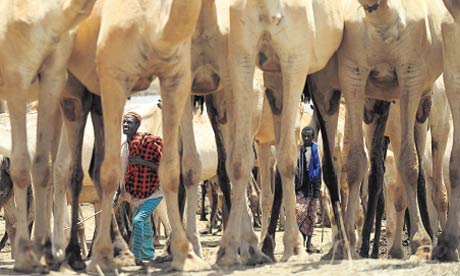
Three years of failed rains have left nearly 4 million Kenyans dependent on food aid. Thousands of animals have died and malnutrition rates are climbing in a drought that has hit pastoralists the hardest. In many areas they're trekking an extra 20 miles in search of water and pasture, their fate determined by careful negotiations with local leaders such as Abdi. His fear of fighting is not unfounded. According to the UN Office for the Co-ordination of Humanitarian Affairs (Ocha), since January this year 306 pastoralists have died from conflicts over scarce resources.
"What we're observing are some of the world's first climate-change conflicts," says Jeanine Cooper, head of Ocha Kenya, in Nairobi. "Tribes have fought over water points before now," she says, "but climate change has increased the frequency and duration of drought, exacerbating the competition over scarce resources."

Forty miles away in the town of Moyale, Molu Dika, drought management officer for the government's Arid Lands programme, agrees that the "future is not bright for pastoralists". He is well informed about climate change. "We used to have drought in cycles of 10 years; now every other year there is depressed rainfall," he says.

As the government struggles to provide the most basic infrastructure the task of adapting to climate change has been left to the NGOs. Leading the way in Moyale is Farm-Africa - its strategy of creating alternative livelihoods has already helped 5,000 households find new ways of generating an income - from haymaking co-operatives to new business ventures in camel meat.
Project co-ordinator Boru Dulacha says that traditional ways of adapting to drought - building water points or managing grazing patterns - are no longer enough. "We want to help pastoralists maintain their traditional way of life, but without them being dependent on livestock to survive," he says.

The changing weather patterns and accompanying conflicts and adaptations seen in Kenya are a microcosm of what's happening in other countries across the world. As leaders prepare for the climate- change conference in Copenhagen, in December, Sir David King, director of the Smith School of Enterprise and the Environment at Oxford University, says: "How we help developing countries adapt to climate change now is critically important - as by the middle of this century there is likely to be an increase in conflict related to resource scarcity."


But climate change alone isn't responsible for these issues, emphasize some experts.  Rather, poor land use practices and repressive policies contribute to the impacts of climate changes:

But how far is climate change responsible for the tensions already escalating in regions such as north Kenya? Idean Salehyan, assistant professor of political science at the University of North Texas, says: "The causes of violence are rarely as simple as resource scarcity." Instead, he thinks conflicts are over how resources are managed and are therefore a political problem as much as an environmental one. "Deliberate policies to reward political supporters and undermine opponents can play an important role in determining the distribution of these resources," says Salehyan. "Countries that are accountable to the needs of their people can withstand environmental disasters better than those with undemocratic governments."

Today, we've journeyed from the Arctic to the Caribbean to Africa learning about impacts of climate change affecting peoples' lives and well being NOW.

Wither the mainstream news networks doing their part to help raise public awareness about these issues?  Too often, the storyline remains that climate change is some distant environmental issue irrelevant to our well being.  As these stories demonstrate, the impacts of climate change are very much here.

Read the full story>>

More from the BBC>>
...

Tuesday, November 17, 2009

National Security and the Threat of Climate Change

A new report details the threats to our national security posed by climate change -- threats that can be avoided by passing bold climate change and clean energy solutions legislation:

Global climate change presents a serious national security threat which could impact Americans at home, impact United States military operations and heighten global tensions, according to a new study released by a blue-ribbon panel of retired admirals and generals from all branches of the armed services.

The study, “National Security and the Threat of Climate Change,” explores ways projected climate change is a threat multiplier in already fragile regions, exacerbating conditions that lead to failed states — the breeding grounds for extremism and terrorism.

The CNA Corporation brought together eleven retired three-star and four-star admirals and generals to provide advice, expertise and perspective on the impact of climate change.

The report includes several formal findings:
  • Projected climate change poses a serious threat to America's national security.
  • Climate change acts as a threat multiplier for instability in some of the most volatile regions of the world.
  • Projected climate change will add to tensions even in stable regions of the world.
  • Climate change, national security and energy dependence are a related set of global challenges.
The report also made several specific recommendations...

If only our political system wasn't so strictly partisan -- and people would actually vote on the what's best for their constituents, and Harry Reid would do to the Republicans what they'd had done if Democrats had so abused the filibuster when in the minority -- maybe we could get a solution out of Congress.

Which Senatorial leaders or fence-sitters are ready to be bold here..?

Read more>>
...

Wednesday, August 02, 2006

Sustainability for Security's Sake

Among the most important benefits of society's current push toward sustainability is security.

It is now quite apparent that society's dependence on fossil fuels for energy supplies is threatening not just the environment, but also to plunge the world into deadly energy wars.

Already the U.S. has spent hundreds of billions of Americans' hard-earned tax dollars to (who's kidding who) position itself to defend oil reserves in the Middle East. Even a couple of years ago, people were already starting to realize that if the U.S. had invested the money it's spent on the Iraq War into clean, efficient renewable energy and energy conservation technologies and infrastructure, we could have set ourselves on the road to energy independence (and greatly enhanced our security, as well as the health of our environment and the stability of our economy!). Woops.

Now ENN has posted an intriguing article titled, "Where Are the World's Looming Water Conflicts?" The importance of this predictive article cannot be understated, especially given that 2002 predictions of a water war between Israel and Lebanon have now born themselves out.

The ENN article provides yet another reminder that whether through new techologies that conserve water (and save money!), or through improved land management practices that protect, purify, and store drinking and agricultural water supplies (i.e., management practices that protect the ecosystem service of water purification), sustainability is about much more than protecting the health of the environment.

It is about protecting and improving our security, the safety of our children and families, the stability of our economy, the public's health, and our overall quality of life.