Showing posts with label payments for ecosystem services. Show all posts

Wednesday, September 21, 2011

Businesses Getting into the Ecosystem Services Game


Following up on yesterday's post about Asia's lessons on the value of ecosystems, how are businesses getting involved in protecting and restoring ecosystem services? And why should they?

This excellent piece on The EcoInnovator provides some answers, noting that:
"a growing number of leadership minded companies are realizing that correctly pricing nature can inform smarter financial decisions and lead to real business opportunities.  This is why Dow has chosen to invest $10M with The Nature Conservancy to incorporate the value of ecosystem serices into the company's decision making; specifically starting with three of Dow's manufacturing sites.  Similarly 14 leading companies chose to road test the World Business Council for Sustainable Development's Guide to Corproate Ecosystem Valuation.  It is worth noting that these companies are not waiting for a top-down governmental mandate but instead (are) leading the way to a world where business decisions are aligned wit the laws of nature."
"So how does an individual company get started?" the authors ask.

A good first step, they say, is to assess which parts of your business are materially impacted by or dependent upon ecosystem services.  Is your business or supply chain prone to drought? Are critical inputs dependent on pollinators?

They emphasize a business case for ecosystem services that we'll be hearing more and more of as our civilization increasingly bumps up against "Peak Everything": Focus on benefit to your company. How might more sustainable practices help you increase resource and energy efficiency, boost your brand's reputation and sales, and reduce business risks -- including those increasingly associated with global weirding (e.g., floods, droughts, wildfire, severe storms, insect infestations)?

If companies such as Coca Cola and McDonalds are realizing the benefits of asking these questions, why shouldn't your's?

Read more>>
...

Tuesday, September 20, 2011

New Research: Protecting Forests Will Deliver Economic Boom for Southeast Asia


Are forests more valuable to humanity left standing or for what's produced when they're cut?

More and more, we are learning just how much value healthy, intact and sustainably managed forests provide to society.

According to this post on Mongabay.com, for example, this lesson is being realized in Southeast Asia, where tropical rainforests face a range of threats, including conversion to palm oil and rubber plantations, illegal logging and poaching, and slash and burn agriculture.  It turns out that ecologically unsustainable practices are proving to be economically ruinous:
  • The Rajawali Institute for Asia at the Harvard Kennedy School of government estimates that by eliminating its natural capital for negligible gains, deforestation caused losses of $150 billion to Indonesia between 1990 and 2007
  • An investigation by a task force set up by Indonesian President Susilo Bambang Yudhoyono found that clear-cutting and conversion of forests to palm oil is so widespread that it's drastically reduced the availability of wood to be cut, costing the Jambai province, alone, 76,000 jobs in the sector.
  • "According to the Rand Corporation, particularly intense forest fires in Indonesia and Malaysia have increased deaths by 22 percent.  Bad air quality can also send people to the hospital and increase asthma attacks, lowering productivity.  One of Southeast Asia's challenges is attracting global companies to locate high-level executive headquarters in the region, in part because of the intense air pollution exacerbated by forest fires."
Clearly, the economic impacts of "unsustainability" reach far beyond agriculture and forestry sectors, influencing public health, safety and economic competitiveness.

Conversely, more sustainable practices are being found to confer wide-ranging socio-economic benefits:
  • Studies have shown that coastal mangrove forests can reduce tsunami flow by as much as 90 percent. During the infamous 2004 tsunami, villages that had cut down their mangroves were often wiped out while those that maintained them fared much better.
So how do we incorporate the conservation value of intact forests, such as the mangroves described above, into our economic system?

In most cases, the only option for landowners to earn income and feed their families is still extractive: clearing, logging, farming, grazing, mining or otherwise converting their forest plots.  The Natural Capital Project, The Economics of Ecosystems and Biodiversity (TEEB) and The Partnership for Wealth Accounting and the Valuation of Ecosystem services (WAVES) are among those making progress developing systems for valuing ecosystem services and compensating landowners whose property provides them. 

But at a time of increasing financial hardship and budgetary constraints, will we be able to deploy these new payments for ecosystem services systems quickly enough to restore and protect the world's remaining hot spots of biodiversity?

If there were ever a time for the emerging field of sustainable business to help conservationists entrepreneurially innovate, this is it.

Read more>>
...

Monday, September 12, 2011

The Forest (Ecosystem Service) Companies of the Future


As efforts grow to better align our economy with our ecology (due to very real biophysical limits of natural resource availability), businesses and landowners are exploring how to generate income via the valuable ecosystem services produced by their property.

The Guardian reports on how forest companies are making the transition from solely extractive-based revenues to diversified revenue streams that capitalize on conservation value:  

Climate change, population growth, and soaring demand for food, energy, water and other resources are changing the way the world sees and values forests. A vision is emerging of a new kind of company – the forest services company. 
Our vision is being propelled by new markets that are emerging for forest services such as carbon storage, wildlife preservation, recreational facilities and watershed protection. This trend is creating huge business opportunities for forest companies with the foresight to reinvent themselves and look beyond the traditional equation of forests equal timber. 
Forest companies of the future will expand their business model beyond delivering products to providing an array of crucial services to communities. Timber revenue will still be important, but successful companies will have supplemented their income from the fast-growing new markets that emerge from the increasing scarcity of ecosystem services.

Sounds rosy. But is this just more unrealized happy talk about the future potential of ecosystem services markets?  I was pleased to find some real-world examples of these types of changes actually happening now -- both at home and abroad:
Sveaskog, Sweden's largest forest company, is doing exactly that. Approximately 15% of annual net sales comes from biomass for energy and non-timber services such as windfarm leases and hunting and fishing licences. In addition, Sveaskog is managing one-fifth of its land for conservation and promotion of biodiversity. The company is also experimenting with ways to maximise carbon uptake through different forest management measures and plans to sell the additional uptake to carbon markets. In 20 years, Sveaskog expects its current sales share of 15% from biomass and different kinds of non-timber services to have doubled. 
Other major companies are similarly shifting focus to incorporate services. Plum Creek, the largest US private landowner, has about a third of the company's 7m acres of timber lands under revenue-generating conservation and wildlife protection agreements. Mondi, a leading international paper and packaging group, recently identified opportunities to tap into growing markets for biomass and ecotourism through a review of ecosystem services at three of its South African plantations. 
The shifting nature of forest companies is a win-win opportunity for governments as well, creating new jobs in struggling rural areas and improving the quality of life for urbanites.

One question I'd love to explore: are these ecosystem services-oriented revenue streams being designed in conjunction with neighboring landowners as part of regional-scale conservation planning efforts?

Read more>>
...

Monday, May 10, 2010

UN Report Warns of Economic Impact of Biodiversity Loss

Coral reefThe UN today issued a new report that warned of the economic impact of biodiversity loss:

The relationship between nature loss and economic harm is much more than just figurative, the UN believes.
An ongoing project known as The Economics of Ecosystems and Biodiversity (TEEB) is attempting to quantify the monetary value of various services that nature provides for us.
These services include purifying water and air, protecting coasts from storms and maintaining wildlife for ecotourism.
The rationale is that when such services disappear or are degraded, they have to be replaced out of society's coffers.
Loss of coral reefs will reduce humanity's supply of seafood
TEEB has already calculated the annual loss of forests at $2-5 trillion, dwarfing costs of the banking crisis.
"Many economies remain blind to the huge value of the diversity of animals, plants and other lifeforms and their role in healthy and functioning ecosystems," said Achim Steiner, executive director of the UN Environment Programme (Unep).
"Humanity has fabricated the illusion that somehow we can get by without biodiversity, or that it is somehow peripheral to our contemporary world.
"The truth is we need it more than ever on a planet of six billion heading to over nine billion people by 2050."
The more that ecosystems become degraded, the UN says, the greater the risk that they will be pushed "over the edge" into a new stable state of much less utility to humankind.
For example, freshwater systems polluted with excess agricultural fertiliser will suffocate with algae, killing off fish and making water unfit for human consumption.
The main question that I keep coming back to is how we go about enacting land use plans that simultaneously protect biodiversity and human well-being without ticking a lot of people off.

How can we make conservation both possible and profitable, and transform the public's perception of biodiversity conservation from a threat to their economic well being to a new revenue opportunity?  It comes down to creating smart land management and policy solutions that reward property owners for the conservation value that their lands provide to society -- perhaps via some form of payments for ecosystem services system.

The bottom line is that humanity is still working on management and policy solutions for making conservation an economically viable alternative to extractive uses.  We're getting there in some places, but in many others, we've got real work to do.

Read more>>
...

Wednesday, December 23, 2009

To Save Fish, Conservation Loops in the Locals


EcoTourism is a work in progress, with the conceptual idea (paying locals for the tourism that their local healthy ecosystems attract) still being a work in progress on the ground.

This Discovery article reports on an adaptive effort in Fiji that is meeting with some success:

Not far from one of Tuivuna's favorite dive sites in Fiji, a group of remote villages is working hard to have it all -- tourism, biodiversity and cultural resiliency. About 1,000 people live in the Kubalau district on the island of Venua Levu. Among the members of one local village, Kiobo, 33 have completed ecotourism courses and are eager to host guests.

Scuba divers already have to pay $25 Fijian ($13 U.S.) to dive in the nearby Namena Marine Reserve, which is located inside the Kubalau's traditional fishing grounds, called Quoliquoli. The money goes toward conservation and scholarships.

Through divers and other tourists, the people of the Kubalau hope to bring in even more money that could buy the village some of the things they don't have, including electricity and running water.

"There is a really strong desire through a lot of communities to really come together," said Stacy Jupiter, Fiji's program director for the Wildlife Conservation Society. "It can work."

In the 1980s, ecotourism sprang up as a simple attempt to make money out of nature and people's desire to see it.

At the 1992 Earth Summit in Rio de Janeiro, leaders from more than 150 nations (not including the United States) agreed for the first time that protecting biological diversity needed to be an essential consideration during the process of development. As a result, USAID, the World Bank and other agencies began funding so-called Integrated Conservation and Development Projects. From Mexico to Guyana, hundreds of ICDPs attempted to address the needs of local people and involve local participation.

As much as those projects made sense in theory, results were mixed and backlash followed, Merelender said. Indigenous groups were angry about new limitations on their ability to hunt, fish and cut down trees.

Outspoken critics argued that biodiversity conservation could never coexist with economic development.

Moving forward, Merelender said, conservationists are focusing more on the trade-offs involved in trying to protect parts of the Earth where people have lived for many generations. They are admitting that compensation is sometimes necessary, and that people have always impacted the planet -- and always will.

The new model is called community-based natural resource management.

But figuring out what success means is still a work in progress.

"Both man and nature are so complicated, no simple picture is going to allow you to predict what will happen if you change what you are doing," said Les Kaufman, a marine ecologist and conservation biologist. "It's an adaptive dance. We make a move, and we see what nature does."

Trying is the only way to succeed -- kudos to these folks for what sounds like an excitingly innovative approach that I look forward to following.  In fact, I'm sure craving a trip to Fiji right about now...

Read more>>
...

REDD Agreement to Prevent Deforestation Postponed


I'm continuing to sort through the maelstrom of coverage coming out of the Copenhagen COP15 Climate Change conference.

The latest I've read is a bit of bad news -- that the plan to reduce emissions from forest destruction and degradation (REDD) was put off, postponing this crucial policy tool for making forest conservation a viable, respectable way for people to make a living.

Mongabay reports:

A plan to reduce tropical deforestation by paying developing countries to protect forests was postponed Saturday after world leaders failed to produce a binding climate agreement, reports the Associated Press.

Progress on the proposed REDD+ mechanism, which would compensate poor countries for reducing emissions from deforestation and forest degradation, had been seen as one of the only bright spots during climate negotiations in Copenhagen, but it appears to be on hold until there are more advances on a broader agreement. The postponement means that forests around the world may continue to fall, endangering biodiversity, depleting potentially renewable resources, and exacerbating climate change. Tropical deforestation is a larger source of greenhouse gas emissions than all the world's cars, trucks, planes, ships, and trains combined.

The final draft REDD text produced in Copenhagen was weakened from earlier versions. It includes mention of several hot-button issues including rights of indigenous people and the importance of protecting biodiversity, but emphasizes "sustainable management" (logging) over conservation, a disappointment to environmental groups.


While gloomy on the prospect of another year of negotiations, some REDD supporters remained optimistic that progress had been made in Copenhagen.

"The REDD text published is a major backdown from what almost everyone thought was an advanced text on many regards," John O. Niles of the Tropical Forest Group, a forest policy NGO, told mongabay.com. "[But] REDD was by several orders of magnitude, the most technically and politically enlightened and advanced topic in Copenhagen." 

It can't be good that I just started thinking about Humpty Dumpty, but I did.  The earth is going to be here for a long long time, but as humanity destroys the earth's life support systems, which sustain civilization as we know it, what's at stake is our quality of life and...civilization as we know it.

Growing up reading and watching Tarzan, visiting zoos, and sitting in my parent's den watching shows like Wild Kingdom, I was spellbound by nature.  Even the word "nature" always had some kind of magical connotation to it.  It was inspiring to just know that these amazing places -- from the rainforests of the Amazon and the Congo, to the grasslands and savannahs of the Serengetti, to the Ancient forests of the Pacific Northwest, USA -- were out there.  I looked at all the people who had destroyed some of these special places and caused beautiful species to go extinct as backwards and cruel.  Surely, I thought, we know better now.

Now as a Ph.D. conservation scientist, I know that we do.  Yet, the power of greed always seems to superceed the power of knowledge, and is on course to be humanity's Achilles heel.

Can humanity wake up and turn things around, especially given that the solutions to our most urgent environmental problems will also make our lives so much better -- via an economy powered by clean technologies that offers more and longer-term jobs, more energy security, cleaner air to breathe, clean water to drink and swim in, and healthier ecosystems full of Mother Nature's wonders, not to mention 'ecosystem services' such as flood protection and pollination?

I'm in to do my best to make it so, all while being sure to have fun and enjoy life (which is so very important for maintaining the balance required to continue to offer my best effort)!

Read more>>
...

Tuesday, December 22, 2009

Copenhagen Sees Advances in Efforts to Protect Rainforests' Carbon Sequestration Services

One of the apparent victories of Copenhagen is the advance of strategies to reduce emissions from forest destruction and degradation (REDD).

This exchange between Living on Earth host Steve Curwood and an adviser for Prince Charles' Rainforest Project of Living on Earth gets into the matter -- in a story that also includes some choice quotes from Prince Charles, himself.

CURWOOD: So, REDD made a lot of advances during the Copenhagen conference of the parties on climate. Why so?

JUNIPER: I think it was one of the things that was inadvertently left out at the time of the Kyoto Summit, when it was decided that avoided deforestation wouldn't be a part of the process, and there were many different reasons for that. Not least the idea that the industrialized countries should go first in terms of cutting emissions and the tropical countries should be left out of the framework. But I think people have reflected long and hard on this particular subject over those years. And a lot of tropical countries – they actually would like to keep their rainforests and they would like to have that resource there. They're not clearing them away for reasons that are frivolous, they're doing it because of the economics of their country's development pathways, and so they're having to do it.

They'd rather not do it, and in many cases they thought it was about having a different pathway that could keep one of the principle assets that they have. Namely, these incredible ecosystems that generate rainfall, that harbor biodiversity, that are a potential source of renewable income for centuries into the future. And also, of course, you know, that the western countries are looking for ways in which global emissions could be reduced, without too much pressure on their industrial emissions, it looked like a good deal for them, too.

I just hope that they got REDD right in this agreement -- designed in a way that protects biodiversity and respects the rights of indigenous peoples.  I'll report on this question more as soon as I have some more answers...

Read more>>
...

Monday, December 21, 2009

Kenya REDD Project Becomes First in Africa to Win Gold Certification

Here's an actual story of a well-run payments for forests ecosystem services scheme being recognized for its successes:

A Reduced Emissions from Deforestation and Forest Degradation (REDD) project in Kenya has become the first in Africa to win GOLD level validation under the Climate Community and Biodiversity (CCB) Alliance's REDD Standard, a certification program to ensure that communities and biodiversity benefit from such projects.

The Kasigau Corridor REDD Project aims to reduce carbon dioxide emissions by 3.5 million tons over its 20-year lifetime, generating carbon credits that may receive a premium relative to other credits due to the CCB certification. The project is run by Wildlife Works in partnership with local communities and the Kenya Forest Service (KFS).

"This is a milestone in the progress of REDD towards achieving legitimacy in the global carbon marketplace, and sets a positive example for those millions of Africans who have the potential to gain financial reward from REDD to help them move forward with sustainable development in the face of massive and growing pressure to their livelihoods caused by climate change," said Mike Korchinsky, Wildlife Works' Founder and President, in a statement. "We believe this demonstrates clearly that REDD is ready for prime time in Africa."

The project is funding construction of new schools, free health programs, and organic farming and agroforestry initiatives for local communities.

Kenya was one of 14 countries to receive funds in the first round of the World Bank's Forest Carbon Partnership Facility, a scheme to kick-start REDD projects in developing nations. REDD is widely seen as an attractive way to reducing greenhouse gas emissions while simultaneously conserving forests and sustaining rural livelihoods.


I'd still love to learn more about the carbon accounting here -- how the emissions are counted and verified, as well as safeguarded over time -- but it's great to see forest protection benefiting local communities like this.  We've got to start somewhere, and will inevitably learn how to fine tune these types of projects as we go...

Read more>>
...

Sunday, December 20, 2009

Jane Goodall Excited About REDD's Prospects for Slowing Rainforest Destruction


Via Treehugger comes word that REDD (paying countries to reduce emissions from forest destruction and degradation) has gotten words of support from Jane Goodall:

On her way out the door after a long day, Dame Goodall said she hopes that REDD would draw more money by the end of the conference, expressed wonder at the big commitments flowing in, and explained that people increasingly appreciate that this kind of program is one of the best ways the world can prevent intentional forest fires (and other kinds of deforestation).

This has the potential to be the type of program that rainforest conservationists have sought for decades.  I look forward to doing whatever I can to help make it so.

Read more>>
...

Monday, December 14, 2009

Where the Forest Ends: The Great REDD Hope for Indonesia

Following up on its stellar stories from last week about ending Amazon deforestation, this week's Living On Earth includes a spellbinding journey into villages and government offices in Indonesia.

The island nation's high level of deforestation -- often resulting in conversion of rainforests to plant palm oil plantations -- is not only killing off Orangutans.  It is making Indonesia one of the world's top emitters of the heat-trapping gases that cause global warming:

In Indonesia, there are 40 million people who live around forests, ten million of them live in poverty and need job opportunities. With industrial forests, people are employed, and it earns government revenue. We need to grow, and the country earns a lot of money from the forests. So if we're not allowed to log and cut down forests, then how can we build? The outside world can't just tell us to take care of the forests and not compensate us.

LOBET: But concern for peat lands and carbon is seeping into government here, and Joe Leitmann, environment coordinator at the World Bank, in Jakarta, says the UN R-E-D-D (a program to pay landowners for reducing forest destruction and degradation), or REDD money, will accelerate this shift.

LEITMANN: We have been looking for an opportunity like this for decades. In the 1990s, the big hope was that people's concern about biodiversity would lead to better forest management. That was never enough to turn the game around. We think that with R-E-D-D it's a potential game changer.

LOBET: Agus Purnomo thinks so, too. Indonesia has a national climate change agency now, and he's the chief. We caught up with Purnomo at a climate meeting in Bangkok. He pointed out that much of the remaining forest in Indonesia could be lost in the single term of an elected official.

PURNOMO: If R-E-D-D going to take seven to eight years to produce revenues – forget about it! No elected official will be interested. Now, are they bad people? No, they are not bad. But they have to make the most of the terms, and if there is no money going to come in until seven years from now, why should they worry about it?

LOBET: That's why Indonesia's climate change chief believes it must become profitable to save forest without delay.

It's breathtaking how political and structural issues like this, which cause people to think only short-term, are humanity's main impediment to solving climate change.  This seems to be the case from the halls of the U.S. Congress to the rainforests of Indonesia.

Listen to the rest of the story>>
...


Thursday, December 10, 2009

Getting REDD Right: Destruction of Old Growth Forests Looms Over Climate Talks

As delegates at the COP15 climate conference in Copenhagen try to work out a deal that pays countries and communities for conserving the carbon-storing services provided by their forests, there are of course opposing political forces at work, reports Mongabay:

Some environmental groups are pressing for conservation of old-growth forests — the most carbon-dense, and biologically-rich state of forests — to be the centerpiece of REDD, while industry and other actors are pushing for "sustainable forest management" or logging using reduced-impact techniques to be the primary focus of REDD.

Central to the issue are concerns over biodiversity. Logged forests have been shown to be biologically impoverished relative to intact forests, but only temporarily in the case of selectively logged concessions, which under favorable conditions (i.e. reduced impact logging techniques, use of forest buffers, etc) can see a recovery of 70-80 percent of their biodiversity (among conspicuous plant and animal groups) within 30 years. Of course some primary forest specialists — species that cannot tolerate disturbance — lose out, likely heading towards extinction if at least some of their habitat is not preserved at the scale needed for their survival.

Inevitably, there will be compromises, and the solution will vary from one ecosystem type to the next.  Certainly low-intensity selective logging is better than slash and burn that converts rainforests to cattle pastures.  My concern is that especially in tropical countries, logging brings roads and roads bring more illegal logging (among other problems -- like weed invasions, increased fire risk, and other fragmentation-related impacts).  Such issues would make REDD schemes that involve logging of old growth riskier, and likely much more expensive to enforce in many cases.

Just from a moral standpoint, given how little old growth is left in the world and how quickly what's remaining is disappearing, I'd love to see what remains protected (in a way that respects the rights of indigenous peoples), and the interests of maximizing carbon uptake and biodiversity conservation balanced properly across the board via management that reflects the best available science.

Of course, in addition to the value of preserving our rare remaining old growth's valuable ecosystem services and biodiversity, there's also the aesthetic -- anyone who's ever been in an ancient forest knows that their cathedralesque feeling is spiritually uplifting in a way that is unequaled by second growth.

Read more>>
...

Water Cap and Trade? Coming to a Watershed Near You


We've seen landowners paid for the carbon sequestering services provided by their forests and soils.  I've always said next up would be water.

The Triple Pundit reports on the Bonneville Environmental Foundation's new water restoration certificates:

“BEF WRCs are a measurable and effective way for companies and individuals to take responsibility for their water use. Each BEF WRC that is purchased represents 1,000 gallons of water that will be returned to critically dewatered rivers and streams. By leaving water in-stream where it’s protected and cannot be withdrawn for any other use, WRCs help these critically dewatered rivers and streams become healthy and flowing again.

When BEF WRCs are purchased, the restored water is officially registered and available for view in the Markit Environmental Registry. Once it has been verified that the water has been restored, the WRC is retired so it can’t be sold, traded or double counted. To ensure that BEF WRCs produce real environmental benefits, the National Fish & Wildlife Foundation reviews each proposed BEF WRC project, selecting and certifying those with the greatest potential to add water where it’s most critically needed.”

Each WRC represents a 1000-gallon unit of water restoration that is standardized, inventoried, and ready for purchase.

It's not exactly a payment for an ecosystem service, since the water running through their land isn't necessarily the water being provided or filtered by it.  But it's an important incentive that helps make conservation and restoration profitable for landowners, providing them with a way to generate revenues off of doing what's right for the ecosystem.

Of course, the benefits flow to not only fish and other species dependent on healthy waterways, but to the people and businesses who depend on them for fishing and other forms of recreation.

We'll keep you posted on the progress and impact of this intriguing new conservation finance tool...

Read more>>
...

Wednesday, December 09, 2009

Federal Forests Could Be Tasked With Fighting Global Warming


The Oregonian provides a nice summary of the various scientific and management arguments regarding use of Oregon's highly productive forests to store carbon.

Regarding Oregon's moist west-side forests:

"Stopping logging in western Oregon alone would be the equivalent of taking every Oregon car off the road," said Erik Fernandez of the group Oregon Wild.

Conservationists base their arguments on recent studies by scientists like Oregon State University's Mark Harmon that conclude forests like those that cover half of Oregon should generally be left alone if you want to maximize their carbon storage.

Harmon likes to compare forests to leaky buckets for carbon. The forest ecologist says forests store carbon like a bucket with holes in it stores water. So long as more is entering the bucket than is leaving through the holes, it's achieved net positive carbon storage.

To increase the amount of carbon a forest holds, you can try to plug some of the leaks or increase how much is coming in. Carbon leaks through processes like decomposition, fire and logging. So letting more time pass between logging operations, for instance, lessens the leakage.

Even so, "we won't have as much carbon storage as if we never touched it again," Harmon said. "That's the least leaky bucket we could design, even with fires."

The story is a bit different in drier east-side forests:

In dry, low-elevation Ponderosa pine forests east of the Cascades. scientists say thinning out of small trees could help. Decades of fire suppression left many of these forests filled with thickets of small and medium-sized trees, which could cause uncharacteristically large and intense wildfires.

Though thinning out these stands can release carbon in the short term, it could increase the forest's ability to capture and store more of the greenhouse gas in the future, said Matthew Hurteau,  a forest carbon expert at Northern Arizona University in Flagstaff.

"You are structuring the forest so that when you have a fire it happens in a way that more trees survive," Hurteau said.

Props to a couple of my former UC Davis grad student colleagues -- Hurteau and Kit Batten -- who are quoted in here.  It's great to see 'em involved in this important work!

Read more>>
...

Tuesday, December 08, 2009

Carrots and Sticks: Saving the Amazon and Stalling Climate Change

Of all the stories I've read or heard about the fight to reduce deforestation in the Amazon and reconfigure the region's cattle-heavy economy to make conservation possible and profitable, this radio piece from Living on Earth is among the best.

Host, Bruce Gellerman, takes listeners on a remarkable journey from a federal bust of an illegal ranching operation, to a flight in a single engine plane with a rancher championing REDD (payments for the forest's carbon services), to a visit with another rancher joining the 'deforestation-free' beef certification created by the previous one.

Give it a listen>>
...

Monday, December 07, 2009

Amazon is Best Site for Forest Carbon Investments, Which if Planned Properly Could Also Protect Biodiversity


A new Forest Carbon Index, designed by Resources for the Future and Climate Advisers, aims to help investors identify opportunities to profit from protecting the forest ecosystem service of absorbing the heat-trapping gas, carbon dioxide.

Reported in the the British journal, Nature:

Amazon nations will be the early winners in a future market for forest carbon credits, which could grow to US$20 billion annually by 2020, according to a new report.

(T)here is general agreement that the next global climate deal – under negotiation next week in Copenhagen – should include a forest protection plan.

The plan would let rich nations meet their emissions targets in part by investing in forest preservation in developing countries. If the plan goes through, governments will then have to work out where to put their money.

The Forest Carbon Index, released by the environmental think tank Resources for the Future and consultancy firm Climate Advisers, both based in Washington DC, aims to help investors and policy-makers choose between forests around the world.

The index is calculated based on an area's biological potential to store carbon and the local opportunity costs of protecting forests rather than cutting them down for timber, or to clear land for agriculture and grazing. The index also takes into account the investment risk based on each country's capacity to monitor and market its forests, the ease of business, the political stability and local governance conditions.

I like how this study incorporates not only the biological potential of forests to store carbon -- reflecting the measurable ecological process of forest carbon uptake -- but also reflects key weaknesses of forest carbon offsets.

In the past, efforts to use forests in offsets have prompted considerable questions about the long-term stability of protected forests.  For example, how secure are the forests involved in purchased offsets?  What is the likelihood that they will be illegally logged?

This index, which will undoubtedly undergo revision as its inventors track its usefulness and accuracy, will help carbon investors address such questions.

Ideally, efforts to pay communities to protect forests for their carbon storing services will account for the costs required to keep included forest parcels safe from logging.

Read more>>

Efforts will also protect biodiversity

Another benefit of these forest protection schemes, of course, is that they will help protect biodiversity.

However, they must be properly designed if they are to successfully protect this additional -- and crucial -- ecosystem service:

A program aimed at protecting forests in developing countries to save on carbon emissions could also help slow down the rapid loss of the planet's species, say researchers.

But, they add, only if it compromises on the amount of carbon emissions it saves.
Oscar Venter from the University of Queensland in Brisbane and colleagues report their study on the UN-REDD Programme in today's issue of the journal Science.

"Massive increases in biodiversity protection can be achieved at very low cost to carbon outcomes," says Venter, who did the research for his PhD under the supervision of Professor Hugh Possingham and Dr Kerrie Wilson.

Read more about this study>>
...

Sunday, December 06, 2009

Rural Oregon Set to Benefit From Climate Policy


An Oregonian op-ed touts the benefits of climate change policy for environment and economy alike, with emphasis on Oregon's rural communities:

Oregon's more than 149,000 woodland owners and other rural landowners can play a key role in slowing climate change by absorbing carbon dioxide in forests, farms and grasslands. In fact, the U.S. Environmental Protection Agency estimates that America's rural lands can absorb up to 25 percent of our nation's annual greenhouse gas emissions.

Oregon Sens. Ron Wyden and Jeff Merkley, along with several of their colleagues, have developed a program to reward landowners for capturing and storing carbon on their lands. The program, contained in the Forest Carbon Incentives Program Acts would pay owners for practices that will increase carbon uptake beyond usual levels, like reforesting damaged areas, improving forest management, or preventing development with a permanent conservation easement.

This program is an important complement to strong forest carbon offset markets, helping small owners who may not be able to participate in these markets because of high entry costs. Carbon offset markets and incentives such as these are essential components of climate legislation, to fully tap our forests to mitigate climate change. Recently a new Oregon-based company, Woodlands Carbon, was launched to assist family woodland owners who want to sell carbon offsets.

Rural America should not be overlooked in efforts to address climate change. Management of our rural landscape, especially our carbon-rich woodlands, is an essential piece. Ron Wyden and Jeff Merkley should be applauded for their efforts to create this win-win climate solution that will have far-reaching benefits for our economy and our environment.

I remain skeptical of the effectiveness of forest carbon offsets in temperate climates, since researchers have emphasized that we get the best bang for our carbon reduction buck by protecting tropical and, more recently, boreal forests.

But I like the direction that this merging of climate and conservation policy is heading, in terms of creating new income opportunities for landowners that are rooted in conservation, freeing them from economic dependence on logging and other extractive activities.

I can't wait to watch as additional opportunities crop up via the water ecosystem markets that are just now beginning to crop up...

Read more>>
...

Friday, December 04, 2009

U.S. Cap and Trade Payments Could Help End Amazon Deforestation

Mongabay.com reports more good news about the dramatic environmental, economic, cultural and other benefits of climate change solutions:

Funds generated under a U.S. cap-and-trade or a broader U.N.-supported scheme to reduce greenhouse gas emissions from deforestation and degradation ("REDD") could play a critical role in bringing deforestation in the Brazilian Amazon to a halt, reports a team writing in the journal Science.

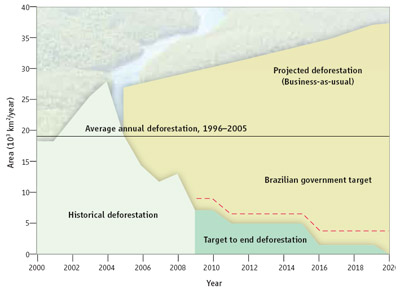
Analyzing Brazil's plan to cut Amazon forest clearing by 70 percent over the next decade and current efforts by major Brazilian beef and soy producers to exclude deforesters from the supply chain, Dan Nepstad of the Woods Hole Research Center and colleagues lay out a scenario under which net forest loss in the Brazilian Amazon could fall to zero by 2020. The external cost of the effort would be $7 to $18 billion, or 13-33 percent of what Americans spend annually on diet foods and beverages.

Roughly half the payments would go towards establishing a forest peoples' fund to pay for "community forest-based economic activities, health, education, and cultural preservation for the region's indigenous, and traditional forest peoples and smallholder farmers."

Ending deforestation in the Brazilian Amazon would reduce global carbon emissions 2-5 percent, safeguard the planet's largest reservoir of terrestrial biodiversity, and ensure the continued provision of critical ecosystem services for Brazil and the world. It would also clearly establish Brazil as the leading player in the environmental services market, a sector expected to be worth hundreds of billions of dollars annually in the next 20 years. Brazil's reduction in emissions from deforestation could alone generate $37 billion to $111 billion between 2013 and 2020 in revenue, some of which could be used to expand the program to end deforestation.

Finally, eliminating Amazon deforestation in Brazil would send a powerful message to other countries, showing that it is indeed possible to protect the environment and benefit economically. 

The boldfaced text is my own emphasis added.  It blows me away that for 13-33% of  what Americans spend annually on diet food and beverages, we can protect the precious ecosystem services and astounding biodiversity of the Amazon.  Better yet, this type of investment in conservation should have tremendous returns for Brazil.  This is because with its abundant rainforest lands, the country stands to become a leading player in the emerging Environmental Services market.

It's almost a land conservation equivalent of investments in energy efficiency and clean energy.  Payments made to successfully protect the Amazon are not a simple costs. They are wise investments that will pay for themselves -- often not only economically, but in terms of human health, security, and other ways that are beneficial to human well-being.

Read more>>
...

Saturday, November 21, 2009

Biodiversity's Bright Spot


The journal, Nature, has an outstanding success story about efforts to protect Brazil's Atlantic Coastal Forest:

Stemming the deforestation required a broad set of measures: new laws and governmental incentives, the commitment of researchers and conservationists, increased funding from international donors and the Brazilian government, and a growing community awareness. Lately, a boost has come from efforts to emphasize the forest's value as a source of water, a draw for ecotourism and a generator of other ecosystem services.

International pressure has also helped. Through the Convention on Biological Diversity, countries have committed to slow the rate of biodiversity loss and to protect 10% of their ecoregions by 2010. Although few nations will meet these goals, Brazil has set aside 16% of its land. Most of this is in the Amazon, but the biodiversity treaty has put pressure on Brazilian authorities to establish state parks in the Atlantic forest southwest of São Paulo, says Oliver Hillel, an officer in the convention's secretariat in Montreal, Canada.

Read more>>
...

Wednesday, November 18, 2009

Global Warming and Forest Protection: Making Sure We Get REDD Right

Speaking of the law of unintended consequences...

Scientists have sounded the alarm about the need to properly design schemes to pay countries to protect their tropical forests as a means of slowing global warming.

Deforestation is estimated to contribute about 20% of global emissions of the heat-trapping gas, carbon dioxide (CO2).

In a paper published in Current Biology magazine, the scientists warned that the market may target forests that are cheap to protect and rich in carbon and neglect those that have less carbon but more endangered animals and plants.

"We are concerned that governments will focus on cutting deforestation in the most carbon-rich forests, only for clearance pressures to shift to other high biodiversity forests which are not given priority for protection," said the team's joint leader, Alan Grainger, of the University of Leeds.

The scientists, from Britain, the United States, Germany, Switzerland and Singapore, said concentrations of carbon and biodiversity in tropical forests only partially overlap.

They said up to 95 percent of damage to REDD-protected forests could be displaced to nearby unprotected forests.

Their report cited the example of the Peruvian Amazon, where the creation of forest reserves contributed to a 300 to 470 percent rise in damage to forests in adjacent areas.

State workers and public money may be switched to REDD forests, leaving unprotected areas at risk, the paper said.

The scientists also fear that REDD could, perversely, lead countries to delay forest protection measures that they might otherwise have taken anyway, as they await the new agreement and the rewards it might bring.

 What's the solution, then?

They urged countries meeting in Denmark to add rules on safeguarding biodiversity to the text of any deal and consider giving incentives to poor nations that address the issue.

"Despite the best of intentions, mistakes can easily happen because of poor design," Grainger added. "A well designed REDD can save many species."

Read more>>

Some suggestions on how to get REDD right by including private landowners - From Mongabay.
...

Wednesday, November 11, 2009

Norway Leads the Way to Save South America's Rainforests

Big props to Norway for stepping up and leading the way as the world tries to figure out how to save the tropical rainforests that serve humanity as the lungs of our planet.

Reuters reports that Norway has now ponied up as much as $250 million to help compensate the country of Guyana for the conservation value of their forests:

"Saving the world's remaining tropical forests is a crucial element in the battle against climate change," Norwegian Environment Minister Erik Solheim said of a memorandum he signed in Guyana with President Bharrat Jagdeo.

"Provided that the expected results are achieved and that other elements of the partnership fall into place, our support for the years up to 2015 could add up to as much as $250 million," he said in a statement.

Plants soak up carbon dioxide as they grow and release it when they are burnt or rot. The United Nations says deforestation accounts for about a fifth of all greenhouse gas emissions from human activities.

Until now, nations with high levels of forest cover have attracted less cash than worse performers promising to slow high rates of deforestation.

"Success in the global fight against deforestation means that both the countries that have high deforestation rates and those with low rates should obtain incentives to preserve their forests," the Norwegian ministry said.

I love how in this case, Norway is moving proactively to reward a country that still has the majority of it's forests standing.

Read more>>
...