Monday, November 23, 2009

Coastal Ecosystems a Powerful Carbon Sink

We know that coastal ecosystems such as mangroves, salt marshes and sea grass provide valuable environmental services such as protection against storms and floods, filtration of pollutants, and crucial fishery breeding grounds.

However, says Conservation International's Emily Pidgeon, it turns out that they are also quite powerful carbon sinks -- absorbing the heat-trapping gas, carbon dioxide (CO2) and storing the carbon deep in sediments:

PIDGEON: (One) way that plants sequester carbon is by burying it in the soil or the sediment below them. And these marine plants, or marine ecosystems, seem to be incredibly effective at the second type of carbon sequestration. This burying it in the sediment below them.

LIVING ON EARTH: Why is that?

PIDGEON: There's a couple different ways they do it. The two main ones are they have these incredibly deep root systems. If you can imagine they're all living in the sort of tidal or wave dominated part of the coast and they're holding on for dear life with these deep root systems. And it's through this deep root systems that they can pull carbon out of either the water or the air and then pump it down in to the sediment and push it out. There is also these areas that are really good for capturing sediment that is in the shallow water, and by doing that that settles down and also captures lot of carbon that way.

More good reason to protect and restore these valuable ecosystems...

Listen to the Living on Earth Story>>
...

Sunday, November 22, 2009

Bottled Water Sucks

A new documentary film illustrates the environmental, economic and health damage caused by the proliferation of bottled water:

With style, verve and righteous anger, the film exposes the bottled water industry's role in suckering the public, harming our health, accelerating climate change, contributing to overall pollution, and increasing America's dependence on fossil fuels. All while gouging consumers with exorbitant and indefensible prices.

Claire Thompson summed up the problem well in her post on the movie at Grist:

"Not only is it [bottled water] a clear waste of resources (only 20 percent of plastic water bottles used in the United States are recycled, and far too many of the rest probably end up in the Pacific Garbage Patch), it's an incredible waste of money for consumers, who pay more than the price of gasoline for water that's marketed as "pure," but in reality is largely unregulated, full of harmful toxins like BPA, and far less safe for drinking than free tap water. (In fact, 40 percent of the time, bottled water is nothing but municipal tap water, freed from the government oversight that keeps it safe.)"

The main excuse that I hear from people who abuse bottled water is convenience.  For example, in my martial arts dojo, they offer bottled water for $1, and almost every student uses it.  I bring my own stainless steel water bottle, and have never had to purchase a single plastic bottle. So to me, the 'convenience' line doesn't hold water (no pun intended).

My Sensei agrees that we should try to find a better solution, but the owner of the dojo apparently insists on the disposable plastic water bottles for the convenience of kids classes, in particular.  That's the excuse he received for why the solution I proposed wouldn't work: changing to a water cooler and re-fillable 5-gallon jugs, with compostable plastic cups.  Apparently, the cups would make too much of a mess.  Plus, it wouldn't be as easy to re-coup the costs by charging per cup as it is to charge for a water bottle.

Then again, if she charged $1 per 12 ounce CUP (usually filled to 11 oz), she'd bring in about $58 per 5 gallon jug -- and with bottled water delivery services, these jugs cost about $5-8 each. Even with the added cost of cups and disposal, it would still be a money-making green solution!

Well, I'll keep trying... 

Read more>>
...

Deforestation Emissions Should Be Shared Between Producer and Consumer, Argues Study

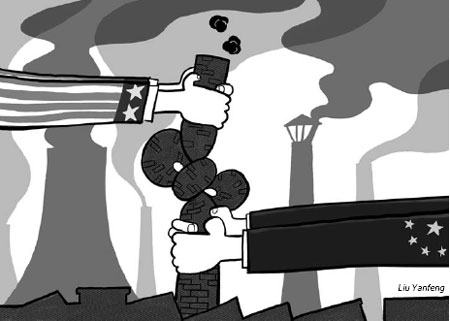
Should China take the full blame for its skyrocketing emissions of carbon dioxide (CO2) and other heat-trapping gases that cause global warming? Or should these emissions be split with the U.S., EU and other countries that are outsourcing their manufacturing -- and their emissions -- to China?

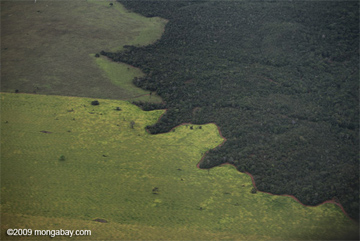
The same question can be asked of Brazil, where deforestation accounts for 75% of the country's carbon footprint, and the major causes of deforestation are cattle ranching and soy production to produce products that are exported to Europe, Asia and Africa.

Mongabay.com reports on a new study that explores these questions:

Brazil's high annual deforestation rates are currently supporting a massive agricultural industry that exports most of its product abroad: Brazil is the world's largest exporter of both beef and soybeans. Between 1990 and 2006, exports of beef increased by 500 percent. The soy boom, which began in the 1990s, did not cause as much direct deforestation, but pushed cattle farmers and small-land holders deeper into the forest.

From 1990-2006, EU countries and Asian countries were the primary importers of Brazil's soy, while importers of Brazil's beef came from around the world, including Eastern Europe, the EU, the Middle East, Asia, Africa, and other South American nations. Yet so far none of these nations have had to pay a cent for the environmental damage, including high carbon emissions, caused by the deforestation of the Amazon.

Zaks and his team have proposed a model to change this. According to their study when a product is exported half of the emissions should be the responsibility of the producing country and half of the importing country and its consumers.

"There is no 'right way' to proportion emissions between consumer and producer, but we did not think that assigning the burden of emissions to either Brazil OR the importing country would be logical," explains Zaks. "If emissions are assigned only to the importing country, there is a reduced incentive to decrease deforestation in the exporting country."

He adds that the study "chose to split them 50/50 as more of an illustrative example than a definitive answer."

This is some good lifecycle-type thinking here, and I definitely agree that we can't blame countries like Brazil and China for all the emissions.  That said, this type of thinking also shows how important it is that we (1) reduce our beef consumption (or at the very least choose more locally raised, grass fed beef from sustainably managed ranches), and (2) choose local and organic.

Perhaps it also indicates that consuming nations need to contribute conservation funding, in an amount in proportion to their imports from Brazil, to REDD-type forest protection initiatives.

Read more>>
...

Agriculture and Global Warming: Making it Better, Making it Worse

Did you know that agriculture contributes about 20% of America's emissions of carbon dioxide (CO2) and other heat-trapping gases that cause global warming?  For the entire planet, agriculture contributes about 12% of these emissions.

How are the impacts of our food, fiber and biofuel production systems so severe, and what are some ways that we can revolutionize our agricultural practices to turn them from a source of carbon emissions to a sink?

Treehugger explores these questions:

If we consider some of the embodied energy required for industrial ag, it gets worse. According to Will Allen, green farmer extraordinaire, including all the "manufacture and use of pesticides and fertilizers, fuel and oil for tractors, equipment, trucking and shipping, electricity for lighting, cooling, and heating, and emissions of carbon dioxide, methane, nitrous oxide and other green house gases" bumps the impact up to between 25 and 30 percent of the U.S.'s collective carbon footprint. That's a big jump.

(However), Organic agriculture can remove from the air and sequester 7,000 pounds of carbon dioxide per acre per year. The Rodale Institute study that found that staggering number also found that, when properly executed, organic agriculture does not compromise yield. As a matter of fact, in drought years, it increases yield, since the additional carbon stored in soil helps it to hold more water. In wet years, the additional organic matter in the soil wicks water away from plant roots, limiting erosion and keeping plants in place. Both of those attributes will also benefit organic ag's ability to adapt to the higher highs (and lower lows) of climate change.

Obviously, there are some very powerful economic interests -- the multinational corporations who make all the fertilizers, pesticides and even crop types -- who are going to try to fight these types of positive changes tooth and nail.

That's why it's up to people like you and me to vote with our everyday choices (the more of us choose organic, the more land will need to be farmed organic to meet our demand), and contact our state and federal decision-makers and demand change -- for the earth and for ourselves.  You can reach your Congressional representatives at 202-224-3121.

Read more>>
...

Saturday, November 21, 2009

The Challenge of Making Solar and Wind Power More Reliable


We know about the environmental, economic, security and health benefits of solar and wind power: lower emissions, cleaner air, reduced dependence on foreign oil, abundant job opportunities as these technologies get installed far and wide.

What we don't hear about too often are the very real challenges of our transition to a clean energy-powered economy.

These are crucially important to be aware of, as our engagement will help spawn fresh ideas that drive innovation.

The NY Times gets into these challenges.

We'd love to hear your thoughts!
...

Global Biodiversity Conservation: Gloom, But Some Promise

While the world's efforts to sustain biodiversity continue to fall short, the journal Nature reports that there are some silver linings to the continuing cloud of biodiversity loss:

Since the 2010 target was adopted in 2002, the Brazilian government has increased the proportion of land designated as protected by 25% and deforestation rates have been reduced by 60%. It plans to identify further priority areas for conservation over the coming year.

And in Sweden, 9 new marine nature reserves were established between 2007 and 2008, bringing the nation's total to 21 sites. A further seven marine protected areas and six no-fishing areas are planned by 2010.

A surge of further efforts can be expected before next October to ensure that countries will be able to report some positive news.

Read more>>
...

Biodiversity's Bright Spot


The journal, Nature, has an outstanding success story about efforts to protect Brazil's Atlantic Coastal Forest:

Stemming the deforestation required a broad set of measures: new laws and governmental incentives, the commitment of researchers and conservationists, increased funding from international donors and the Brazilian government, and a growing community awareness. Lately, a boost has come from efforts to emphasize the forest's value as a source of water, a draw for ecotourism and a generator of other ecosystem services.

International pressure has also helped. Through the Convention on Biological Diversity, countries have committed to slow the rate of biodiversity loss and to protect 10% of their ecoregions by 2010. Although few nations will meet these goals, Brazil has set aside 16% of its land. Most of this is in the Amazon, but the biodiversity treaty has put pressure on Brazilian authorities to establish state parks in the Atlantic forest southwest of São Paulo, says Oliver Hillel, an officer in the convention's secretariat in Montreal, Canada.

Read more>>
...

Friday, November 20, 2009

When Behavioral Economics Meets Climate Change

Here's a fun little anecdote from Marc Gunther that has bigger implications for how we advance our transition to a Green Economy:

At the Net Impact conference last week, a waiter stopped by before lunch to ask if anyone at our table wanted a vegetarian meal instead of chicken. Just one or two people did.

This, as it happens, is typical. When a meat-based entrée is being served, and people are offered a vegetarian alternative, about 5 to 10 percent will request it.

But what if the choices were reversed? Organizers of the 2009 Behavior, Energy and Climate Change Conference, which began Monday in Washington, tried an experiment: They made a vegetarian lunch the default option, and gave meat eaters the choice of opting out.

Some 80 percent went for the veggies, not because there were lots of vegetarians in the crowd of about 700 people but because the choice was framed differently. We know that because, at a prior BECC conference, when meat was the default option, attendees chose the meat by an 83 percent to 17 percent margin.

As for the larger implications of the above findings, reports Gunther, these are what Behavioral Economists talk about:

Might there be broad-based ways to promote a vegetarian diet, while giving people the freedom to choose what they want? How can smart-grid technology be designed to encourage people to conserve energy? Which green marketing messages work, and which don’t? Can the insights of behavioral economics help fight climate change?

Those are the questions that engaged the policy makers, academics, and business executives at this BECC event, which differs from most conversations about climate change. Typically, when politicians, environmentalists or corporate executives discuss the issue, they focus on technology (solar, wind, electric cars) or regulation (cap-and-trade, the UN climate talks). The BECC crowd focuses on another powerful lever, albeit one that doesn’t get as much attention: human behavior, and in particular the irrational, emotional, self-defeating, short-term, inconsiderate and plain old silly human behavior that most of us engage in every day.

It's a fascinating topic -- one that we'll continue to follow for you here at CV Notes.  You can find related posts under our "Motivating Change" category...

Read more>>
...

Solar's Rapid Evolution Makes Energy Planners Re-Think the Grid

With the rapid rise and proliferation of solar technologies, could cities become generators of electricity rather than consumers of power?

If we put solar panels on the untold millions of acres of roof-tops that are essentially wasted space right now, can we dramatically reduce our need to spend $billions of taxpayer dollars on new power lines that transport electricity from the Mojave desert to urban centers?

Apparently, according to this Grist article, the answers to these questions are "Yes" and "Yes".

..the rapidly evolving solar photovoltaic market may moot the need for some of those expensive and contentious transmission lines, requiring transmission planners to rethink their long-term plans, according to Black & Veatch, the giant consulting and engineering firm that does economic analysis for RETI (Renewable Energy Transmission Initiative).

In short, solar panel prices have plummeted so much as to make viable the prospect of generating gigawatts of electricity from rooftops and photovoltaic farms built near cities.

“This has pretty significant implications in terms of transmission planning,” Ryan Pletka, Black & Veatch’s renewable energy project manager, told me last week. “What we thought would happen in a five-year time frame has happened in one year.”

That’s prompted Pletka to radically revise the potential for so-called distributed generation—solar systems that can plug into the existing grid without the construction of new transmission lines—to contribute to California’s need for 60,000 gigawatt hours of renewable electricity by 2020.

When Black & Veatch did its initial analysis last year, it predicted that photovoltaic solar could contribute 2,000 gigawatt hours, given the high cost of conventional solar modules and the fact that a next-generation technology, thin-film solar, had yet to make a big commercial breakthrough.

Pletka’s new number is a bit of a shocker: Distributed generation could potentially provide up to 40,000 gigawatt hours of electricity, or two-thirds of projected demand.

“Certainly some of the new transmission lines will be needed but not as many as before,” he says.

That analysis also calls into question the need for as many large-scale solar power plants. Currently there are about 35 Big Solar projects planned for California that would generate more than 12,000 megawatts of electricity.

“I’ve worked in renewables since the ‘90s and I myself had written off solar PV for years and years and years,” Pletka says. “That’s a firmly rooted mindset among everyone who works from a traditional utility planning perspective.”

“We present this new information on photovoltaics to people and it’s still not sinking in,” he adds. “It would cause a major shift in how we plan.”

“It brings up questions people haven’t had to talk about before,” says Pletka.

Get the feeling that change is happening fast on the clean energy front, whether Congress can keep up or not?

I've long asked many of these same questions that this article addresses, and noted that going in the direction of distributed generation would help reduce the major economic and security risks posed by, for example, terrorist attacks on major power plants.  But I've been told it's simply not a viable solution for meeting the bulk of our power needs.

We're getting into times where the inconceivable is happening -- both on the bad news front of climate change (which is getting worse much faster than expected), and on the good news front of solutions -- as described here.

Let's do our best to focus on the solutions, and do whatever we can to create the world we'd like to see!  I think I can, I think I can...

Read more>>
...

U.S. and China Announce Plan For Collaboration on Clean Energy and Climate Change

In a very good piece of news to head into your weekend with, the U.S. and China actually did MORE than expected in their announced plan for collaboration on Clean Energy and Climate Change.  As Grist and Climate Progress report:

Tuesday, a comprehensive plan for U.S.-China cooperation on clean energy and climate change was announced in Beijing by President Obama and President Hu Jintao. The overall plan is much more ambitious in scope and depth than we had anticipated and contains directives to create various institutions and programs addressing a wide array of cooperation on clean-energy technologies and capacity building, including very important efforts on helping China build a robust, transparent, and accurate inventory of their greenhouse gas emissions.

These efforts include cooperation in the following areas:

1. Greenhouse gas inventory.
2. Joint clean energy research center.  (Factsheet)
3. Electric vehicles. (Factsheet)
4. Energy efficiency.  (Factsheet)
5. Renewable energy. (Factsheet)
6. 21st century coal.  (Factsheet)
7. Shale gas. (Factsheet)
8. Nuclear.
9. Public-private partnerships on clean energy.

In a joint statement, Obama and Jintao agreed on a common approach to achieve a successful outcome in international climate negotiations (emphasis added in bold):

Regarding the upcoming Copenhagen Conference, both sides agree on the importance of actively furthering the full, effective and sustained implementation of the United Nations Framework Convention on Climate Change in accordance with the Bali Action Plan. The United States and China, consistent with their national circumstances, resolve to take significant mitigation actions and recognize the important role that their countries play in promoting a sustainable outcome that will strengthen the world’s ability to combat climate change. The two sides resolve to stand behind these commitments.

It's a good thing we currently have strong Executive Branch climate and clean energy action to help offset the intractability of the U.S. Senate, which through its bickering is only making itself irrelevant on these critical issues.

Read more>>
...