Tuesday, September 13, 2011

New Climate Communication Study: Polar Bears Don't Work

How can we get past America's uber-partisan divide on climate change  to foster political support for bold policy solutions?

According to a new study, images of distant polar bears and melting ice sheets not only don't cut it, messaging-wise, but actually make the problem worse. As reported by Big Think:
Climate change campaigns in the United States that focus on the risks to people in foreign countries or even other regions of the U.S. are likely to inadvertently increase polarization among Americans rather than build consensus and support for policy action.
Fortunately, the researchers found a way to build support for climate policy solutions: to use local stories that make the benefits of action immediately relevant to the community:
Research shows that individuals are more likely to support action on a problem when those threatened or at risk are perceived as more socially similar.  Conversely, when those affected are perceived as more socially distant, support for action is likely to be less.
That certainly makes sense...

Memo to those working to more effectively communicate the need for climate change solutions: use locally relevant pictures and stories.  Enough with the remote images already (in themselves, at least). How does the problem (including as illustrated by stunning remote imagery) really impact the lives of, say, Wal-Mart shoppers? How are the solutions going to protect local communities and improve lives where I live?

These types of messaging improvements are opportunities that Seth Godin talked about back in 2006, but that the climate action community still hasn't fully figured out how to implement.

This new study provides important clues on how to get the important job done of maximizing influence across the political spectrum.

Read more>>
...


Monday, September 12, 2011

The Forest (Ecosystem Service) Companies of the Future


As efforts grow to better align our economy with our ecology (due to very real biophysical limits of natural resource availability), businesses and landowners are exploring how to generate income via the valuable ecosystem services produced by their property.

The Guardian reports on how forest companies are making the transition from solely extractive-based revenues to diversified revenue streams that capitalize on conservation value:  

Climate change, population growth, and soaring demand for food, energy, water and other resources are changing the way the world sees and values forests. A vision is emerging of a new kind of company – the forest services company. 
Our vision is being propelled by new markets that are emerging for forest services such as carbon storage, wildlife preservation, recreational facilities and watershed protection. This trend is creating huge business opportunities for forest companies with the foresight to reinvent themselves and look beyond the traditional equation of forests equal timber. 
Forest companies of the future will expand their business model beyond delivering products to providing an array of crucial services to communities. Timber revenue will still be important, but successful companies will have supplemented their income from the fast-growing new markets that emerge from the increasing scarcity of ecosystem services.

Sounds rosy. But is this just more unrealized happy talk about the future potential of ecosystem services markets?  I was pleased to find some real-world examples of these types of changes actually happening now -- both at home and abroad:
Sveaskog, Sweden's largest forest company, is doing exactly that. Approximately 15% of annual net sales comes from biomass for energy and non-timber services such as windfarm leases and hunting and fishing licences. In addition, Sveaskog is managing one-fifth of its land for conservation and promotion of biodiversity. The company is also experimenting with ways to maximise carbon uptake through different forest management measures and plans to sell the additional uptake to carbon markets. In 20 years, Sveaskog expects its current sales share of 15% from biomass and different kinds of non-timber services to have doubled. 
Other major companies are similarly shifting focus to incorporate services. Plum Creek, the largest US private landowner, has about a third of the company's 7m acres of timber lands under revenue-generating conservation and wildlife protection agreements. Mondi, a leading international paper and packaging group, recently identified opportunities to tap into growing markets for biomass and ecotourism through a review of ecosystem services at three of its South African plantations. 
The shifting nature of forest companies is a win-win opportunity for governments as well, creating new jobs in struggling rural areas and improving the quality of life for urbanites.

One question I'd love to explore: are these ecosystem services-oriented revenue streams being designed in conjunction with neighboring landowners as part of regional-scale conservation planning efforts?

Read more>>
...

Sunday, September 11, 2011

Imagining a Different Response to 9/11


"For every thousand hacking at the leaves of evil, 
there is one striking at the root."
- Henry David Thoreau

Imagine the president had invested all of our post-9/11 war money ($trillions) into a bold transition to clean energy and transport.  The goal would have been to strike at the root of the terrorism problem, while also strengthening America's economic and national security, revolutionizing our aging infrastructure, and creating millions of 21st century jobs.

How different do you think our economy, jobs crisis, deficit and national morale would be right now?

Not to mention our progress -- domestically and globally -- toward solving Americans' growing concern that our climate is doing weird and increasingly dangerous things...

So then, what do you think we should do NOW to strike at the root of the terrorism problem..?
...

Friday, September 09, 2011

Our Economy Depends on Our Ecology


Following yesterday's post, it make sense that a healthier environment not only means healthier people, but also a healthier economy and society.

Ecosystem Marketplace's Steve Zwick sums it up well in this piece:

Neither party really gets it right, because they both -- at best -- see environmental protection as something we should do -- like a bit of housekeeping, akin to trimming the bushes -- as opposed to something we must do -- like shoring up the foundation, which is what it is.
Both parties, in short, seem oblivious to the fact that our economy depends on our ecology, and that everything we buy, sell, eat, and produce is derived from nature. If we destroy nature, we destroy our own livelihoods -- as people living along the Mississippi River and its tributaries learned all too clearly this past Spring, when decades of poor wetland management exacerbated flooding and cost us billions.

This idea was similarly expressed by a 2009 National Academy of Sciences report, The Hidden Costs of Energy: dirty energy (e.g., especially that produced by burning oil and coal) inflicts a devastating $120 billion in "primarily health damages" alone on our economy.

If we want to reduce our skyrocketing health care and health insurance costs, a good place for America to start is by investing in a clean energy revolution.

Read more>>
...

Thursday, September 08, 2011

We Are Everything

We are what we eat.  Literally.  And of course, that means that every molecule that makes up our bodies today was once part of not only a plant or animal, but also a river, an ocean, a forest, a rock, a pinch of sand, an insect, and yes, even another person.

The healthier our surroundings, the healthier we are too.

What are you doing today to help make your surroundings -- and you -- healthier?

Wednesday, September 07, 2011

Carbon Nation: The Surprising (and Common Sense) Benefits of Cutting Heat Trapping Carbon Pollution


Would well-designed legislation to stabilize our increasingly weird climate and free America from our dangerous oil dependence really wreck the economy, as media pundits and GOP policy positions warn?

Fortunately, as America seeks ways to create millions of jobs and revitalize our national morale and qualify of life, the answer is a resounding "no!"  The story of why is told in the new documentary, "Carbon Nation", according to GreenBiz.

The movie's directors paint a wonderfully positive and non-partisan picture of the promise offered by 21st century technologies and practices that are already helping companies thrive.  They tell the story of how:
"We learned that Dow Chemical had spent just under $2 billion on energy-efficient programs since 1994 and had saved nearly $10 billion so far."
In another story, based in Texas, farmers banded together to form a cooperative that allowed them to establish new income streams via wind energy:
Now, farmers who were solely dependent on their hit-or-miss cotton crops had a steady source of income, derived from the turbines: a royalty that ranged from $3,000 to $15,000 per year, per turbine. This changed lives.
Who wouldn't be happy with this kind of financial boost? On top of the money, of course, these good Americans get bragging rights: they're helping lead America's way off of our dependence on dirty energy like oil and coal.  I'm sure their friends are proud of them!

This is the kind of morale boost America reads right now - and a majority of Americans are ready.  As Carbon Nation's director states:
We know, from hundreds of conversations across the nation, that we are not a polarized country. Especially when it comes to energy efficiency, national and energy security, and even clean energy. There is great agreement for healthy solutions in the middle. It’s just that we’re constantly being told we’re a polarized country, mainly because our political leaders are polarized and TV networks make more money selling the idea of a polarized country. And good people are believing this stuff, and acting as if we are polarized. The old self-fulfilling prophecy.
But when you get down to it, listen to people, respect their opinion, and be open-minded, you will find, as I have, that the middle 60% of the U.S. would be on board if they were hearing the right stories. We’ve been lucky enough to find the right stories while making “Carbon Nation.” The folks in our film are heroes. If enough people hear from them, see them in action, then we can achieve our biggest aspirations: to have this movie influence lawmaking, to inspire companies to tie life-cycle costs to all purchases, and to push clean energy so that it simply becomes cheaper than coal. That would be huge.

Cheers to the folks who have brought us Carbon Nation -- the more folks hear these types of stories, the more the movement to revitalize our economy via a job-creating clean energy revolution will gain momentum.

Read more>>
...


Tuesday, September 06, 2011

Ceres: Fuel Efficiency Standards Benefit the Economy

"Our report makes clear that the stronger the (fuel efficiency) standards, the greater the economic benefits." - CERES

As I emphasize time and again, the less money people and businesses have to spend on gasoline because their cars are more efficient, the more money they have to spend on everything else.  That's broad economic stimulus.

Monday, September 05, 2011

Climate Change Threatens Mental Health (As Many In Eastern U.S. Can Attest After Irene)


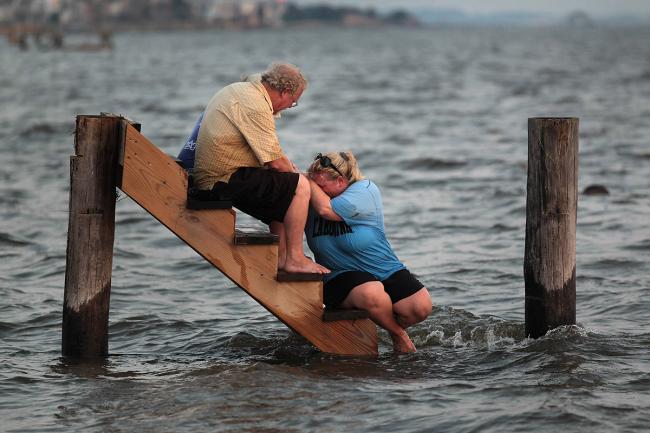
After Hurricane Irene last weekend, my parents in New York had no electricity for days, and had to:
  1. purchase a generator (which wouldn't be necessary if they had solar electricity and hot water - they'd be sitting much prettier right now)
  2. purchase ice bags a couple of times per day to keep their extra fridge and freezer cool and prevent spoilage
  3. pay to have several fallen trees removed from their property.  One fell on the roof above where they were sleeping, but thankfully caused little damage
  4. have a leaky roof fixed.
They were not happy campers, and it took a great deal of mental strength to remind themselves that it could have been a lot worse, and they have much to be grateful for.  I'm sure that across the eastern U.S., they're among millions who are having a very rough time right now.  It's emotionally exhausting, if not depressing, to have to deal with extreme weather.

Indeed, a new study from the University of Sydney's Brain and Mind Institute finds that extreme weather, on the increase due to humanity's unsustainable emissions of heat-trapping carbon pollution, "threatens mental health."

Here are a couple of choice quotes from the researchers:
"Recent experience shows extreme weather events also pose a serious risk to public health, including mental health and wellbeing, with serious flow-on consequences for the economy and wider society."
"The emerging burden of climate-related impacts on community morale and mental health - bereavement, depression, post-event stress disorders, and the tragedy of self-harm - is large."
In the case of Irene, which has left millions without power, just think how much happier folks with solar roofs are right now, compared to their neighbors who remain entirely dependent on America's aging electricity grid.

Why not include a big Solar America push in the upcoming jobs plan that President Obama plans to announce this week? As I like to say, empty roofs = wasted space. Perhaps start with schools, but also include low-cost financing programs for homeowners who are tired of the increasing unreliability of the grid and are ready to move their home's energy source into the 21st century.

The result will be to create untold thousands of jobs and make a lot of people happier.


Monday, June 13, 2011

Timberland Documentary About the Conservation Value of Urban Forests - Dig It

I'm proud to share a clip from my first documentary film appearance. The film is named "Dig It" -- about the valuable benefits that urban forests provide to people and biodiversity alike.


Huge props to Danny Clinch, Tim Donnelly and crew for an exceptional job on this, and special thanks to Timberland for their support.


Enjoy...


Thursday, January 27, 2011

Spring Course at UC Berkeley Extension: Principles of Green Purchasing and Sustainability

What's really 'Green'?

What does the latest science say about the real benefits -- to our environment, economy, health and quality of life -- of green products and services?

How are people and businesses improving their personal and financial health by using green products?

How can you know which 'green' products you can trust to provide such claimed benefits as:
  • reduces emissions of the heat-trapping carbon pollution that causes climate change
  • protects our natural heritage and its wondrous biological diversity
  • reduces toxic pollution and waste (and helps protect YOU from toxic chemicals)
  • protects our health and the safety of our children
  • supports green jobs and our transition to a more secure clean energy economy
  • reduces our dependence on oil and other dirty energy sources
  • improves our national security
Find out the answers to these questions and more this spring at UC Berkeley Extension, where I'll be teaching a weekly evening course titled 'Principles of Green Purchasing and Sustainability".  It runs from Tuesday March 29 - Tuesday May 31 2011 at the San Francisco campus.

Spanning multiple product categories, this course pulls together years of my research -- as both a conservation scientist and sustainability expert -- to help you and your company gain a foundational understanding in green purchasing.  The course description reads as follows:
A good understanding of the principles of green purchasing is important to limit the impact that businesses, governments and corporations have on natural resources,  ecosystems and human well-being. This course is intended to provide sustainable business enthusiasts with an important foundational overview of the environmental information underlying sustainable purchasing. You will learn how to access, understand and evaluate the information that you need for green procurement.   Evaluate business cases that illustrate how companies can boost profits and productivity by using and selling sustainable products.
Many problems with sustainable business reflect a need for managers to become better versed in the technical environmental information underlying sustainability.  Each week, you will explore a new aspect of green procurement and learn how to distinguish those products that credibly limit impacts on the environment – and people too.  You will become well versed in the environmental information underlying sustainable business, and learn how to distinguish between different green certifications and identify those that are credible.
Click here to sign up now to gain valuable expertise in green purchasing.  Tell your friends and peers about this class (use the 'share' button below).  Thank you so much -- you're the best!

***

FREE COURSE PREVIEW -- A SPECIAL INVITATION

Advancing the Green Economy: Achieving Impact from the Office to the Ecosystem

Thursday March 17, 2011, 6:30–8 pm
UC Berkeley Extension: Golden Bear Center
1995 University Ave, Berkeley, CA

Join scientist and sustainability expert Jonathan L. Gelbard, Ph.D., as he explores the connections between choices made in the office and the health of ecosystems and people. Hear stories about how businesses are learning to boost profits and productivity by using and selling green products. Gain valuable tips on how to identify the products, partners, and certifications that can help your company achieve measurable positive impacts and advance the green economy.

Jonathan L. Gelbard, Ph.D., principal at Conservation Value, Inc., is a researcher, writer, speaker, and educator. He has taught at the World Wildlife Fund’s Climate Camp workshops; appeared in the 2009 urban forest documentary, Dig It; and served as an educational producer for some of America’s largest green music festivals.

EDP 426320
1 meeting
Reserve Your Place Now
extension.berkeley.edu/enroll